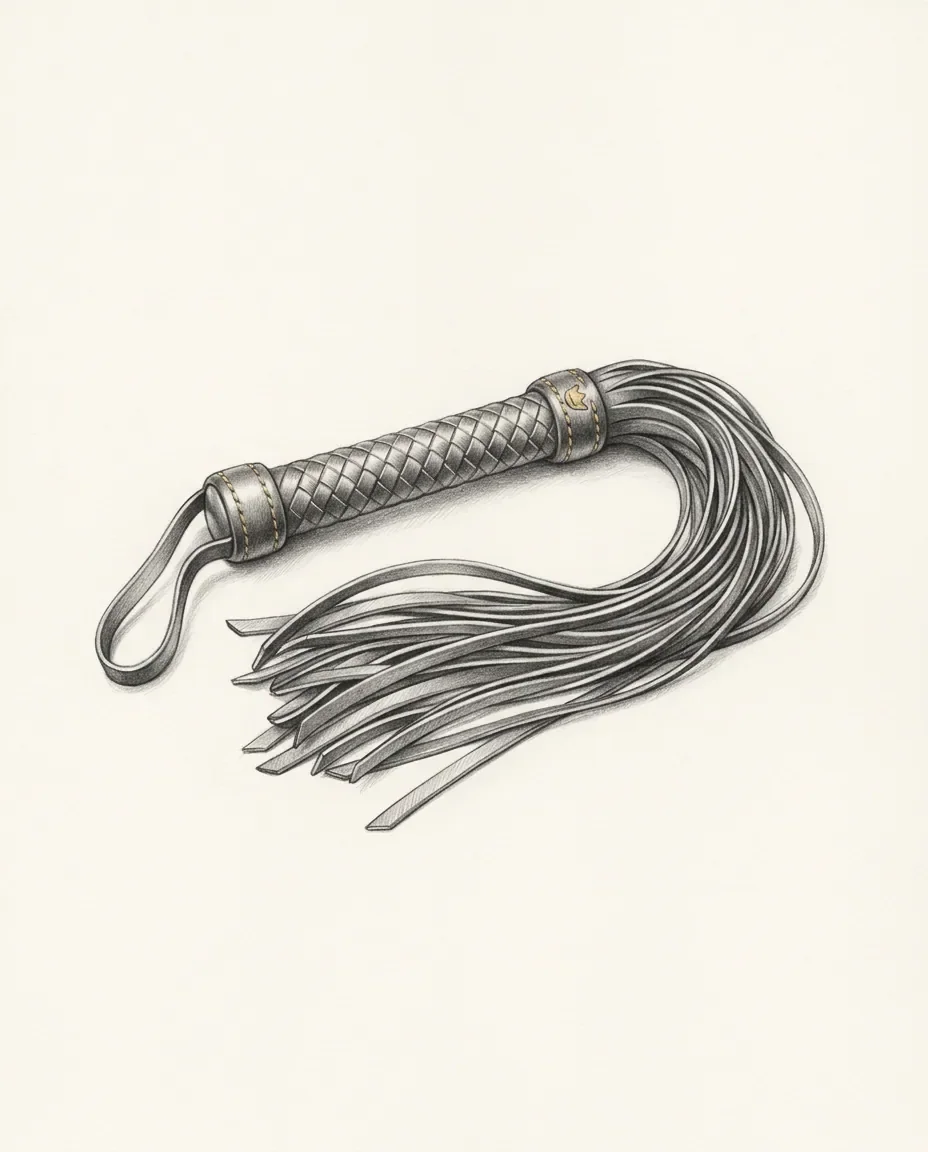
Pain Play
Algolagnia
Added 21 Jun 2026 · Updated 22 Aug 2026
Pain play (algolagnia) is a clinical umbrella term for sexual arousal connected to physical pain, whether that pain is received or inflicted. The received form is labelled active/masochistic, the inflicted form passive/sadistic. It frames pain itself, not any specific implement, as the source of erotic interest.
- Prevalence
- Ultra-common
- Category
- Sensation & Pain
- Clinical term
- Algolagnia
- Domain
- Sexual interest
- Confidence
- Medium confidence
- Status
- Historical clinical umbrella for pain-linked arousal; a mild consensual interest is a common variation, not a disorder absent distress, impairment, or non-consent.
- Also known as
- algolagnia, sexual pain interest, painphilia, pain-as-arousal, erotic pain
- Added
- 21 Jun 2026
- Updated
- 22 Aug 2026
Featured in
Overview
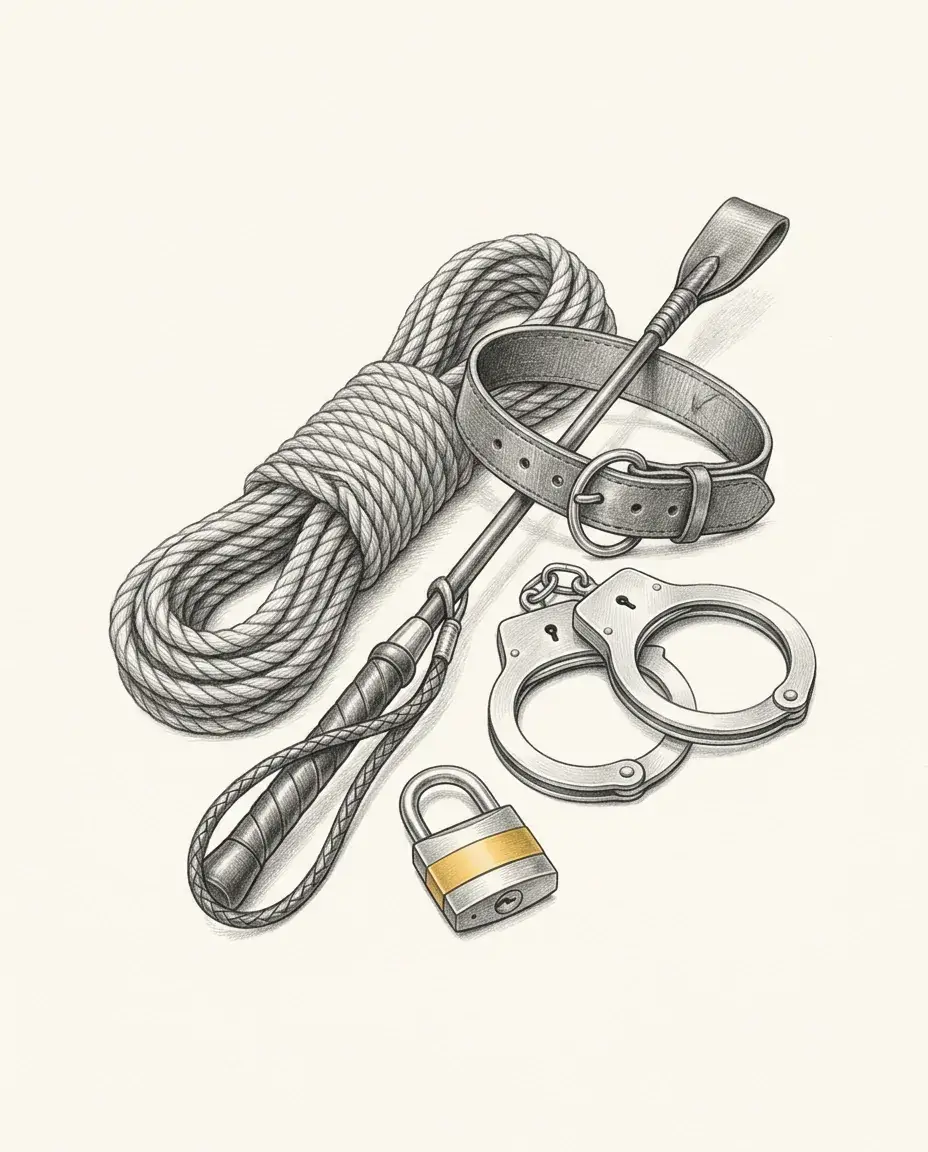
Pain play, captured clinically by the older umbrella term algolagnia, describes sexual pleasure or arousal connected to physical pain rather than to any single implement or act. It is traditionally divided into active algolagnia, arousal linked to receiving pain, and passive algolagnia, arousal linked to inflicting pain: the two halves modern usage calls masochism and sadism. As a conceptual category rather than a specific behaviour, it frames the broad phenomenon of pain itself functioning as an erotic stimulus. This article covers its naming, expression, psychology, prevalence and the safety and legal questions it raises.
Examples
Because the category is defined by a sensation rather than by an implement, almost every impact and sensation practice falls under it, while several things that look similar do not.
What the term covers. The impact practices (spanking, flogging, caning, bastinado) together with the pressure and pinch family of clamps, biting, scratching and hair pulling; thermal sensation such as wax and temperature play; and the sharper, more technical practices including electro play, figging and urtication. What unites them is that a controlled painful sensation is the thing being sought, whether for arousal, for the concentration it produces, or for what it signifies between the two people involved.
What the term does not cover. Humiliation and degradation work on the mind and need cause no pain at all; sensation play is the larger category that also holds feathers, silk and cold; predicament play trades on discomfort and dilemma rather than on pain as such. Pain inflicted on someone who has not agreed to it is not pain play but assault, and the clinical entries describing arousal from exactly that, piquerism among them, sit outside the consensual field entirely. Nor is it self-injury: the partner, the structure and the negotiated limits make it a different thing.
How the word is used. "Pain play" is community vocabulary and the phrase people actually use. Algolagnia is its nineteenth-century clinical umbrella, now archaic and largely confined to historical writing, and its sibling coinage algophilia is rarer still. Neither umbrella survives in DSM-5-TR or ICD-11; the manuals kept only the two halves, sadism and masochism, under their own names.
History & origins
The lineage of pain play runs along two threads: a precise nineteenth-century clinical coinage, and the older case-study tradition that gave its two halves their names.
Clinical coinage
- 1886: Richard von Krafft-Ebing's Psychopathia Sexualis, a collection of 238 case histories, gave the first systematic clinical descriptions of pain-linked sexuality and supplied the enduring labels: "sadism," after the Marquis de Sade, and "masochism," after the novelist Leopold von Sacher-Masoch, author of Venus in Furs.
- 1892: the German psychiatrist Albert von Schrenck-Notzing coined algolagnia, joining Greek álgos (pain) and lagneía (lust) to give the pain–pleasure link a single neutral umbrella term. He framed it as lust rather than love, distinguishing it from Charles Féré's earlier algophilia, and divided it into the active and passive forms still cited today.
The wider tradition
- 1897–1928: Havelock Ellis discussed the same pain–arousal continuum in his Studies in the Psychology of Sex, treating it as a graded part of normal eroticism rather than a discrete disease.
- 1905: Sigmund Freud, in his Three Essays on the Theory of Sexuality, treated sadism and masochism as paired component instincts present to some degree in ordinary sexuality.
Depathologisation
Across the twentieth century the umbrella word algolagnia faded from everyday use while its two halves persisted in the diagnostic manuals. The DSM and ICD lineages retained sexual sadism and masochism as named entries but progressively narrowed them, reserving a disorder label for cases involving personal distress, functional impairment, or a non-consenting party.
| Manual | Consensual interest | Diagnosis (disorder) |
|---|---|---|
| DSM-5-TR (2022) | not a disorder | Sexual Masochism Disorder / Sexual Sadism Disorder only with distress, impairment, or a non-consenting person |
| ICD-11 (2019/2022) | removed as a diagnosis | only Coercive Sexual Sadism Disorder (non-consenting) sits among paraphilic disorders |
The ICD-11 revision was notable for dropping consensual sadomasochism entirely, keeping only the coercive, non-consensual form as a clinical concern.
In practice
The interest is expressed through the many consensual practices grouped under sensation and impact play (spanking, flogging, caning, pinching, biting, or temperature extremes such as wax play and temperature play) where a controlled pain sensation is sought for its arousing or focusing effect. It is usually realised inside negotiated BDSM scenes with explicit limits, safewords and a shared sense of what "pain" is wanted, rather than as an isolated behaviour.
Psychology
Pain play is commonly explained through the interaction of the body's pain and pleasure systems: endorphin and adrenaline release, an intensely narrowed bodily focus sometimes likened to a flow or "subspace" state, and the symbolic meanings of surrender or control. The evidence base for the precise neurochemistry remains thin and partly inferential. Contemporary clinical thinking, summarised in references such as StatPearls, treats a mild interest in consensual pain as a common human variation, a concern only when it causes the person distress or impairment, or involves a non-consenting party. The representative Australian survey by Richters et al. (2008) found that BDSM participants were no more likely than others to have been coerced or unhappy, undercutting the old assumption that a pain interest signals psychological damage.
Prevalence & culture
How common is a pain interest?
Interest in receiving pain is among the more frequently reported erotic interests in general-population research. In Joyal & Carpentier's (2017) survey of 1,040 adults, masochism interested about 19% of respondents and sadism about 10%, both well above the threshold the authors treat as statistically unusual, and masochism was significantly associated with greater sexual satisfaction. Fantasy figures run higher still: Lehmiller's (2018) survey of 4,175 Americans found a large majority had fantasised about receiving pain in a sexual context, while behaviour is rarer: Richters et al. (2008) recorded about 1.8% of Australian adults involved in any BDSM in the prior year. As an older academic word, algolagnia appears mostly in historical and clinical literature, while communities organise around specific activities or simply call it "pain play." Research attention is substantial because the concept underpins the well-studied sadism and masochism literatures.
Safety, consent & law
Between consenting adults, a pain interest is legal and not in itself a disorder. Safe practice mirrors the rest of sensation play: informed negotiation, clear limits and safewords, and attentive aftercare, including for the flat mood that can arrive a day or two afterwards (subdrop).
Anatomy does most of the work. Community and clinical guidance converge on confining impact to well-padded muscle, the buttocks, the upper thighs and the upper back, and keeping it away from the kidneys and the small of the back, the spine and tailbone, the neck and throat, the joints, and the head. Nerves that run close to the surface, at the elbow, the outside of the knee and the wrist, compress and bruise easily, and sustained pressure from clamps or restraints restricts circulation: numbness, tingling, or a change in skin colour or temperature is a signal to stop rather than something to work through. Broken skin turns a sensation practice into a bloodborne-infection question, and anticoagulant medication or a bleeding disorder raises the stakes of ordinary bruising. None of this amounts to a technique manual; it is why experienced practitioners treat instruction and basic anatomy as prerequisites rather than refinements.
Inflicting pain on a non-consenting person, or pursuing serious injury, is harmful and may be unlawful. In some jurisdictions consent does not legally extend to serious bodily harm, so the law can treat severe injury as assault even where both parties agreed.
Common questions
Why does pain feel good during sex?
Partly chemistry and partly framing. Intense sensation triggers endorphin and adrenaline release and narrows attention sharply, which many people experience as absorbing rather than distressing. But the same stimulus is read completely differently depending on context: a struck thigh means one thing in an agreed scene with a trusted partner and something else entirely in a car park. Consent, anticipation and safety change the interpretation, which is why the effect does not transfer to unwanted pain.
Which parts of the body should be avoided in impact play?
Padded muscle takes impact; structures do not. The areas conventionally avoided are the kidneys and the small of the back, the spine and tailbone, the neck and throat, the head and face, and the joints, along with anywhere a nerve runs close to the surface, such as the elbow or the outside of the knee. Bruising over bone hurts disproportionately and heals slowly. Numbness or tingling anywhere is a stop signal, not a phase to push past.
Is pain play the same as self-harm?
No, and the differences are structural rather than a matter of degree. Pain play is consensual, usually partnered, negotiated with limits and a safeword, sought for arousal or focus, and followed by aftercare. Self-harm is typically private, concealed and used to manage distress. The overlap worth taking seriously is someone using scenes to regulate something painful outside them, which is a reason to talk to a professional rather than a reason to stop asking the question.
What is subspace?
An altered state some people enter during intense sensation or submission: floaty, detached, slow to speak, with pain registering differently or barely at all. It is generally described as pleasant, but it impairs judgement, which is exactly why limits are set before a scene rather than during one. It wears off gradually, sometimes over hours, and the flat mood that can follow a day or two later is common enough to have its own name, subdrop.
How do you try pain play safely for the first time?
Talk first, about what kind of sensation appeals and what is off limits, and agree a word that stops everything immediately. Then start far lighter than seems interesting: hands before implements, the backside and thighs before anywhere else, and frequent checks on how it is landing. Stopping while it is still going well beats finding the ceiling by hitting it. Set aside time afterwards, because the wind-down matters as much as the scene did.
Is it legal to hurt someone who has consented?
Up to a point, and the point varies by country. Ordinary consensual pain play attracts no legal interest anywhere in practice. But several legal systems hold that consent cannot license actual bodily harm, the English case R v Brown (1993) being the standard example, in which convictions for consensual sadomasochistic injury were upheld on appeal. The practical effect is that the threshold sits at injury: what leaves no lasting damage does not reach it.
What is the difference between pain play and sadomasochism?
Pain play names the activities; sadism and masochism name the orientations behind them. Someone can enjoy receiving a caning without describing themselves as a masochist, and the two clinical words carry a diagnostic history that the plain phrase does not. The nineteenth-century umbrella that once covered both has effectively left everyday use and now appears mostly in historical writing.
Does everyone into BDSM like pain?
No, and assuming so is the most common outside misreading of the whole field. Large parts of BDSM involve no pain at all: bondage is about restraint, power exchange is about authority, and sensation play covers texture, temperature and light touch as readily as impact. Many people who enjoy submission actively dislike pain, and plenty of long-standing dynamics never include it.
From the blog
- Flogging60/100Sensation & PainConsensual impact play in which one partner strikes another's body with a multi-tailed flogger, whip, or single-tail. The rhythmic sensation ranges from a broad "thuddy" impact to a sharp, stinging line. It is a common, negotiated element of BDSM sensation play.60
- Caning48/100Sensation & PainConsensual impact play using a thin, flexible rod such as a rattan cane or switch to deliver sharp, stinging strokes. It is a focused subset of BDSM impact play known for an intense, lingering sensation and carries higher injury risk than padded implements.48
- Wax Play50/100Ceroticism · Sensation & PainConsensual temperature and sensation play in which warm candle wax is dripped onto a partner's skin for a brief heat sensation. A cooling, hardening trace follows. It is a popular, ritualistic element of BDSM sensation play that requires care to avoid burns.50
- Temperature Play49/100Sensation & PainConsensual sensation play that uses warmth and cold, such as ice, chilled or warmed objects, and contrasting temperatures, to heighten skin sensation. It is a gentle, accessible branch of BDSM sensation play centered on thermal contrast.49
- Subdrop58/100Sensation & PainThe emotional and physical low that some people, usually submissives, feel in the hours or days after an intense BDSM scene as heightened arousal subsides. Sadness, fatigue and irritability are typical.58
- Shibari (Japanese Rope Bondage)59/100Sensation & PainShibari is the Japanese art of binding a partner with rope into intricate patterns, derived from kinbaku ("tight binding"). It blends visual artistry, sensation and restraint with the trust between the person tying (rigger) and the bound partner (bottom).59
From the Greek álgos (pain) + lagneía (lust); coined in 1892 by the German psychiatrist Albert von Schrenck-Notzing to name the link between pain and sexual arousal.
clinical umbrella · pain-as-arousal · masochism/sadism-adjacent
Prevalence is computed from the entry's cited population estimate. Rows marked ESTare indicative editorial estimates scored against a fixed anchor rubric, not measured quantities. Method & anchors: methodology.
Ultra-common · ≈ 1 in 5 or more
- 01Joyal & Carpentier (2017), The Prevalence of Paraphilic Interests and Behaviors in the General Population, J. Sex Research 54(2):161-171active interest in receiving pain / masochism ~23% in the general population
- 02Lehmiller (2018), Tell Me What You Want, survey of 4,175 Americansfantasy prevalence; receiving pain fantasized by ~65% of adults
- 03Richters et al. (2008), Demographic and Psychosocial Features of Participants in BDSM: Data from a National Survey, J. Sexual Medicine 5(7):1660-1668Representative Australian survey (n=19,307): ~1.8% of sexually active adults involved in BDSM in the prior year; participants no more likely to have been coerced or unhappy than others.
- 04List of paraphilias, Wikipediadefinition of algolagnia as the clinical umbrella for sexual pain interest
- 05Algolagnia, Wikipediaterm coined 1892 by Albert von Schrenck-Notzing from Greek algos (pain) + lagneia (lust); active vs passive division
- 06Richard von Krafft-Ebing, Psychopathia Sexualis (1886)foundational clinical descriptions of sadism (after de Sade) and masochism (after Sacher-Masoch) in a collection of 238 case histories
- 07Albert von Schrenck-Notzing, WikipediaGerman psychiatrist who coined 'algolagnia' in 1892, distinguishing it from Féré's 'algophilia' as lust rather than love.
- 08Marquis de Sade, WikipediaThe author after whom 'sadism' was named.
- 09Leopold von Sacher-Masoch, WikipediaThe novelist (author of Venus in Furs) after whom 'masochism' was named.
- 10Havelock Ellis, WikipediaStudies in the Psychology of Sex discussing the pain–arousal continuum as part of normal eroticism.
- 11Three Essays on the Theory of Sexuality, WikipediaFreud (1905) treats sadism and masochism as paired component instincts of ordinary sexuality.
- 12Paraphilia, StatPearls (NCBI Bookshelf)Clinical reference: a consensual pain interest is a common variation, pathological only with distress, impairment, or non-consent.
- 13DSM-5-TR, American Psychiatric AssociationReserves sexual sadism/masochism disorder for cases with distress, impairment, or a non-consenting party.
- 14ICD-11, World Health OrganizationCurrent WHO classification distinguishing consensual interest from coercive/distressing disorder.