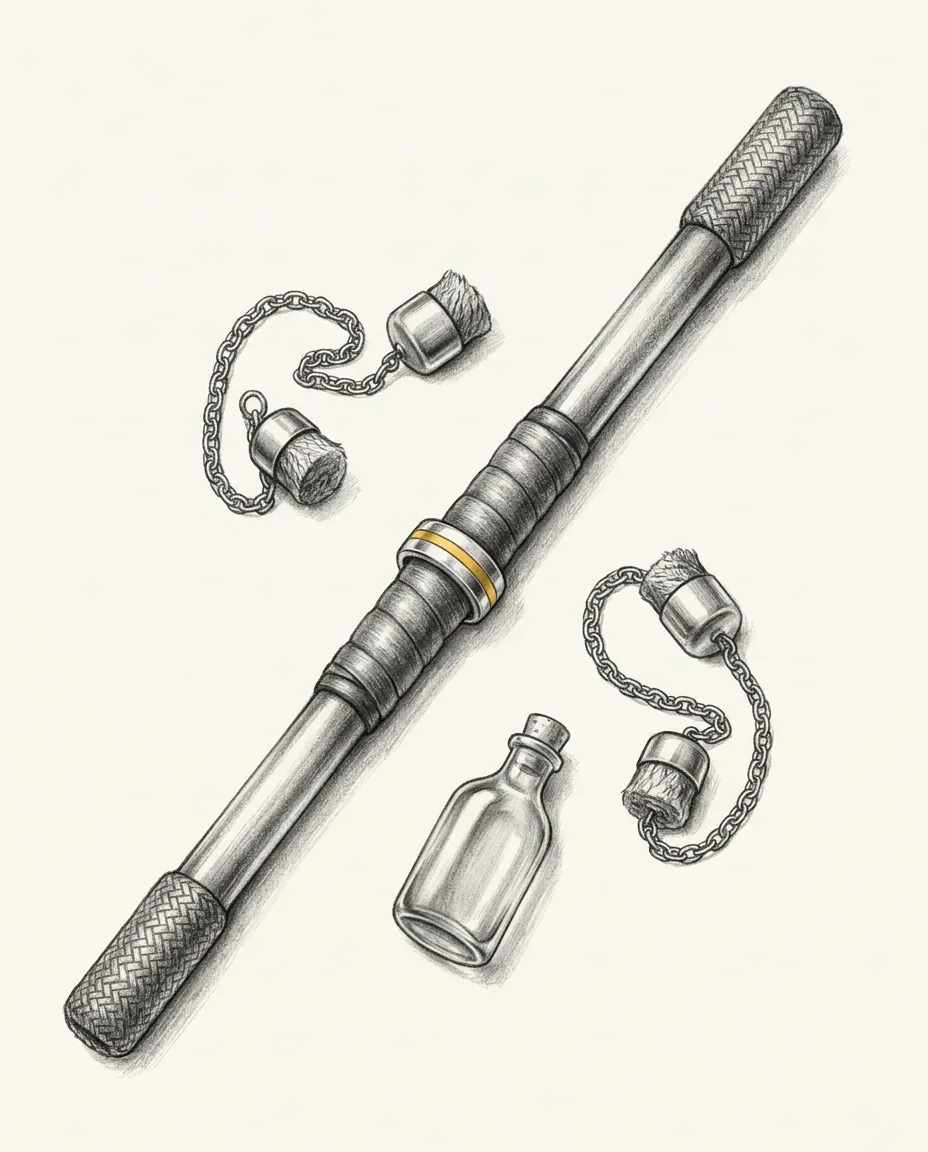
Fire Play
Pyrophilia
Added 21 Jun 2026 · Updated 22 Aug 2026
Pyrophilia is a rare paraphilia in which fire, flame, or the imagery of burning is a focus of sexual arousal. The related consensual "fire play" is a BDSM sensation technique using brief, controlled flame on skin. Both are distinct from arson, a crime.
- Prevalence
- Rare
- Category
- Sensation & Pain
- Clinical term
- Pyrophilia
- Domain
- Sexual interest · Paraphilia
- Confidence
- Low confidence
- Status
- Rare paraphilia documented mainly in case reports; would fall under DSM-5-TR "other specified paraphilic disorder" only if it causes distress, impairment, or harm. Consensual fire play is a non-paraphilic BDSM technique.
- Also known as
- fire play, pyrophilia, flame play, fire cupping play, fire-arousal
- Added
- 21 Jun 2026
- Updated
- 22 Aug 2026
Featured in
Overview
Pyrophilia is a rare paraphilia in which fire, flame, or the act and imagery of burning is a focus of sexual arousal and gratification. In the broader kink world the related term "fire play" refers to a consensual BDSM sensation technique in which brief, controlled flame is passed over the skin for warmth and a fleeting heat sensation. The two overlap but are not identical: clinical pyrophilia centres on the erotic charge of fire itself, while fire play is a negotiated activity within sensation play. Crucially, neither should be confused with arson or pyromania, the destructive or compulsive setting of fires, and this article keeps those threads carefully separated.
Definition & scope
Four distinct ideas are routinely conflated in popular writing. Keeping them apart is the point of this entry:
| Concept | What it is | Sexual? | Legal status |
|---|---|---|---|
| Pyrophilia | Paraphilic arousal from fire, flame or burning imagery | Yes | The interest itself is not a crime |
| Fire play | Consensual BDSM sensation technique using brief, controlled flame | Usually | Lawful between consenting adults |
| Pyromania | Impulse-control disorder: compulsive fire-setting for tension relief | No (by definition) | Acts of firesetting are criminal |
| Arson | Deliberately setting fire to property | Not inherently | A crime |
Pyrophilia is the erotic thread; only fire play is a recognised recreational practice; pyromania and arson are the harmful or criminal categories from which both are kept separate.
Examples
What the term covers. On the clinical side, pyrophilia describes arousal attached to fire itself: flame imagery, candlelight, the sight of something burning, or fantasies of burning, frequently with no partner and no contact of any kind. On the recreational side, "fire play" names a small family of BDSM techniques built around brief, controlled flame, including fire wands drawn quickly across skin, fire cupping, and the flash-cotton and fire-breathing spectacle performed at fetish events. The two share a subject and little else: one is a documented erotic focus, the other a negotiated activity between consenting adults.
What it does not cover. The table above keeps fire play apart from arson and pyromania; the confusions inside kink are different ones. Wax play uses a candle, but what reaches the skin is hot wax rather than flame. Temperature play works with warmth and cold and involves no combustion at all. Branding and burning play sits at the far end of the same axis, aiming at a deliberate and permanent mark where fire play is meant to leave nothing behind. And fire play is one member of edgeplay, the community's umbrella for practices whose risk cannot be negotiated away, rather than a synonym for it.
How the word is used. Pyrophilia is clinical in register but marginal in use: outside a handful of case reports few clinicians reach for it, and the near-synonym pyrolagnia turns up occasionally in older writing. "Fire play" is the phrase the kink community actually uses, and it belongs to workshop listings, venue rules and safety curricula rather than to the medical literature, which is why a sentence like "the venue does not permit fire play" reads as ordinary event-organiser English.
History & origins
Clinical lineage
The interest belongs to the long sexological tradition of cataloguing unusual desires that began with Richard von Krafft-Ebing's Psychopathia Sexualis (1886), which set the template of Greek-and-Latin -philia labels later applied to fire arousal. Pyrophilia itself is a much later and far thinner coinage: it has never been common or well studied, and the medical record consists almost entirely of isolated case reports rather than systematic research.
- 1987: psychiatrists Dominique Bourget, John Bradford and Wilson published "Fire Fetishism, Diagnostic and Clinical Implications: A Review of Two Cases" in the Canadian Journal of Psychiatry, describing arsonists for whom fire appeared to function as a sexual fetish and noting the psychosexual element sometimes entangled with firesetting.
- 1999: Larry C. Litman reported "A case of pyrophilia" in the CPA Bulletin of the Canadian Psychiatric Association, one of the very few publications to use the term directly.
- 2002: Balachandra and Swaminath documented a further case in a letter titled "Fire Fetishism in a Female Arsonist?" in the Canadian Journal of Psychiatry, underscoring how scarce the literature remains.
The closely related word pyrolagnia (from pyro- plus -lagnia, "lust") is sometimes used interchangeably for sexual excitement derived from watching or igniting fire. Pyrophilia is not separately listed in the DSM-5-TR, where it would fall under the residual category of "other specified paraphilic disorder," and the DSM's classification of pyromania as an impulse-control disorder deliberately gives no indication of overlap with the paraphilias. As a result, pyrophilia is "not fully accepted by the general psychological community."
Cultural & subcultural evolution
Consensual fire play, by contrast, has no nineteenth-century clinical pedigree at all. It is a modern recreational development documented through contemporary BDSM education, workshops and community guides rather than through medical history, and it sits alongside other heat-based sensation techniques such as wax play and temperature play within the wider world of sensation play.
In practice
Clinical pyrophilia, where the focus is the erotic meaning of fire itself, may centre on flame imagery, candles, or simply watching fire, and need not involve any contact at all.
Consensual fire play is performed cautiously and is universally classed as advanced, higher-risk edgeplay:
- small amounts of fuel are applied to a tool or briefly to the skin and ignited, producing a quick flash of warmth;
- the flame is kept moving and never allowed to dwell, the goal being sensation and spectacle rather than any burn;
- fire-safety equipment (damp towels, a fire blanket, an extinguisher) is kept within immediate reach.
This entry documents the interest clinically and deliberately contains no instructional detail.
Psychology
The appeal is generally attributed to the primal intensity of fire, the adrenaline of managed danger, and the strong trust dynamic between participants: fire is both beautiful and threatening, which makes its controlled use a potent vehicle for arousal and power exchange. The evidence base is, however, very thin: with only a handful of case reports, proposed mechanisms remain speculative rather than empirically established. As with all paraphilias, clinical significance depends on whether the interest causes distress or impairment, or risks harm; a consensual, safely managed interest is not in itself a disorder.
Prevalence & culture
Pyrophilia is rare, and fire play is a small, specialist niche even within the sensation-play community. It appears in advanced kink curricula and reference lists rather than in mainstream prevalence surveys such as Joyal & Carpentier (2017), so reliable figures are scarce: the honest summary is that the precise prevalence is undocumented. Fire imagery nonetheless carries a long symbolic association with passion in art and literature, giving the theme cultural visibility far beyond its small group of actual practitioners.
Safety, consent & law
Fire carries serious risk of burns, scarring, smoke inhalation and accidental fire spread, so any practice demands training, sober participants, fire-safe environments and immediate suppression tools; it must be fully consensual and negotiated with clear limits and a safeword. Consensual fire play between adults is generally lawful, but deliberately setting fires to property, or any non-consensual burning, is criminal: and where firesetting is driven by sexual motivation, that is the destructive behaviour the criminal law targets, not the private interest.
Common questions
Is fire play safe?
No practice involving open flame on skin is safe; at best it is risk-managed. The documented hazards are burns and scarring, smoke inhalation and fire spreading beyond the intended area, and the community classes it as edgeplay, meaning risk that cannot be negotiated away. Where it is done at all it is done by trained, sober people in fire-safe rooms with damp towels, a fire blanket and an extinguisher within immediate reach. This entry documents the interest and deliberately contains no technique.
Is pyrophilia a real diagnosis?
Not a distinct one. DSM-5-TR does not list pyrophilia by name, and a fire-focused interest causing distress, impairment or harm would fall under the residual category of other specified paraphilic disorder. The evidence base is a handful of case reports: Bourget, Bradford and Wilson's two-case review in 1987, Litman's single case in 1999, and Balachandra and Swaminath's letter in 2002. That thinness is why the term is not fully accepted across the psychological community.
Is pyrophilia the same as being an arsonist?
No, and separating the two is much of the reason this entry exists. Arson is a crime defined by setting fire to property; pyrophilia is an erotic focus that may involve no fire being set at all and often amounts to watching a flame. The 1987 case review that gave the association currency described arsonists in whom fire appeared to carry a sexual charge, but a few forensic cases linking them does not make the interest and the offence one thing.
What is the difference between fire play and wax play?
What touches the skin. Wax play drips warm candle wax, which cools and hardens into a trace and involves no flame contact; fire play passes actual flame, briefly, and is intended to leave nothing behind. Wax play is a common and accessible part of BDSM sensation play, while fire play is a specialist, higher-risk practice with a far smaller following and a much steeper training expectation.
Does fire play burn the skin?
It is not meant to. The practice is built around flame that is brief enough to register as a flash of heat and is smothered before it can dwell, so a well-run scene leaves no mark. That is an intention rather than a guarantee: burns, blistering and scarring are the known failure mode, and they are exactly why the practice is classed as advanced and why fire-suppression equipment is kept at arm's length throughout.
Is fire play legal?
Consensual fire play between adults is generally lawful; there is no offence in agreeing to a brief flame. Setting fire to property is arson, and any non-consensual burning is a criminal assault. In practice the binding constraints are frequently not criminal law but venue rules and fire regulations, which govern what may be lit indoors and with what precautions.
How common is pyrophilia?
Nobody knows, and that is the honest answer. General-population paraphilia surveys do not measure it, including Joyal and Carpentier's 2017 study of paraphilic interests and behaviours, and the clinical record consists of case reports rather than counts. Fire play is likewise a small specialist niche within sensation play, present in advanced kink curricula rather than in prevalence data. Any figure quoted for it, this entry's included, is a low-confidence estimate.
- Temperature Play49/100Sensation & PainConsensual sensation play that uses warmth and cold, such as ice, chilled or warmed objects, and contrasting temperatures, to heighten skin sensation. It is a gentle, accessible branch of BDSM sensation play centered on thermal contrast.49
- Wax Play50/100Ceroticism · Sensation & PainConsensual temperature and sensation play in which warm candle wax is dripped onto a partner's skin for a brief heat sensation. A cooling, hardening trace follows. It is a popular, ritualistic element of BDSM sensation play that requires care to avoid burns.50
- Pain Play58/100Algolagnia · Sensation & PainPain play (algolagnia) is a clinical umbrella term for sexual arousal connected to physical pain, whether that pain is received or inflicted. The received form is labelled active/masochistic, the inflicted form passive/sadistic. It frames pain itself, not any specific implement, as the source of erotic interest.58
- Sensation Play45/100Sensation & PainAn interest in heightened, varied skin sensations created with soft, textured, or lightly stimulating implements. Feathers, fur, silk, brushes, ice, or pinwheels are typical, often combined with anticipation and the contrast between soothing and prickling touch. It is a common, gentle form of erotic play.45
- Abrasion Play26/100Sensation & PainAbrasion play is a sensation-play practice in which rough, scratchy textures are drawn across the skin to create friction-based sensation. Sandpaper, coarse cloth, abrasive gloves and fingernails are typical. It is a niche, consensual BDSM activity, not a paraphilia.26
- Predicament Play28/100Sensation & PainA consensual BDSM practice in which a restrained or instructed partner is held in a sustained, awkward position. The position is engineered so that relieving one discomfort introduces another. The appeal lies in endurance, surrender, and slowly building muscular sensation rather than acute pain.28
From Greek pŷr ("fire") plus -philia ("love, attraction"), coined on the standard nineteenth-century sexological pattern for paraphilia names. The near-synonym "pyrolagnia" replaces the suffix with Greek -lagnia ("lust").
fire play · sensation play · edge play
Prevalence is computed from the entry's cited population estimate. Rows marked ESTare indicative editorial estimates scored against a fixed anchor rubric, not measured quantities. Method & anchors: methodology.
Rare · ≈ 1 in 1,000
- 01Pyrophilia, WikipediaDefines pyrophilia as sexual arousal involving fire and distinguishes it from pyromania and arson.
- 02List of paraphilias, WikipediaLists pyrophilia among catalogued paraphilias and gives its fire-focused definition.
- 03Psychopathia Sexualis (Krafft-Ebing, 1886), WikipediaFoundational nineteenth-century sexological text that established the -philia naming tradition into which pyrophilia is later placed.
- 04Bourget, Bradford & Wilson (1987), Fire Fetishism, Diagnostic and Clinical Implications: A Review of Two Cases, Canadian Journal of Psychiatry 32(6):459-462Landmark case-report pair describing arsonists for whom fire functioned as a sexual fetish; documents the psychosexual element sometimes entangled with firesetting.
- 05Pyromania, WikipediaDSM classification of pyromania as an impulse-control disorder with no indicated overlap with the paraphilias; basis for distinguishing pyrophilia from pyromania.
- 06DSM-5-TR, American Psychiatric AssociationPyrophilia is not separately listed; would fall under the residual 'other specified paraphilic disorder' category only with distress, impairment, or harm.
- 07Joyal & Carpentier (2017), The Prevalence of Paraphilic Interests and Behaviors in the General Population, J. Sex Research 54(2):161-171Representative general-population paraphilia survey that does not measure fire arousal, illustrating why reliable pyrophilia prevalence figures are absent.
- 08Arson, WikipediaDefines arson as the crime of deliberately setting fire to property, the destructive act from which consensual fire play and clinical pyrophilia are distinguished.