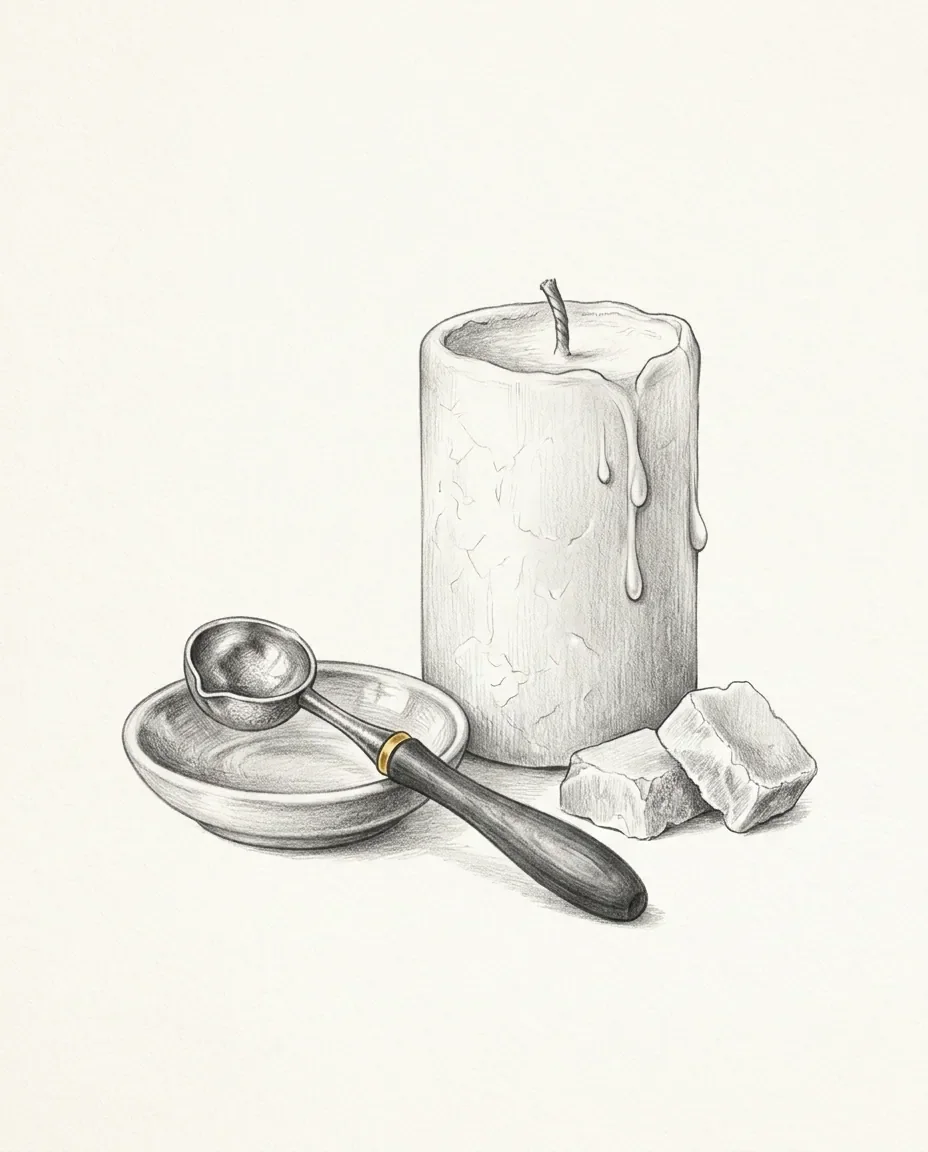
Wax Play
Ceroticism
Added 21 Jun 2026 · Updated 22 Aug 2026
Consensual temperature and sensation play in which warm candle wax is dripped onto a partner's skin for a brief heat sensation. A cooling, hardening trace follows. It is a popular, ritualistic element of BDSM sensation play that requires care to avoid burns.
- Prevalence
- Common
- Category
- Sensation & Pain
- Clinical term
- Ceroticism
- Domain
- Sexual interest
- Confidence
- Medium confidence
- Status
- Consensual BDSM sensation play; a benign variation in consenting adults rather than a disorder, though recognized as carrying burn risk.
- Also known as
- hot wax, candle play, ceroticism, hot wax play, candle wax play, temperature play
- Added
- 21 Jun 2026
- Updated
- 22 Aug 2026
Featured in
Overview
Wax play is a form of consensual sensation play in which melted candle wax is dripped or poured onto a partner's body, producing a momentary spike of heat that quickly fades as the wax cools and hardens on the skin. It combines temperature play with a tactile and visual element, and is frequently woven into broader BDSM scenes alongside restraint or other sensation work. Because ordinary candles can burn, the wax type and drip height are chosen deliberately to keep the heat within a tolerable range. This article covers its origins, how it is practised, its psychology, and the safety logic that governs it.
Examples
What the term covers. A candle held high above a partner so the wax cools on the way down and lands warm rather than hot; a slow line drawn along the back or thighs while the receiver, often blindfolded, cannot see where the next drop will fall; a scene in which the hardened wax is left in place for a while as a visible trace and peeled away afterwards. It usually appears inside a longer scene rather than on its own, paired with bondage, other sensation play, or the cold half of temperature play for contrast.
What the term does not cover. It is not branding and burning play, which uses open flame or heated metal and often intends a lasting mark, where wax play is meant to be transient. It is not impact play, flogging or caning, where the sensation comes from a blow rather than from heat. It is not straightforwardly pain play either; practitioners more often describe the appeal as intensity, contrast and anticipation than as pain. And it is not edgeplay, the community's category for risks that cannot be negotiated away, although wax handled carelessly borrows some of the same hazards.
How the word is used. Wax play is plain community vernacular, coined inside modern BDSM culture rather than in any clinical literature. The pseudo-clinical ceroticism circulates in compiled lists of paraphilias and folk taxonomies but appears in no diagnostic manual; neither DSM-5-TR nor ICD-11 recognises wax play as a disorder. "Hot wax" is the usual shorthand and is slightly misleading, since most of the craft consists of keeping the wax from being hot.
History & origins
A community practice, not a clinical category
The deliberate erotic use of warm wax has no single documented inventor, and the colloquial term "wax play" is a plain-English description that emerged within modern BDSM and kink communities rather than from clinical literature. The pseudo-clinical label ceroticism is occasionally applied, built from the Latin cera ("wax") and the Greek eros ("love, desire"); it appears in folk taxonomies and compiled lists of paraphilias rather than in the formal diagnostic manuals, which do not recognise wax play as a distinct disorder.
Roots in sexology and the leather subculture
As an organised practice, wax play belongs to the broader history of consensual sadomasochism that nineteenth-century alienists first catalogued.
- 1886: Richard von Krafft-Ebing's Psychopathia Sexualis framed pain- and sensation-seeking within early clinical sexology, though it did not single out wax.
- Early 1900s: Havelock Ellis's Studies in the Psychology of Sex further normalised the study of sensory and algophilic interests as variations rather than diseases.
- Later 20th century: the activity's modern shape (negotiated consent, deliberate candle selection, drip-height control, and aftercare) was refined in the leather and BDSM subcultures and disseminated through community manuals.
- 1990s–2010s: wax play gained recognisable cultural visibility through BDSM imagery in film and television, and instructional knowledge migrated to online guides and forums, broadening access to safety practice.
In practice
Wax play is typically expressed as a slow, attentive ritual. The top controls the heat reaching the skin chiefly through candle choice and drip height (holding the candle higher lets the wax cool further in flight, lowering the temperature on contact) and maps sensation across the bottom's body, often pairing it with restraint or blindfolding to sharpen anticipation. The cooled wax leaves a sculptural trace that is peeled or scraped away afterward. The interest often centres on anticipation, contrast, and the meditative focus the heat produces, as much as on the raw sensation. Which wax is used is not a stylistic choice but a temperature one, and is treated below as a safety question.
Psychology
Psychologically, the appeal draws on heightened sensory awareness, the trust and vulnerability of receiving controlled heat, the suspense between drips, and the aesthetic of hardened wax tracing the body. It sits within the wider masochistic and sensation-seeking spectrum, where surrendering bodily control to a trusted partner is itself a source of arousal and intimacy. As a consensual variation it is regarded as benign rather than a clinical condition, and the dedicated empirical literature specific to wax play is sparse, so most accounts generalise from broader BDSM research.
Prevalence & culture
Direct prevalence data on wax play specifically are limited, so estimates lean on community presence and broader sensation-play proxies. The umbrella context is well-populated: in Lehmiller's Tell Me What You Want (2018) survey of 4,175 Americans, BDSM fantasies were nearly universal, only a small single-digit percentage had never had one, with a majority reporting fantasies of receiving or inflicting pain. Population surveys such as Joyal & Carpentier (2017) likewise found masochistic interest common rather than rare. Wax play is a recognisable, named kink in mainstream guides such as Glamour's A–Z of kinks, and active interest groups on platforms like FetLife provide a community-size proxy. Its visual shorthand has also surfaced in mainstream film, from the candle scene in Body of Evidence (1993) to The Wolf of Wall Street (2013), per the Wax play reference, which has kept the image familiar to general audiences.
Safety, consent & law
Between consenting adults wax play is legal, and essentially all of its risk is thermal: melted wax can cause first- and second-degree burns and scarring, which is why community guides class it as moderately advanced rather than beginner play.
The fact that governs that risk is that waxes are not interchangeable. Per the Wax play reference, soy wax melts at roughly 46–57 °C and plain paraffin at about 47–65 °C, both within a range skin can generally tolerate, while beeswax (about 62–65 °C), microcrystalline wax (roughly 63–93 °C) and stearin (around 80 °C) run considerably hotter and are treated as unsafe for direct contact with skin. Added dyes and scent oils raise a wax's melting point, so an ordinary decorative or scented candle is an unknown quantity even where its base wax would have been a safe one. Height works on the same variable, since wax cools as it falls: the same candle delivers a different temperature from a different distance.
The remaining precautions follow from that. Practitioners test wax on themselves before it reaches a partner, keep it away from the face, eyes and other sensitive areas, and keep burn first-aid and a means of extinguishing the flame within reach; an open flame near hair, bedding or suspended rope carries its own risk quite apart from the wax. Applying heat to a non-consenting person is assault, and causing serious injury may exceed the limits of what consent can lawfully authorise in some jurisdictions.
Common questions
Does wax play hurt?
Usually it registers as a brief spike of heat that fades within a second or two as the wax cools and hardens on the skin, closer to a strong sensation than to pain, and often described as a jolt followed by warmth. How intense it feels depends almost entirely on which wax is used and how far it falls before landing. Wax that genuinely hurts is wax that was too hot, which is a safety problem rather than a question of tolerance.
Can you use ordinary household candles for wax play?
Not reliably. Decorative, scented and coloured candles are the usual mistake: dyes and fragrance oils raise a wax's melting point, and blended candles seldom state what they are made of, so the temperature at which the wax leaves the candle is simply unknown. Community practice favours plain, undyed low-melting candles for that reason. Several common waxes melt far hotter than skin tolerates and are not used on the body at all.
Can wax play cause burns or scars?
Yes. First- and second-degree burns are the documented risk, and a second-degree burn can scar. The mechanism is straightforward: a wax that melts above what skin tolerates, a candle held too close, or an area of thin or sensitive skin. The result is a genuine burn and is treated like any other. That is why the practice is described as moderately advanced rather than as a casual first experiment.
Is wax play safe for beginners?
It is approachable but not trivial, and the reason is attention rather than technique. There is an open flame, a hot liquid, and usually a partner who is restrained and cannot simply move away, so the person pouring has to monitor continuously and the person receiving needs a way to stop things that still works mid-scene. Most people begin with a known low-melting wax and a modest area of skin rather than an elaborate scene.
Is wax play a paraphilia or a disorder?
No. It appears in neither DSM-5-TR nor ICD-11, and the pseudo-clinical name ceroticism comes from compiled folk taxonomies rather than from any diagnostic manual. As consensual sensation play between adults it is treated as an ordinary variation. Clinical attention would be warranted only where an interest causes a person real distress or impairment, or involves someone who has not consented.
Is wax play legal?
Between consenting adults, in the ordinary case yes. Two limits matter. Applying heat to someone who has not agreed to it is assault regardless of the setting. And in a number of jurisdictions consent is not a defence to serious bodily harm, so an injury severe enough to need medical treatment can raise legal questions even where both people wanted the scene to happen.
How common is wax play?
No survey measures it directly. The umbrella around it is very large: in Lehmiller's Tell Me What You Want (2018) survey of 4,175 Americans, BDSM fantasies were close to universal, and Joyal and Carpentier's (2017) population work found masochistic interest common rather than rare. Wax play is a named, recognisable kink inside that umbrella with a steady community presence, which is the basis for this entry's low-single-digit estimate rather than any direct measurement.
- Temperature Play49/100Sensation & PainConsensual sensation play that uses warmth and cold, such as ice, chilled or warmed objects, and contrasting temperatures, to heighten skin sensation. It is a gentle, accessible branch of BDSM sensation play centered on thermal contrast.49
- Flogging60/100Sensation & PainConsensual impact play in which one partner strikes another's body with a multi-tailed flogger, whip, or single-tail. The rhythmic sensation ranges from a broad "thuddy" impact to a sharp, stinging line. It is a common, negotiated element of BDSM sensation play.60
- Pain Play58/100Algolagnia · Sensation & PainPain play (algolagnia) is a clinical umbrella term for sexual arousal connected to physical pain, whether that pain is received or inflicted. The received form is labelled active/masochistic, the inflicted form passive/sadistic. It frames pain itself, not any specific implement, as the source of erotic interest.58
- Caning48/100Sensation & PainConsensual impact play using a thin, flexible rod such as a rattan cane or switch to deliver sharp, stinging strokes. It is a focused subset of BDSM impact play known for an intense, lingering sensation and carries higher injury risk than padded implements.48
- Biting Kink51/100Odaxelagnia · Sensation & PainOdaxelagnia is a consensual interest in arousal from biting or being bitten, ranging from gentle nibbling to firmer bites that may leave a temporary mark. It blends strong sensation, intimacy, and a mild element of marking, and sits at the gentle end of sensation play.51
- Face Slapping51/100Sensation & PainA consensual BDSM activity in which one partner strikes another's face with an open hand, valued for its sharp sensation and immediate charge of dominance. The appeal is not injury. Aimed at the fleshy cheek, it is a higher-focus form of impact play because the face carries vulnerable structures.51
The colloquial "wax play" is plain descriptive English. The pseudo-clinical label "ceroticism" combines Latin cera ("wax") with Greek eros ("love, desire").
temperature · heat sensation · skin sensation
Prevalence is computed from the entry's cited population estimate. Rows marked ESTare indicative editorial estimates scored against a fixed anchor rubric, not measured quantities. Method & anchors: methodology.
Common · ≈ 1 in 20
- 01List of paraphilias, Wikipediadefinition/existence of wax play (ceroticism) as a recognized sensation-play interest
- 02Lehmiller (2018), Tell Me What You Want, survey of 4,175 AmericansBDSM umbrella context (only 4-7% never had a BDSM fantasy; active pain/sensation interest much lower)
- 03An A–Z of Kinks and Fetishes, Glamourmainstream lay framing of wax/candle play as a common BDSM sensation kink
- 04FetLife, kink community group sizes (community-size proxy)community-size proxy for wax-play interest groups
- 05Richard von Krafft-Ebing, Psychopathia Sexualis (1886)early sexological framing of consensual sadomasochism within which sensation play sits historically
- 06Wax play, Wikipediadefinition; candle types and melting points (soy 46-57 C, paraffin 47-65 C, beeswax 62-65 C; microcrystalline and stearin hotter and unsafe); classified as moderately advanced play with burn risk; cultural visibility in film
- 07Joyal & Carpentier (2017), The Prevalence of Paraphilic Interests and Behaviors in the General Population, J. Sex Research 54(2):161-171general-population context that masochistic and fetishistic interests are not statistically rare