Predicament Play
Added 21 Jun 2026 · Updated 22 Aug 2026
A consensual BDSM practice in which a restrained or instructed partner is held in a sustained, awkward position. The position is engineered so that relieving one discomfort introduces another. The appeal lies in endurance, surrender, and slowly building muscular sensation rather than acute pain.
- Prevalence
- Uncommon
- Category
- Sensation & Pain
- Domain
- Sexual interest
- Confidence
- Low confidence
- Status
- Consensual BDSM sensation practice, not a clinical paraphilia; benign between consenting adults but carries notable physical risk.
- Also known as
- predicament / stress-position sensation play, stress positions, endurance play, positional discomfort
- Added
- 21 Jun 2026
- Updated
- 22 Aug 2026
Featured in
Overview
Predicament play, closely overlapping with what the BDSM community calls predicament bondage, is a form of consensual sensation and power-exchange play in which a partner is held or directed into a posture that becomes progressively uncomfortable to maintain. Its defining feature is the "predicament" itself: the arrangement is engineered so that relieving one source of discomfort introduces another, leaving no fully comfortable option and concentrating attention on holding still, breathing, and surrender. The appeal lies in endurance, trust, and slowly building muscular sensation rather than acute, applied pain. This article traces the practice's documented lineage, how it is typically expressed, its proposed psychology, and the safety and consent framing it demands.
Definition & scope
The classic illustration is deliberately simple: a bottom stands on tiptoe to keep a rope or attachment from pulling uncomfortably, so the choice narrows to enduring calf fatigue or accepting the discomfort of settling back down. Wikipedia frames the practice as one in which a person is "restrained and forced to experience opposing sensory forces", a "damned if you do, damned if you don't" arrangement. What separates it from ordinary bondage is that the bottom keeps making a choice: there is no neutral resting state, only a slow trade between two sensations, either of which grows as the scene continues.
Examples
What the term covers. Arrangements in which two discomforts are set against each other so that easing one tightens the other: a posture that can be held only by keeping a limb raised, a connection between two points where slack gained in one place is lost in another, or an object that must be kept in position by muscular effort alone. Wiseman's handbook describes multi-participant versions in which the dilemma becomes a moral one: spare a loved one by taking the discomfort yourself, or spare yourself by passing it on. The common thread is that the bottom is never passive: they keep choosing, and every choice costs something.
What the term does not cover. A stress position held to exhaustion is the simpler thing (one discomfort, growing with time, with no trade to manage), and it is the building block a predicament is assembled from rather than a synonym for it. Plain bondage restrains without engineering a dilemma, and strappado and hogtie ties are positions that may or may not be arranged into one. Impact play and pain play apply force from outside, where a predicament makes the bottom's own body and choices the source of the sensation.
How the word is used. Community jargon, taught at demonstrations and in workshops rather than defined in any manual; "predicament bondage" is the commoner phrasing, and the broader sense used here also covers arrangements held by instruction rather than by rope. It appears in neither the DSM-5-TR nor the ICD-11.
History & origins
A modern, community-born term
As a named kink concept, predicament play is a product of the late-twentieth-century BDSM community rather than of the clinical literature, and the term's precise first coinage is not well documented; it circulates through community education, demonstrations, and writing rather than peer-reviewed scholarship. The closest documented anchor is the educational literature on rope and restraint that put the idea in print. Jay Wiseman's Erotic Bondage Handbook (Greenery Press, 2000) helped standardise the surrounding vocabulary of safe, dynamic restraint, and it also describes multi-participant predicaments in which the dilemma becomes a moral one: sparing a loved one pain by taking it oneself, or sparing oneself by passing it to another. The clinician and educator Stefani Goerlich's The Leather Couch: Clinical Practice with Kinky Clients (Routledge, 2020) is among the contemporary works cited for the practice's place in kink-aware therapy.
Ancient building blocks
The technique's ingredients are far older than the term. "Stress positions", postures that grow painful through sheer duration rather than through any active force applied to the body, are long described in the history of punishment and coercion, which is precisely why the consensual version foregrounds rigorous negotiation, limits, and aftercare to distinguish it ethically from its non-consensual antecedents. The practice therefore sits at the meeting point of two threads: the very old human knowledge that a held posture eventually hurts, and the modern, consent-centred kink culture that repurposes that knowledge as play.
Clinical lineage of the wider field
Within the broader arc of sadomasochism documented since Richard von Krafft-Ebing's Psychopathia Sexualis (1886) and Havelock Ellis's Studies in the Psychology of Sex, predicament play is a specialised contemporary refinement rather than a distinct diagnostic category. It does not appear as a standalone entry in the DSM-5-TR or the ICD-11; like consensual kink generally, it is treated as a benign interest, framed clinically only where genuine distress, harm, or non-consent arises. The internet accelerated its spread: forums and early kink sites circulated user-generated setups from the early 2000s, and the 2008 launch of community platforms such as FetLife gave enthusiasts a dedicated space to document and share predicament arrangements.
In practice
The practice is expressed through carefully negotiated positions, balance challenges, or sustained holds, often combined with light bondage. The hallmark is choice under constraint: the bottom retains agency and must continuously decide which discomfort to favour, with no fully neutral option. The experience is typically slow and psychological, emphasising anticipation, helplessness, and the top's control over duration rather than any single sharp sensation. Scenes are paced, closely monitored, and ended on agreed signals or safewords.
Psychology
The appeal draws on themes of dominance and submission, trust, focused attention, and the meditative or cathartic state some people report when enduring controlled discomfort within safe limits. For the top, the draw often centres on attentiveness, design, and responsibility; for the bottom, on letting go and being held to a challenge they have freely accepted. The active, decision-making quality distinguishes it from passive restraint and may heighten the sense of complicity in one's own ordeal. The dedicated evidence base is thin: there are no controlled studies of this specific technique, and explanations are extrapolated from the broader psychology of BDSM, endurance, and consensual masochism.
Prevalence & culture
This is a niche corner of the wider BDSM world, with no direct prevalence research and only modest dedicated community visibility. Estimates are therefore approximate, inferred from general kink and fantasy surveys rather than from studies of this technique. The relevant context is that BDSM-themed fantasy is itself extremely common: in Lehmiller's (2018) survey of 4,175 Americans, BDSM fantasies were near-universal, with only about 4% of women and 7% of men reporting they had never had one. Predicament play occupies a far smaller, technically demanding slice of that landscape, sustained mainly by community education and demonstration rather than by mass media.
Safety, consent & law
Because sustained positions and restraint can compromise circulation, nerves, joints, and breathing, this is a higher-risk practice that demands experienced partners, conservative time limits, constant monitoring, quick-release plans, and informed, ongoing consent. Muscle fatigue can progress quickly from challenging to genuinely dangerous, so partners watch for numbness, loss of sensation, and circulatory warning signs. It is legal between consenting adults, but careless or non-consensual use can cause serious injury, and non-consensual confinement in stress positions can constitute assault or unlawful restraint. It should never be combined with isolation or with any impairment of a person's ability to communicate distress or be released.
Common questions
What is the difference between predicament play and a stress position?
A stress position is one discomfort that grows with time: hold the posture and it hurts more. A predicament sets two against each other, so there is no neutral option and the bottom has to keep choosing which one to carry. Stress positions are the raw material; the predicament is what gets built from them. In practice the two shade into each other, and community usage is not always careful about the line.
Is predicament play painful?
Usually uncomfortable rather than sharply painful, and the discomfort comes from duration rather than from anything being applied. Muscles fatigue, joints complain, and a position that was easy in the first minute is not in the tenth. That slow build is the point: the appeal is endurance and surrender, not the acute sting of impact play.
Is predicament play dangerous?
Yes, genuinely. Sustained positions and restraint can compromise circulation, nerves, joints and breathing, and muscle fatigue can move from challenging to unsafe faster than a person expects. Numbness, pins and needles, loss of sensation, colour changes or any difficulty breathing mean the scene stops immediately. It demands experienced partners, conservative time limits, constant monitoring and a quick-release plan, and it should never be combined with isolation.
Do you need rope or bondage gear for predicament play?
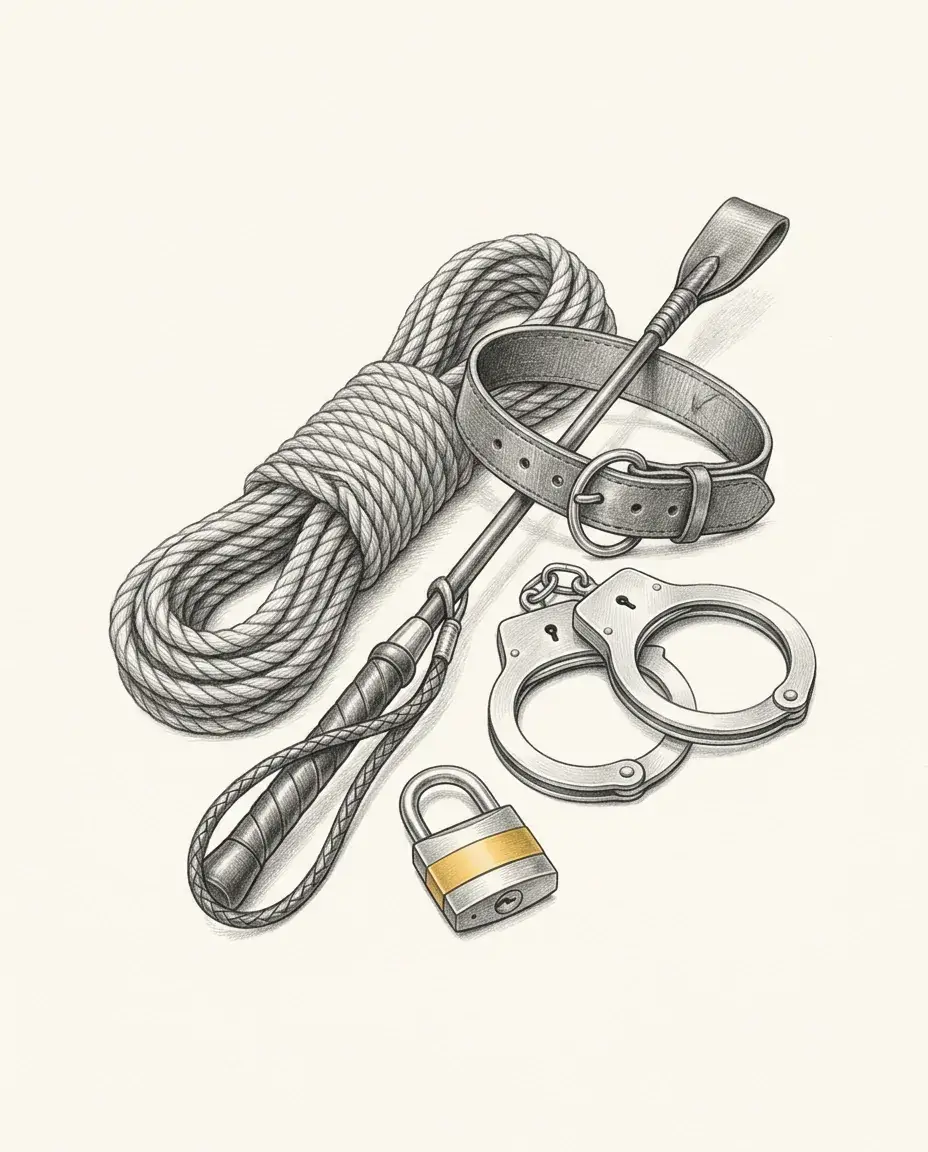
Not necessarily. The dilemma is the mechanism, not the hardware, and a partner who has agreed to hold a position on instruction is in a predicament as surely as one held there by rope. Rope, cuffs and attachment points make the arrangement harder to abandon, which is much of the appeal, but they also stack the risks of bondage on top of the positional ones.
How is predicament play different from torture?
By consent, and by everything that follows from it. Held postures have a long history as instruments of punishment and coercion, which is exactly why the consensual version is built around negotiated limits, safewords, close monitoring and aftercare, and why it ends the moment it is asked to. Interrogation play borrows the imagery of coercion deliberately, and it too is a scene two adults agreed to and can stop.
Is predicament play legal?
Between consenting adults, yes. The complication is the one that runs across BDSM: consent is not a complete defence to serious injury in many jurisdictions, so an arrangement that causes real harm can raise assault questions regardless of what was agreed beforehand. Confining or restraining someone in a stress position without their consent is unlawful, and can amount to assault or unlawful restraint.
- Dominance and Submission92/100Power, Roles & ScenariosA consensual erotic dynamic in which one partner takes a dominant role and the other a submissive role, exchanging power within agreed limits. It is one of the most widespread elements of BDSM and of human sexual fantasy.92
- Dominance85/100Power, Roles & ScenariosTaking the leading, controlling role in a consensual power-exchange dynamic. One of the two halves of dominance and submission (D/s) within BDSM, in which a person directs the scene, sets the rules, and guides a willing partner who has agreed to yield control.85
- Sounding28/100Sensation & PainConsensual insertion of a smooth rod or dilator into the urethra for erotic sensation. A niche, higher-risk form of penetration play named after the medical instruments (urethral sounds) repurposed for it.28
- Fire Play27/100Pyrophilia · Sensation & PainPyrophilia is a rare paraphilia in which fire, flame, or the imagery of burning is a focus of sexual arousal. The related consensual "fire play" is a BDSM sensation technique using brief, controlled flame on skin. Both are distinct from arson, a crime.27
- Sensory Overload Play29/100Sensation & PainA consensual sensation-play practice of deliberately flooding the senses with intense, layered, or competing input. Overlapping touch, temperature, sound, and light produce an overwhelming, disorienting state. It is the mirror image of sensory deprivation.29
- Suction Play29/100Sensation & PainA consensual sensation interest in applying controlled suction or vacuum to the skin or body parts to create a sustained pulling feeling. Glass or silicone cups and hand or battery pumps are used, leaving redness and temporary marks. A niche practice within sensation play.29
From English 'predicament' (a difficult, unavoidable situation; via Late Latin *praedicamentum*, 'something asserted or a state of being'), describing the engineered dilemma in which any movement trades one discomfort for another.
sustained discomfort · endurance · muscular sensation
Prevalence is computed from the entry's cited population estimate. Rows marked ESTare indicative editorial estimates scored against a fixed anchor rubric, not measured quantities. Method & anchors: methodology.
Uncommon · ≈ 1 in 100
- 01List of paraphilias, Wikipediadefinition/existence of predicament and stress-position sensation play
- 02Lehmiller (2018), Tell Me What You Want, survey of 4,175 Americansbroad BDSM/pain-play fantasy context within which this niche technique sits
- 03FetLife, kink community group sizes (community-size proxy)community-size proxy indicating a small dedicated audience
- 04Richard von Krafft-Ebing, Psychopathia Sexualis (1886)historical clinical lineage of sadomasochism within which consensual endurance/predicament play sits
- 05Studies in the Psychology of Sex, WikipediaHavelock Ellis's early sexological survey of sadomasochism, part of the clinical lineage predating the modern kink term
- 06Predicament bondage, Wikipediadefinition and mechanics of predicament bondage as restraint engineered around opposing discomforts, the tiptoe example, the 'damned if you do' framing; cites Goerlich's The Leather Couch (Routledge, 2020) and Wiseman's Erotic Bondage Handbook
- 07Jay Wiseman's Erotic Bondage Handbook (Greenery Press, 2000)foundational community education work that helped standardise the vocabulary of safe, dynamic restraint and describes multi-participant moral-dilemma predicaments
- 08DSM-5-TR, Paraphilic Disorders (American Psychiatric Association, 2022)predicament play is not a standalone diagnosis; consensual kink framed clinically only where distress, harm, or non-consent arises
- 09ICD-11, Paraphilic disorders (World Health Organization)no standalone classification; depathologisation of consensual sadomasochistic interests in modern nosology