Seamed Stocking Fetish
Added 7 Sep 2026
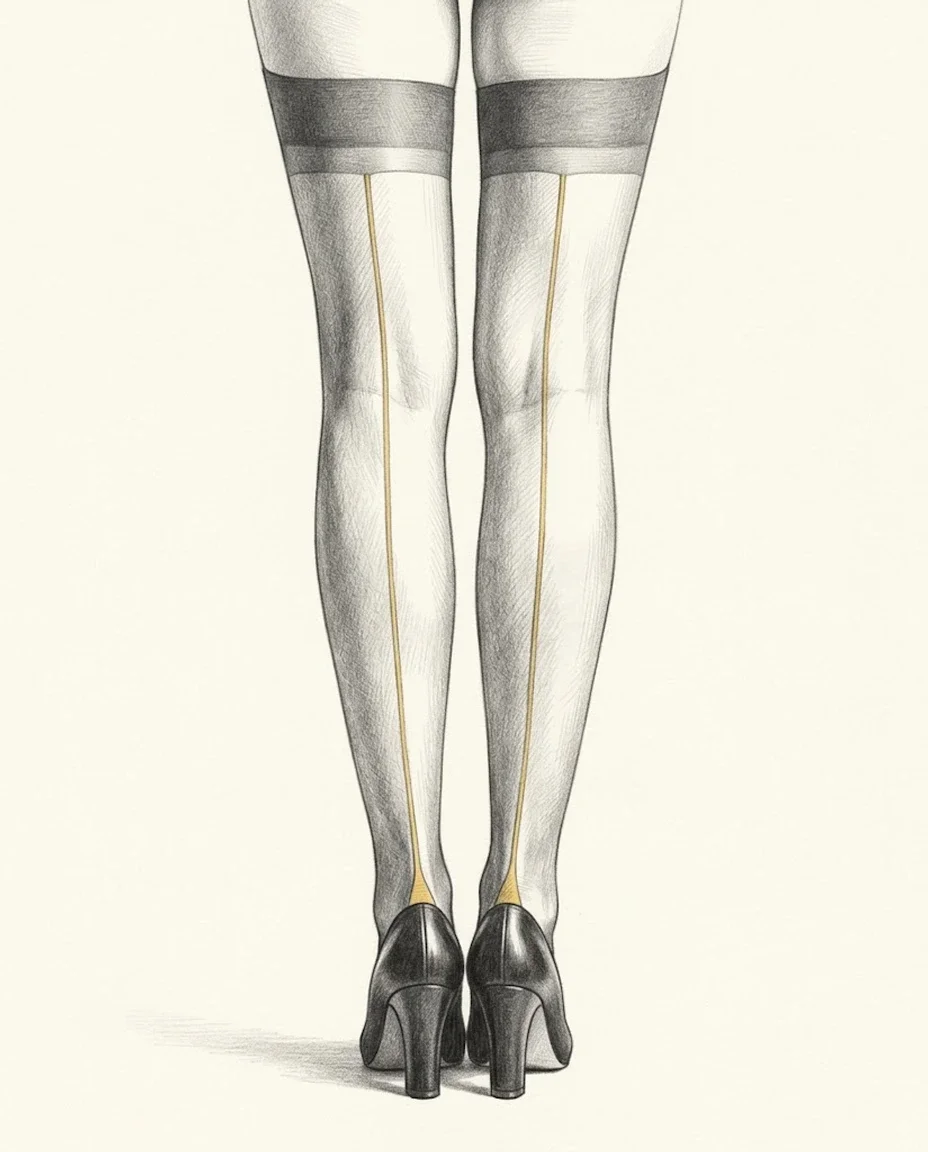
An erotic interest in stockings with a visible seam up the back of the leg, the fully fashioned style of the 1940s and 1950s and its reproductions. A narrowing of the stocking fetish to the seam, the Cuban heel and the period they belong to.
- Prevalence
- Uncommon
- Category
- Clothing & Garments
- Domain
- Sexual interest
- Confidence
- Low confidence
- Status
- A garment interest and a common variation. Neither DSM-5-TR nor ICD-11 names it, and both treat a garment interest as a disorder only with distress, impairment or a non-consenting person.
- Also known as
- back-seam stockings, Cuban heel stockings, fully fashioned stockings, seamed nylons, seam fetish
- Added
- 7 Sep 2026
Featured in
Overview
Seamed stocking fetish is an erotic interest in stockings with a visible seam running up the back of the leg, the fully fashioned stockings of the 1940s and 1950s and their modern reproductions. The attraction attaches to the seam itself, the straight line it draws from heel to thigh, the reinforced heel that finishes it, and the period the style belongs to. It is a narrowing of the stocking fetish, which covers all legwear, to the one construction detail a film from 1945 would show first.
Definition & scope
The seam is the object. A fully fashioned stocking is knitted flat, shaped to the leg by dropping stitches, and then sewn closed up the back, and the seam is the sewing; a seamless stocking is knitted as a tube and has no line at all. The interest is for the line: its straightness, its placement, and the reinforced Cuban heel, squared and darker, that anchors it at the shoe. People with the interest describe the moment of checking whether the seams are straight as the centre of it. The interest sits with the garment interests and borders the leg fetish, since the seam's purpose is to draw the leg.
Examples
What the term covers. A preference for seamed over seamless stockings in a partner or oneself; the ritual of straightening a seam and the glance back to check it; an aesthetic attachment to the whole period style, the seam with the court shoe and the pencil skirt; a collection of fully fashioned stockings, which are still knitted on a small number of mid-century machines; and the drawn seam, the eyebrow-pencil line up a bare leg that wartime rationing made famous, kept alive as a costume detail.
What the term does not cover. The stocking fetish is the parent and covers every kind of legwear, seamed or not. The pantyhose fetish attaches to tights, which have no seam of this kind. The nylon fetish is about the material's sheen and feel and is indifferent to construction. The garter belt fetish attaches to the straps that hold a seamed stocking up, and travels with it without being it. The high heel fetish is the shoe. Each of these can exist without an interest in the seam.
How the word is used. "Seamed stockings" is a trade term and a vintage-fashion term first; "seamed stocking fetish" is the community's own phrase, and there is no clinical synonym. Neither DSM-5-TR nor ICD-11 names it, and both would treat a garment interest as fetishistic disorder only with distress, impairment or a non-consenting person.
History & origins
Fully fashioned
Stockings had seams because of how they were made. Flat knitting on a Cotton's patent machine, from the 1860s, produced a shaped blank that had to be sewn closed, and the seam ran up the back where it showed least; a stocking made this way was "fully fashioned", shaped to the leg. Nylon, announced by DuPont in 1938 and sold as stockings from May 1940, was knitted on the same machines and kept the seam, and the seam became the emblem of the new material.
The drawn seam
The war removed the stockings and left the seam. With nylon diverted to parachutes from 1942, women in Britain and the United States painted their legs with gravy browning or commercial leg make-up and drew a seam up the back with an eyebrow pencil, a scene the Smithsonian records alongside the nylon riots of 1945, when the stockings returned and crowds fought for them. The drawn seam is the plainest evidence that the line mattered more than the fabric.
The seamless turn
Circular knitting made a seamless stocking possible in the 1950s, and by the early 1960s the seamless stocking, then tights, had taken the market. The fully fashioned machines were scrapped or sold on, and a handful survived in specialist hands, which is why a fully fashioned stocking bought today is made on a mid-century frame the way one was in 1955. From the 1960s the seam was a costume detail, and the pin-up, the burlesque revival and vintage fashion carried it into the present as a signifier of the period.
In practice
The interest is expressed through wearing and through looking. A wearer straightens the seams before going out and checks them in a mirror over the shoulder, a small ritual that people with the interest describe as part of the point. An observer notices the seam before the leg. Couples who share the interest fold the stockings into dressing and undressing, with the garter belt and court shoe that complete the look, and collectors buy fully fashioned stockings from the few makers who still knit them. Nothing about it needs a scene.
Psychology
The accounts are the garment-fetish accounts, with one addition. Associative learning explains how a detail paired with arousal becomes arousing on its own, and the seam is a strong candidate because it is a line that leads the eye up the leg and ends where the skirt begins. Havelock Ellis's Studies in the Psychology of Sex treated the garment that frames a body part as a partialism once removed, and a seam frames a leg more explicitly than any other garment detail. The addition is time: the seam belongs to a period, and for many people the interest is inseparable from the 1940s and 1950s and the films, photographs and pin-ups that fixed the style. It is as much a nostalgia as a fetish.
Prevalence & culture
No survey measures the seam on its own. The parent interest is measured: in Scorolli and colleagues' 2007 study of 381 online fetish groups, garments and hosiery were among the largest object categories, and the catalog estimates the stocking fetish at 7 percent of adults. The seam is a fraction of that. The catalog's estimate, one and a half percent, is the share of the parent interest that names the seam as its focus, read from the size of the seamed and fully fashioned communities against the stocking communities, and it carries low confidence. In culture the seam is out of proportion to its numbers: it is film and advertising's shorthand for the whole period, and the vintage and burlesque scenes keep it visible.
Safety, consent & law
The interest is benign and legal and involves ordinary clothing worn by consenting adults. Neither diagnostic manual names it. The one practical note is the same as for any nylon: the fabric ladders, and a fully fashioned stocking with a run is a costly loss.
Common questions
What are seamed stockings?
Stockings with a visible seam running up the back of the leg. The seam comes from the way fully fashioned stockings are made: knitted flat, shaped to the leg, then sewn closed up the back, with a reinforced Cuban or point heel where the seam meets the shoe. Seamless stockings, knitted as a tube from the 1950s, have no seam, which is why the seamed kind reads as vintage.
What is the difference between a seamed stocking fetish and a stocking fetish?
The seam. A stocking fetish covers all legwear, sheer or opaque, seamed or seamless, and the catalog estimates it at 7 percent of adults. The seamed interest is the fraction of that which attaches to the back seam, the Cuban heel and the 1940s and 1950s style they belong to. Someone can have either without the other.
Why did women draw seams on their legs during the war?
Because the stockings were gone and the seam was the part that showed. With nylon diverted to parachutes from 1942, women painted their legs with leg make-up or gravy browning and drew a line up the back with an eyebrow pencil, a scene the Smithsonian records alongside the nylon riots of 1945, when the stockings came back and crowds fought over them.
Are fully fashioned stockings still made?
Yes, by a handful of makers on surviving mid-century machines. Fully fashioned stockings are knitted flat on Reading and Cotton's frames from the 1950s that were scrapped almost everywhere when seamless stockings took the market, and a pair bought today is made the way one was in 1955, at several times the price of a seamless pair.
How common is a seamed stocking fetish?
No survey measures the seam on its own. Scorolli and colleagues' 2007 study of 381 online fetish groups found garments and hosiery among the largest object categories, and the catalog puts the parent stocking interest at 7 percent of adults. The seamed interest is estimated at one and a half percent, read from the size of the seamed communities against the stocking ones, with low confidence.
Is a seamed stocking fetish a disorder?
No. It is a garment interest involving ordinary clothing worn by consenting adults, and neither the DSM-5-TR nor the ICD-11 names it. Both manuals treat a garment interest as fetishistic disorder only when it causes clinically significant distress or impairment or involves a non-consenting person.
- Stocking Fetish57/100Clothing & GarmentsA sexual interest in stockings and hosiery, centered on sheer or textured legwear, seams, garters and the look and feel of nylon and silk. It is among the most common garment and material fetishes.57
- Pantyhose Fetish52/100Garment fetishism (hosiery/legwear subtype) · Clothing & GarmentsA sexual interest in pantyhose and tights, sheer or opaque one-piece nylon legwear, focused on its full-leg coverage, smooth encasing texture, and look. A common close relative of stocking fetishism and one of the more historically recent garment interests.52
- Nylon Fetish43/100Nylon Fetishism · Objects & MaterialsAn erotic attraction to nylon as a material: the sheer, smooth, faintly glossy synthetic fabric used in hosiery, stockings, tights, and other slick garments. It is a textile-material preference rather than a clinically defined paraphilia.43
- Garter Belt Fetish44/100Garter and suspender-belt fetishism · Clothing & GarmentsAn erotic interest in garter (suspender) belts and the straps that frame the thighs and hold up stockings, prized for their glamour. The visual framing of the upper legs is central to the appeal. A common intimate-apparel fetish tied to lingerie, not a clinical disorder.44
- High Heel Fetish56/100Altocalciphilia · Clothing & GarmentsA focused sexual interest in high-heeled shoes (stilettos, pumps, platforms) and the height, posture, and leg line they create. It is a common, generally harmless subtype of shoe fetishism.56
- Leg Fetish53/100Crurophilia · Body Parts & PartialismCrurophilia is a partialism in which the legs are the primary focus of sexual attraction. Interest may center on a leg's shape, length, line, or musculature, or on the way legs are framed by clothing such as stockings, skirts, or heels.53
From "seamed", describing a stocking knitted flat and sewn closed up the back, plus "stocking" and the descriptive "fetish"; "fully fashioned" is the trade term for a stocking shaped to the leg on a flat-knitting machine. A community phrase with no clinical coinage.
hosiery · vintage style · garment detail
Prevalence is computed from the entry's cited population estimate. Rows marked ESTare indicative editorial estimates scored against a fixed anchor rubric, not measured quantities. Method & anchors: methodology.
Uncommon · ≈ 1 in 100
- 01Nylon, WikipediaDuPont's 1938 announcement, the May 1940 stocking launch, and nylon's wartime diversion to parachutes
- 02Stocking, Wikipediafully fashioned construction on flat-knitting machines, the back seam, the Cuban and point heel, and the 1950s and 1960s shift to seamless circular-knit stockings
- 03Stocking Series, Part 1: Wartime Rationing and Nylon Riots, Smithsonian Magazineleg make-up and the eyebrow-pencil seam during rationing, and the nylon riots of 1945
- 04Scorolli et al. (2007), Relative prevalence of different fetishes, Int. J. Impotence Research 19(4):432-437garments and hosiery among the largest object-fetish categories in the 381-group community analysis
- 05Studies in the Psychology of Sex, Havelock Ellis, WikipediaEllis's treatment of garments that frame a body part as partialism once removed
- 06DSM-5-TR, Paraphilic Disorders (American Psychiatric Association, 2022)a garment interest is fetishistic disorder only with distress, impairment or non-consent
- 07ICD-11, Paraphilic disorders (World Health Organization)the interest is not named in the international classification