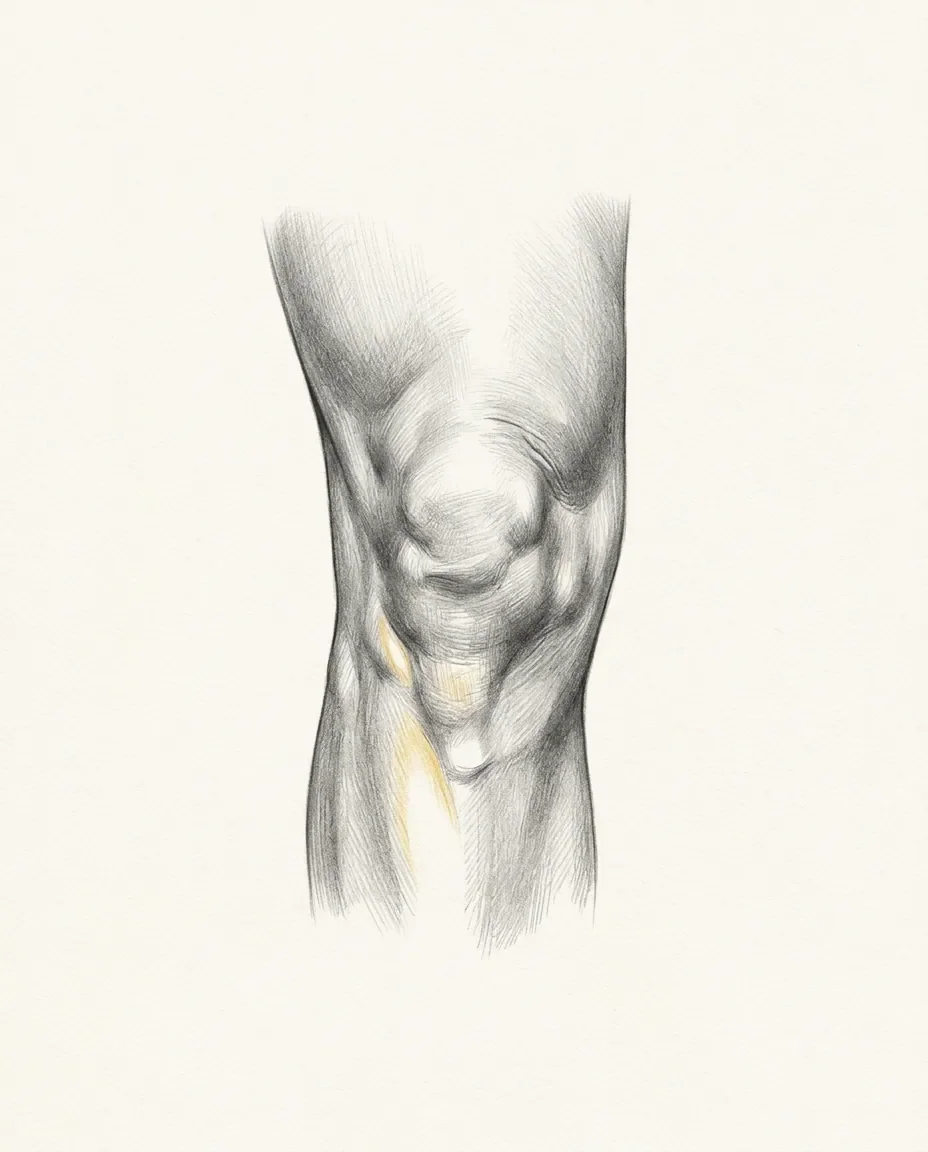
Knee Fetish
Genuphilia
Added 26 Jul 2026 · Updated 22 Aug 2026
A partialism in which the knee, its shape, texture, movement, or the area behind it, is the primary focus of sexual attraction. It is not an incidental feature of leg or foot appreciation.
- Prevalence
- Uncommon
- Category
- Body Parts & Partialism
- Clinical term
- Genuphilia
- Domain
- Sexual interest
- Confidence
- Low confidence
- Status
- Not classified as a distinct paraphilia; no dedicated academic study exists. Would fall under the general partialism/fetishistic-disorder specifier only if exclusive and distressing, a threshold documented cases do not appear to reach.
- Also known as
- genuphilia, knee partialism, knee kink
- Added
- 26 Jul 2026
- Updated
- 22 Aug 2026
Overview
A knee fetish, or genuphilia, is a partialism in which erotic attention settles on the knee itself: its shape, the skin and texture over and behind it, the way it bends, or specific variants such as knock-knees or a scarred or replaced knee, rather than on the leg as a whole. It sits at the narrow, under-studied end of the body-part-fetish spectrum, closely bordered by leg, thigh, and foot attraction, with which it frequently overlaps but from which it is distinct in where the focus actually lands. Unlike many partialisms with decades of sexological documentation behind them, genuphilia has almost no dedicated research literature, and this article treats that absence as part of the story rather than papering over it.
Examples
What the term covers. Attention to the knee as a shape: the cap, the bones, how the joint reads straight and how it reads folded. A preference for a particular kind of knee, knobby, knock-kneed, prominently boned. The thin, sensitive skin of the hollow behind it. A knee marked by scarring or surgery. And knees framed rather than hidden, by a hem, by shorts, by sheer hosiery or knee-high socks. The reported accounts are mostly visual, with non-explicit touch a distant second.
What the term does not cover. The neighbouring partialisms are separate interests with far more documentation behind them: the leg as a whole line and musculature, the thigh, the foot. Where the hosiery rather than the joint is the object, the interest is a garment one, stockings, socks, pantyhose, and the two travel together often without being the same thing. Attraction to braces, casts and mobility aids is abasiophilia, differently grounded even though it involves the same joint. Formally, a knee focus is one partialism among many, classified like every body-part interest under the nongenital-body-part specifier of fetishism rather than as a category of its own.
How the word is used. Genuphilia is written far more often than spoken. It lives in glossaries, blog posts and community bios, while people who have the interest say "knee fetish". It is absent from the diagnostic manuals, which name no partialism by its body part, and the small communities that discuss it treat the Greek label mainly as a search term.
History & origins
A term with no clinical pedigree
Genuphilia does not appear in the classic nineteenth- and twentieth-century sexology that catalogued feet, hair, and hands as objects of fetishistic attraction. It has no entry in Krafft-Ebing's Psychopathia Sexualis or Havelock Ellis's Studies in the Psychology of Sex, and it is absent from Wikipedia's list of paraphilias and from the DSM-5-TR and ICD-11, neither of which names any partialism by its specific body part beyond the general "nongenital body parts" specifier. The most direct documentation comes not from a journal but from psychologist Mark Griffiths, a professor of behavioural addiction at Nottingham Trent University who writes widely on unusual sexual interests. In a 2015 post, Griffiths noted that genuphilia appears in neither Brenda Love's Encyclopedia of Unusual Sex Practices nor Anil Aggrawal's Forensic and Medico-Legal Aspects of Sexual Crimes and Unusual Sexual Practices, two of the standard English-language reference works that between them catalogue several hundred named paraphilias, concluding that the interest is either genuinely rare or a very recently named one.
Etymology as its own evidence
The word is built the same way as its neighbors: Latin genu ("knee," as in genuflect) plus the Greek-derived suffix -philia ("love, affinity"). Griffiths observed that it reads as the deliberate mirror image of the older, better-attested genuphobia (irrational fear of knees), suggesting the erotic term may have been coined by analogy to its phobic counterpart rather than emerging from clinical case material the way podophilia or trichophilia did.
Documentation via online community rather than clinical case study
What evidence exists for genuphilia as a lived interest comes almost entirely from self-report on forums, image boards, and small dedicated communities such as the Reddit community r/sexy_knees, whose own members describe the interest as "a lot less common, or at least less talked about" than mainstream partialisms. Griffiths, reviewing first-person accounts, found descriptions consistent with ordinary associative conditioning, one account traced arousal to adolescent leg-touching games in which a partner's knees became a specific focus, and found the interest reported across genders and sexual orientations, often alongside foot, leg, or hand attraction rather than in isolation.
In practice
Reported preferences vary in what, specifically, draws attention: some describe interest in knees generally regardless of type, others in a particular knee shape (knock-kneed, knobby, prominently boned), skin texture or hair, or the sensitive area behind the knee. Expression is mostly visual, attention to knees exposed by skirts, shorts, or sheer hosiery, and through non-explicit touch, and it commonly co-occurs with a preference for knee-high socks or stockings, connecting it to hosiery-focused clothing fetishes as much as to bare-leg partialism.
Psychology
No controlled study has examined genuphilia specifically. The account most consistent with the available first-person evidence is associative or conditioned learning, the mechanism Krafft-Ebing and Ellis proposed for fetishism generally, in which repeated pairing of knee contact with early sexual arousal establishes the knee as a durable erotic cue. Griffiths, surveying the field, explicitly noted the absence of any dedicated empirical study and considered it unlikely such research would ever be conducted, given that the interest, where it exists, appears to cause no distress and rarely if ever presents clinically.
Prevalence & culture
How common is a knee fetish?
No population survey isolates knee attraction from broader leg or partialism categories. Scorolli and colleagues' 2007 analysis of online fetish communities found feet accounted for roughly 47% of body-part-focused fetish groups, with legs and other lower-body foci trailing well behind and knees not broken out as their own category at all, a strong indication of relative rarity rather than direct measurement. Broader work such as Joyal & Carpentier (2017) shows fetishistic interest in general is common in the population, the umbrella partialism sits within, but again without a specific figure for the knee. Cultural visibility is minimal: knee attraction has no mainstream media presence and sustains only small, scattered online communities, in contrast to the far larger and better-documented followings around feet, legs, or breasts.
Safety, consent & law
The interest involves consenting adults and ordinary attraction or contact, and it raises no safety or legal concerns of its own. It is not recognized as a distinct diagnosis; like other partialisms it would only meet the threshold of fetishistic disorder under the DSM-5-TR if an exclusive focus caused marked distress or functional impairment, a bar the documented cases do not appear to approach.
Common questions
Is a knee fetish a real thing?
Yes, though thinly documented. It has no research literature and no entry in the standard reference works on unusual sexual practices, a gap Mark Griffiths noted when he surveyed it in 2015. What exists is first-person accounts on forums and in small dedicated communities, consistent enough with one another to describe a genuine if uncommon focus.
What is the difference between a knee fetish and a leg fetish?
Where the attention lands. A leg fetish takes in the whole limb, its length, line, shape and musculature, with the knee as part of the scenery. A knee fetish narrows to the joint itself: its shape, the skin over and behind it, the way it bends. They overlap constantly, and most people reporting a knee focus report broader leg or foot interest alongside it rather than the knee in isolation.
Why do some people find the back of the knee attractive?
It is one of the more commonly named variants, and the physiology is unremarkable enough to account for it: the skin behind the knee is thin, rarely exposed and easily tickled, which makes it feel both private and unusually responsive to touch. Beyond that, the general account for any body-part interest applies, in which a part repeatedly present during early arousal becomes a cue in its own right.
Is a knee fetish a disorder?
No. Under DSM-5-TR a body-part interest becomes a disorder only where an exclusive focus causes marked distress or functional impairment, and the documented accounts come nowhere near that bar. Griffiths, reviewing them, expected the interest would never be studied precisely because it causes no distress and effectively never presents clinically.
Are knee socks part of a knee fetish?
Often, though the two can be pulled apart. If the appeal is the fabric, the band, or the strip of skin above it, the interest belongs with hosiery fetishes such as stockings and socks. If the socks matter because of how they frame the joint, and bare knees work just as well, the focus is the knee. Many people report both, and that overlap is one reason knee-specific attraction is rarely counted separately.
Does a knee fetish have anything to do with kneeling?
No, despite the shared word. Kneeling is a posture of deference, and its meaning comes from the submission it signals rather than from the joint doing the work. A knee fetish is a body-part attraction and requires no dynamic at all. The two can coincide, as any two interests can, but neither implies the other.
- Leg Fetish53/100Crurophilia · Body Parts & PartialismCrurophilia is a partialism in which the legs are the primary focus of sexual attraction. Interest may center on a leg's shape, length, line, or musculature, or on the way legs are framed by clothing such as stockings, skirts, or heels.53
- Foot Fetish83/100Podophilia · Body Parts & PartialismA focused erotic interest in feet (their shape, soles, toes, arches, or grooming) as a primary source of attraction. Within partialism (erotic focus on a non-genital body part) it is the example people report most, by a wide margin.83
- Thigh Fetish43/100Body Parts & PartialismA focused erotic interest in the hips and thighs, in which these areas of the lower body are a primary source of attraction. It is a common, benign variation of ordinary attraction rather than a clinical concern.43
- Partialism46/100Partialism · Clinical ParaphiliasThe clinical term for an exclusive or near-exclusive sexual focus on a specific, usually non-genital body part: feet, hands, hair, legs, the navel. It is the umbrella concept under which interests such as foot or hand attraction are formally classified.46
- Stocking Fetish57/100Clothing & GarmentsA sexual interest in stockings and hosiery, centered on sheer or textured legwear, seams, garters and the look and feel of nylon and silk. It is among the most common garment and material fetishes.57
- Ear Fetish19/100Auriculophilia · Body Parts & PartialismEar partialism is a sexual interest focused on the ears, their shape and appearance, and the heightened sensitivity of the region to touch or breath. Ear-related adornment is part of it, and it sometimes overlaps with arousal from whispered sound (auralism).19
From Latin genu ("knee," as in genuflect) + the suffix -philia (Greek philia, "love, affinity"), literally "love of the knee." The coinage appears to mirror the earlier clinical term genuphobia (fear of knees) rather than descending from a documented nineteenth-century case history.
lower body · limbs · partialism
Prevalence is computed from the entry's cited population estimate. Rows marked ESTare indicative editorial estimates scored against a fixed anchor rubric, not measured quantities. Method & anchors: methodology.
Uncommon · ≈ 1 in 100
- 01The birds and the bees knees: A very brief look at genuphilia, Dr. Mark Griffithsprimary documentation of genuphilia: definition, etymology relative to genuphobia, absence from standard unusual-sex-practice reference works, and first-person conditioning accounts
- 02Knee Fetish and Related Knee Kinks, Kink Loverspopular-reference definition and description of variant preferences (back of knee, knock knees, knee socks); notes on relative rarity compared to foot or breast fetishes
- 03Leg fetishism, Wikipediacontext on the broader leg-partialism category within which knee-specific attraction sits
- 04Partialism, Wikipediadefinition of partialism as focus on a non-genital body part and its DSM classification as a fetishistic-disorder specifier
- 05Scorolli et al. (2007), Relative prevalence of different fetishes, Int. J. Impotence Research 19(4):432-437prevalence context: feet dominate body-part fetish groups (~47%) with knee-specific attraction not broken out as its own category, indicating relative rarity
- 06Joyal & Carpentier (2017), The Prevalence of Paraphilic Interests and Behaviors in the General Population, J. Sex Research 54(2):161-171general-population context that fetishistic interest overall is common, though knee-specific attraction is not itemized
- 07DSM-5-TR, Paraphilic Disorders (American Psychiatric Association, 2022)clinical framing that a body-part preference alone is not a disorder absent distress, impairment, or non-consent