Sole Fetish
Added 27 Jun 2026 · Updated 22 Aug 2026
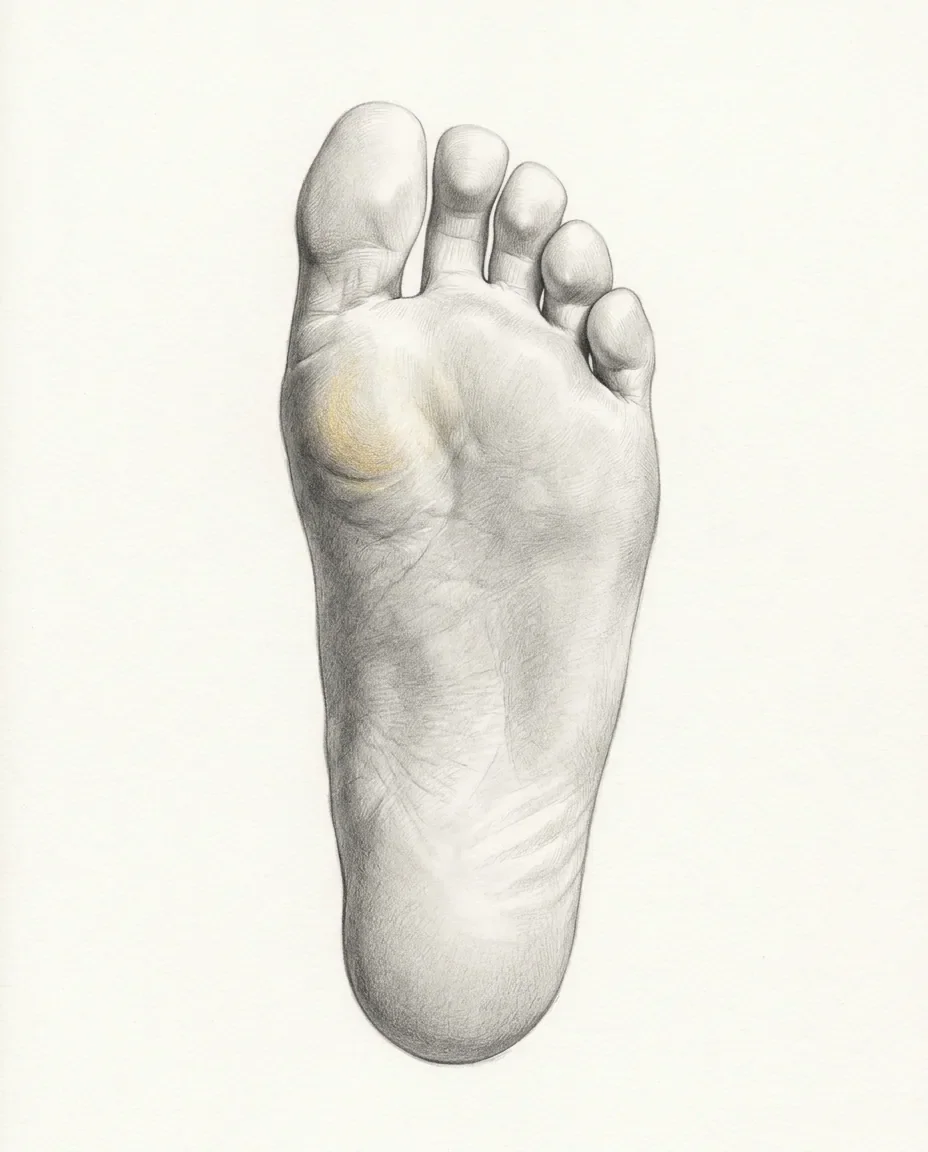
Sole fetishism is an erotic focus on the underside of the foot, the sole, and especially on its texture and softness. The wrinkles and flex-lines that appear when the foot bends are a particular draw. A narrower form of foot partialism tied to the popular "wrinkled soles" search term.
- Prevalence
- Common
- Category
- Body Parts & Partialism
- Domain
- Sexual interest · Paraphilia
- Confidence
- Low confidence
- Status
- A partialism within the foot-fetish spectrum; classified as a paraphilia only if it causes distress, impairment, or harm.
- Also known as
- soles fetish, wrinkled soles interest
- Added
- 27 Jun 2026
- Updated
- 22 Aug 2026
Featured in
Overview
Sole fetishism is an erotic interest concentrated on the underside of the foot, the sole (plantar surface), rather than the foot as a whole. Where general foot fetishism takes in the shape, toes, arch and grooming of the foot together, the sole-focused form narrows attention to the plantar surface itself: its texture, the soft creases and flex-lines that appear when the foot bends, and the contrast between smooth and wrinkled states. In online communities this is captured by the phrase "wrinkled soles," now a well-established niche term and search query. This article places the interest within the documented history of foot eroticism, the mechanisms proposed to explain it, and the prevalence data that exist.
Definition & scope
A partialism is an erotic focus on a specific non-genital body part. Sole partialism is a subset of foot partialism in which the plantar surface, rather than the foot in general, is the principal draw. Attraction commonly attaches to the wrinkles and flex-lines of the sole, its texture and softness, the arch seen from underneath, and the visual play of toes scrunching to deepen the creases. It overlaps heavily with related foot interests such as the arch fetish, the toe fetish, and the broader barefoot fetish, and it usually coexists with general foot appreciation rather than standing entirely apart from it. As with any partialism, it is an ordinary variation of interest, not a diagnosis, unless it causes the person distress or impairment.
Examples
What the term covers. Attention to the plantar surface itself: its texture and softness, the underside of the arch, and above all the creases and flex-lines that appear when the toes curl or the foot bends, the feature the community calls "wrinkled soles". It is expressed mostly by looking: photographs and video framed from below, a partner's soles resting in view, and gentle touch, massage or light tickling. Where it becomes an act rather than an aesthetic, the sole is the contact surface of a footjob and the object of sole licking within a foot worship dynamic.
What the term does not cover. Foot fetishism is the umbrella, and the neighbouring narrow foci divide the same foot between them: the arch is the instep seen from the side, the toes are the digits, and a barefoot interest is about the foot being unshod rather than about one surface of it. Foot odour is a scent interest, and a tickling interest is in the reaction rather than in the skin producing it. Trampling and crush interest use the sole as an instrument of pressure, which shares the anatomy and none of the motive. Interests in shoes, socks and shoeplay attach to what covers the sole rather than to the sole.
How the word is used. It is entirely vernacular. "Sole fetish" and "wrinkled soles" are community and search-engine vocabulary, coined by people describing what they like and adopted wholesale by content platforms; neither has any clinical standing. The formal umbrella is podophilia, treated as a partialism within fetishistic disorder in the DSM-5-TR, and no diagnostic manual singles out one surface of the foot.
History & origins
Clinical lineage
Foot-focused eroticism is among the oldest and best-documented partialisms in the sexological record, and the sole has no separate clinical history of its own: it is treated throughout as a feature of foot partialism. Richard von Krafft-Ebing gave foot and shoe fetishism extended attention in Psychopathia Sexualis (first published 1886), proposing that such interests form when a childhood experience "imprints" an erotic association that persists into adulthood. Havelock Ellis treated the eroticisation of the foot as a recurring theme in his Studies in the Psychology of Sex (Vol. II, 1936 edition), helping establish it as a legitimate object of inquiry.
The clinical word partialism, an erotic focus on a specific non-genital body part, entered the diagnostic vocabulary across the twentieth century. Under the DSM-5-TR it is treated within fetishistic disorder (a reclassification from the separate listing it held in DSM-IV) and warrants a diagnosis only when it causes significant distress, impairment, or harm; otherwise it is regarded as an ordinary variation of sexual interest. The sole-specific form has no separate coinage or dated nosological entry; the literature treats it simply as one focus within podophilia.
The cortical-adjacency hypothesis
One frequently cited neurological idea, popularised by neuroscientist V. S. Ramachandran in Phantoms in the Brain (1998), observes that on the brain's sensory homunculus the cortical map for the foot lies immediately next to the map for the genitals, and speculates that cross-activation between these regions could help explain why the foot so often acquires an erotic charge. Ramachandran drew the idea partly from patients who reported orgasmic sensation referred into a phantom foot after amputation. The hypothesis remains unproven: a later body-mapping survey rated feet low in erogenous intensity and found little clustering between adjacent sites, undercutting a simple homuncular account. It is best read as a suggestive but contested mechanism, not established fact.
Cultural evolution
The eroticisation of feet recurs across many cultures and historical periods, and in the internet era it has become one of the most visible and organised body-part interests online. Within that space the sole has acquired its own vocabulary: "wrinkled soles" functions today as a recognised content niche and search term, with content marketplaces reporting it among the faster-growing foot sub-interests through the mid-2020s. Filmmaker Quentin Tarantino is often cited for the recurrent foot imagery in his films, a frequently noted touchstone of the wider interest's mainstream presence.
In practice
Among consenting adults, expression commonly includes:
- Looking at and gently touching the soles, bare or freshly washed.
- Appreciation of the creases and flex-lines that appear when toes scrunch or the foot arches (the "wrinkled soles" aesthetic).
- Massage or light tickling of the plantar surface.
- Photography or collection of imagery focused specifically on the underside of the foot.
The soles and arches are also the contact surface in a footjob, the most common way a foot interest is expressed as a physical act rather than a visual one.
Like most partialisms, it is usually woven into ordinary intimacy as a preference rather than functioning as a precondition for arousal.
Psychology
What causes it?
There is no settled answer. Alongside the contested cortical-adjacency hypothesis, mainstream accounts emphasise associative learning: an early or memorable pairing of feet with sexual arousal that is later reinforced. Krafft-Ebing's original "imprinting" intuition prefigures these conditioning-based models, and the long-standing cultural eroticisation of feet across many societies supplies ready material for such learning. The sole's particular appeal is often described in terms of texture and visual detail, the wrinkles reading as an intimate feature of the body rarely on display. For the great majority of people the interest works as an aesthetic preference rather than a compulsion, and the evidence base for any single causal mechanism stays thin and debated.
Prevalence & culture
How common is it?
Feet are, by a wide margin, the most common body-part fetish, and the sole is a slice of that. In the large internet survey by Scorolli and colleagues (2007), which analysed 381 fetish discussion groups with roughly 5,000 participants and was published in the International Journal of Impotence Research, feet (podophilia) accounted for about 47% of body-part-focused preferences, the single largest category, with footwear adding a large share of object-related interest. The Scorolli table is widely reproduced, including on Wikipedia's sexual fetishism article. The sole-specific subset is a smaller portion of that total, but it is supported by large, active online communities; "wrinkled soles" in particular has emerged as a distinct, growing niche even though dedicated sole-only research does not exist. The popularity figures in this entry are therefore calibrated to foot-fetish data and scaled down accordingly.
Safety, consent & law
Between consenting adults, sole partialism is a benign variation of sexual interest with no inherent legal concern. The only practical considerations are ordinary foot hygiene and the same clear, explicit consent that any intimate activity requires. Because so much of this interest is visual and image-driven, one boundary is worth stating plainly: photographing or filming a stranger's feet without their agreement is covered by nobody's consent, and many jurisdictions treat covert photography as an offence in its own right.
Common questions
What does "wrinkled soles" mean?
It refers to the creases and flex-lines that appear across the underside of the foot when the toes curl or the foot arches, and it is the most recognisable term in this niche. The phrase originated in online foot communities rather than in any reference work, and now functions as a content tag and a search query as much as a description. Smooth and wrinkled states are often treated as distinct preferences.
What is the difference between a sole fetish and a foot fetish?
Scope. Foot fetishism takes in the whole foot (shape, toes, arch, grooming, sometimes scent) while a sole interest narrows to the plantar surface and its texture. The narrower form almost always sits inside the broader one rather than replacing it, and most people with a sole preference would describe themselves as having a foot fetish if asked a general question.
Is a sole fetish the same as podophilia?
Podophilia is the clinical umbrella for foot-focused attraction generally; a sole interest is one focus within it, and the sexological literature has never given that focus a separate name. The absence is not a judgement about how common it is. It reflects how the research was done (surveys asked about feet, not about which part of the foot), so the finer distinctions people draw among themselves were never measured.
Does having a sole fetish mean wanting to lick or kiss feet?
No. For a large share of people the interest is entirely visual and involves no contact at all. Oral attention to the sole has its own name, sole licking, and belongs to the practice of foot worship, which is a dynamic of reverence rather than an attraction. Someone can find soles compelling and have no wish to go anywhere near one.
Is ticklishness connected to a sole fetish?
They are separate interests that share a piece of anatomy. The sole is among the most nerve-dense areas of the body, which is why it is both ticklish and highly responsive to touch, and light tickling does feature in sole play. But a tickling fetish is organised around the reaction (the laughter, the squirming, the loss of composure), while a sole interest is organised around the surface. Many people with one have no interest in the other.
When does a sole fetish become a clinical concern?
Only when it causes the person marked distress or impairment, or involves someone who has not agreed. That is the same threshold DSM-5-TR applies to every partialism under fetishistic disorder, and the great majority of people with the interest never come near it. An aesthetic preference, however specific, is not a diagnosis.
From the blog
- Foot Fetish83/100Podophilia · Body Parts & PartialismA focused erotic interest in feet (their shape, soles, toes, arches, or grooming) as a primary source of attraction. Within partialism (erotic focus on a non-genital body part) it is the example people report most, by a wide margin.83
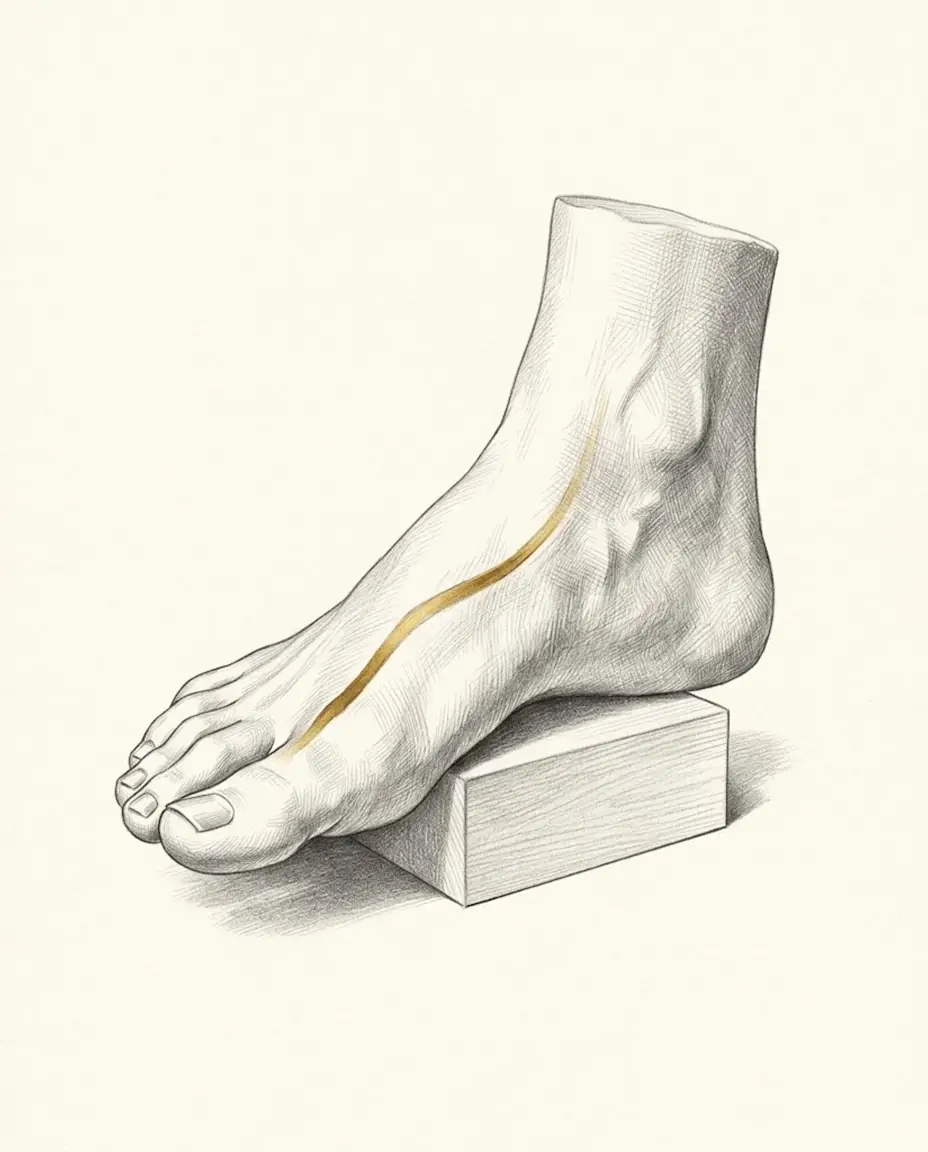
- Arch Fetish47/100Body Parts & PartialismAn erotic focus on the curved instep or arch of the foot, often with a preference for high arches. A narrower expression of foot partialism that overlaps closely with sole and general foot interest.47
- Toe Fetish56/100Toe Partialism · Body Parts & PartialismA focused erotic interest specifically in the toes: a narrower subset of foot partialism. The toes' shape, length, arrangement, adornment such as painted nails or toe rings, or related contact are a primary source of attraction.56
- Barefoot Fetish57/100Body Parts & PartialismAn erotic interest focused specifically on bare, unshod feet rather than feet in shoes or hosiery. A narrower expression of foot partialism, it centres on naked soles and toes, the contrast between clean and dirty feet, and the sight of bare feet in everyday or public settings.57
- Leg Fetish53/100Crurophilia · Body Parts & PartialismCrurophilia is a partialism in which the legs are the primary focus of sexual attraction. Interest may center on a leg's shape, length, line, or musculature, or on the way legs are framed by clothing such as stockings, skirts, or heels.53
- Hair Fetish52/100Trichophilia · Body Parts & PartialismA focused erotic interest in hair, most often scalp hair, attaching to its length, thickness, texture, colour or styling. It sometimes attaches to acts such as brushing, growing or cutting. Clinically termed trichophilia, it is a recognized but moderately uncommon partialism.52
"Sole" (the underside of the foot) descends from Latin solea, 'sandal, bottom of the foot', via Old French. "Sole fetish" is a plain-English descriptive compound, not a clinical coinage; the clinical umbrella is podophilia (Greek pous/podos, 'foot', + -philia, 'love').
lower body · extremities · subset of foot partialism
Prevalence is computed from the entry's cited population estimate. Rows marked ESTare indicative editorial estimates scored against a fixed anchor rubric, not measured quantities. Method & anchors: methodology.
Common · ≈ 1 in 20
- 01Scorolli et al. (2007), Relative prevalence of different fetishes, Int. J. Impotence Research 19(4):432-437prevalence anchor (feet = 47% of body-part fetishes, the most common partialism; soles are a narrower subset)
- 02Sexual fetishism, Wikipedia (carries the Scorolli 2007 relative-frequency table)carries the Scorolli relative-frequency table placing feet at the top of body-part fetishes
- 03Foot fetishism, Wikipediahistory of foot/shoe fetishism (Krafft-Ebing 1886 imprinting, Havelock Ellis 1936), the Ramachandran cortical-adjacency hypothesis and later body-mapping survey undermining it, and the Tarantino cultural reference
- 04Partialism, Wikipediadefinition of partialism as an erotic focus on a non-genital body part and its DSM-5-TR treatment within fetishistic disorder (diagnosed only when it causes distress, impairment, or harm)
- 05Relative prevalence of different fetishes, International Journal of Impotence Research (Scorolli et al. 2007, publisher landing page)publisher landing page for the Scorolli 2007 study reporting feet as ~47% of body-part fetishes across 381 discussion groups
- 06Phantoms in the Brain, V. S. Ramachandran (1998)the cortical-adjacency hypothesis (foot and genital maps neighbouring on the sensory homunculus; phantom-foot orgasm cases) proposed as a possible mechanism for foot eroticism