Footjob
Added 27 Jun 2026 · Updated 6 Sep 2026
A non-penetrative, partnered sexual practice in which one person stimulates a partner using the feet, soles, or toes. It is an act within foot fetishism, distinct from the attraction itself, and benign between consenting adults.
- Prevalence
- Common
- Category
- Acts & Activities
- Domain
- Sexual interest
- Confidence
- Low confidence
- Status
- A consensual partnered activity. Neither diagnostic manual lists it as a paraphilia, and the underlying foot interest counts as a common variation.
- Also known as
- foot job, pedal stimulation, foot stimulation, manual foot stimulation, feet job
- Added
- 27 Jun 2026
- Updated
- 6 Sep 2026
Featured in
Overview
A footjob is a non-penetrative, partnered sexual practice in which one person uses the feet, soles, or toes to stimulate a partner's genitals or body. It is an act. A foot fetish names a standing erotic interest in feet; a footjob is one of the practices that interest, or plain curiosity, produces. The act itself may involve one or both feet, stroking or pressing with the arches and soles, or the toes, and it sits beside related expressions such as foot worship and an aesthetic focus on the sole.
Definition & scope
A footjob targets a partner's penis in most accounts, and Wikipedia's account also records stimulation directed at a partner's vulva or anus. It can be one-sided or mutual. Many people who perform or receive footjobs have a foot fetish, and a footjob can also be a one-off experiment, a playful variation, or an act of service within a foot-worship dynamic. The feet as the instrument of stimulation define it, and nothing else does.
Examples
What the term covers. A partner using the soles and arches to stimulate another; the same act performed with the toes; the mutual form, in which both partners use their feet at once; and the act as one part of a longer foot worship scene. In each case the feet do the stimulating. The motivation, the setting and the level of ceremony around it all vary.
What the term does not cover. A foot massage becomes a footjob only when it is directed at sexual stimulation; intent draws the line, and technique does not. The attraction itself is a different object: someone with a foot fetish who has never given or received one still has the fetish. A toejob is the narrower case, in which the toes rather than the soles do the work, and foot fisting shares only the body part: it is a penetrative, high-risk practice that belongs with fisting. Toe sucking, sole licking and an interest in shoes or stockings are adjacent foot practices people confuse with it, and trampling applies pressure with the feet as a power-exchange act, which shares the body part and none of the purpose.
How the word is used. It is vernacular. "Footjob" and the two-word "foot job" appear interchangeably in everyday speech, in adult-media category labels, and in the survey literature only when quoting participants; neither form appears in DSM-5-TR or ICD-11. A sentence such as "they were curious about a footjob but had no particular interest in feet" is idiomatic because the act does not presuppose the fetish, which is the misunderstanding people bring to the term most often.
History & origins
A colloquial coinage
The foot fetish entered the clinical record in the nineteenth century. The footjob never did. The word is a plain-English compound formed on the productive "-job" pattern shared with other body-part acts, and it emerged in late-twentieth-century English-language adult slang and erotica. No Greek or Latin clinical synonym exists and no dated coinage is on record: general references such as Wikipedia catalogue it, and the diagnostic manuals leave it out.
Within the longer history of foot eroticism
The practice inherits a long lineage of foot-focused eroticism. Foot reverence appears across antiquity and many cultures, and the medical study of foot fetishism begins with Richard von Krafft-Ebing's Psychopathia Sexualis (1886), which catalogued foot-focused fixations and framed them as childhood erotic associations, and continues through Havelock Ellis (Studies in the Psychology of Sex, 1936). Foot-to-body stimulation was being drawn long before it was named: an erotic illustration attributed to the Swiss artist André Lambert, dated to around 1917, depicts a mutual footjob. The modern internet supplied the name, the catalogue and the audience.
In practice
Among consenting adults the practice is non-penetrative and varied. Common forms include:
- stroking or pressing a partner with the soles and arches of one or both feet;
- using the toes for finer contact, sometimes alongside massage;
- a mutual form, in which both partners use their feet at once;
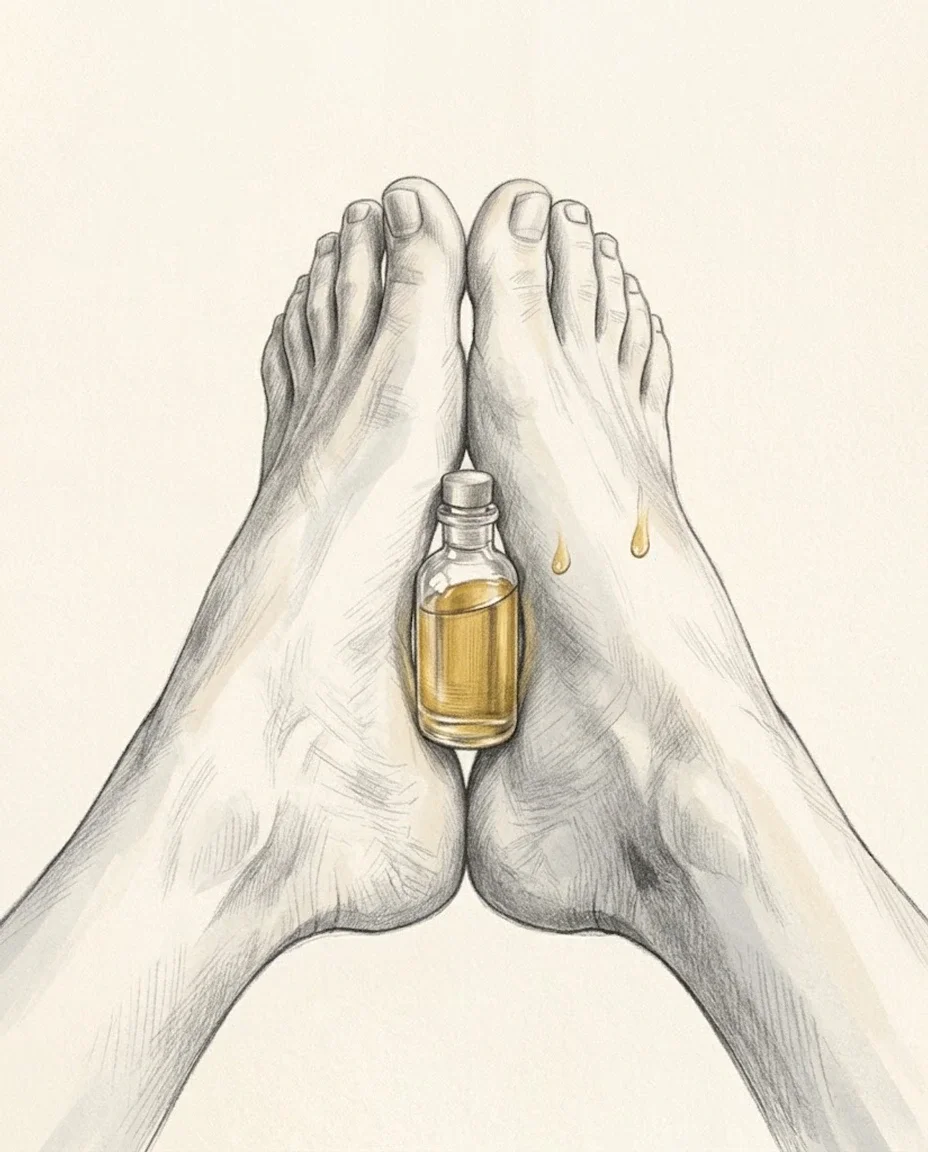
- the optional use of a skin-safe lubricant or oil to reduce friction.
It overlaps with broader foot worship and with the grooming and adornment many people associate with feet. Because it is non-penetrative, some people treat it as a lower-risk form of intimacy.
Psychology
The motivations behind a footjob mirror those of foot interest generally. Some people try it as a novel, playful or sensual variation within an existing relationship and give it no special weight. Others choose it as the expression of a foot fetish, the best-documented partialism (an erotic focus on a non-genital body part). Mainstream accounts of why feet attract such interest lean on associative-learning models, in which a body part repeatedly paired with arousal becomes arousing in its own right, and on the long cultural eroticisation of feet. A neurological conjecture that V. S. Ramachandran popularised notes that the foot and genital maps lie adjacent on the brain's sensory homunculus; the cross-wiring idea remains contested and unproven. For most people, giving or receiving a footjob is an ordinary preference.
How common is a foot interest?
Feet are the most reported body-part fetish. In the large online-community analysis by Scorolli and colleagues (2007), which examined 381 discussion groups covering an estimated 5,000-plus people, feet accounted for about 47% of body-part fetishes, by a wide margin the largest single category. The survey record measures that interest, and it does not measure the act.
Prevalence & culture
No survey measures footjob practice directly, so this entry anchors its prevalence to the well-studied foot interest it expresses. In the general population the figure is smaller than the community data suggests and depends on how the question is framed: Justin Lehmiller's Tell Me What You Want (2018) survey of more than 4,000 Americans found roughly 1 in 7 (about 14%) had fantasised about feet. Within that interested minority the act is common and far from universal, which places the share of adults who have given or received one in the low single digits, the basis for this entry's estimate. Footjobs are among the more visible foot practices online: "footjob" and "foot worship" recur near the top of foot-related search demand, in line with the large dedicated communities around feet the Scorolli data captured.
Safety, consent & law
Between consenting adults a footjob is a benign variation with no legal dimension of its own. Neither DSM-5-TR nor ICD-11 mentions it; an underlying interest becomes a clinical matter only when it causes distress or impairment or involves a non-consenting person. The routine practical considerations are ordinary foot hygiene (clean, well-groomed feet, attention to small cuts or infections, and a skin-safe lubricant if one is used) and the clear, explicit consent any intimate activity requires.
Common questions
Is a footjob considered sex?
It depends on whose definition you use, and no single one is authoritative. A footjob is non-penetrative, so it falls outside the narrow definition of sex as intercourse, and it is a partnered sexual act by any wider one. Surveys that ask about "sex" and surveys that ask about "sexual activity" return different answers for the same behaviour.
Do you need a foot fetish to give or receive a footjob?
No. The act and the attraction are separate. Many people who give or receive one have a foot fetish, and plenty do it out of curiosity, as a variation, or because a partner enjoys it. The reverse also holds: someone can have a lifelong foot fetish and never do this specific thing.
What is the difference between a footjob and foot worship?
A footjob names a physical act: the feet used to stimulate a partner. Foot worship names a dynamic of reverence directed at someone's feet, which may involve kissing, massage, licking or attention alone. The two overlap often. One is a technique and the other an attitude, and either occurs without the other.
How common are footjobs?
No survey measures the act directly. The interest behind it is well documented: Lehmiller's 2018 survey of over 4,000 Americans found roughly one in seven had fantasised about feet, and Scorolli et al. (2007) found feet account for about 47% of body-part fetishes. The act itself is estimated in the low single digits of adults.
Are there any health risks to a footjob?
Few, and they are ordinary. Skin-to-skin genital contact can transmit infections such as HPV or herpes, so the risk is lower than intercourse and above zero. The practical concerns are hygiene and skin integrity: clean, well-groomed feet, care around cuts, calluses or fungal infection, and a skin-safe lubricant if friction is an issue.
Where does the word "footjob" come from?
It is a plain-English compound built on the same productive "-job" pattern as other body-part act names, and it surfaced in late-twentieth-century English adult slang. No medical text records it. There is no Greek or Latin clinical synonym, because nobody catalogued the act clinically; the clinicians catalogued the underlying foot interest and stopped there.
Is a footjob a paraphilia or a disorder?
No. It is a consensual act between adults and appears in neither DSM-5-TR nor ICD-11. An underlying foot interest becomes clinically relevant only if it causes the person distress or impairment, or involves someone who has not consented, the same threshold this catalog applies to every interest.
Why are feet such a common fetish in the first place?
Two explanations dominate, and neither is settled. Associative learning holds that a body part repeatedly paired with arousal becomes arousing itself. A neurological conjecture popularised by V. S. Ramachandran notes that foot and genital regions sit adjacent on the brain's sensory map, an appealing idea that remains contested and unproven. Cultural eroticisation of feet long predates both.
From the blog
- Foot Fetish83/100Podophilia · Body Parts & PartialismA focused erotic interest in feet (their shape, soles, toes, arches, or grooming) as a primary source of attraction. Within partialism (erotic focus on a non-genital body part) it is the example people report most, by a wide margin.83
- Foot Worship55/100Power, Roles & ScenariosThe submissive, reverent practice of kissing, massaging, caressing or venerating a partner's feet, usually inside a dominance-and-submission dynamic. It names an activity and a ritual of devotion rather than the underlying attraction, which is the foot fetish.55
- Sole Fetish53/100Body Parts & PartialismSole fetishism is an erotic focus on the underside of the foot, the sole, and especially on its texture and softness. The wrinkles and flex-lines that appear when the foot bends are a particular draw. A narrower form of foot partialism tied to the popular "wrinkled soles" search term.53
- Toejob34/100Acts & ActivitiesA non-penetrative sexual act in which the toes, rather than the soles or arches, stimulate a partner. It is the toe-focused form of the footjob and a common expression of foot interest, benign between consenting adults.34
- Breeding Kink / Impregnation Fetish54/100Impregnation fetishism · Acts & ActivitiesA pattern of sexual arousal centered on the idea, act, or imagined risk of impregnation, getting someone pregnant or being impregnated. It is usually fantasy or role-play rather than an actual wish to conceive.54
- Double Penetration54/100Acts & ActivitiesDouble penetration is the simultaneous penetration of one receptive partner by two penetrating partners, or by a partner and a sex toy. It is a consensual group sexual act, not a paraphilia.54
A plain-English compound of "foot" plus the productive erotic "-job" suffix (as in "hand job"), describing stimulation performed with the feet. It is late-20th-century vernacular with no classical or clinical derivation.
foot play · non-penetrative · foot-fetish practice
Prevalence is computed from the entry's cited population estimate. Rows marked ESTare indicative editorial estimates scored against a fixed anchor rubric, not measured quantities. Method & anchors: methodology.
Common · ≈ 1 in 20
- 01Footjob, Wikipediadefinition of footjob as a non-penetrative practice using the feet/toes to stimulate a partner; colloquial late-20th-century coinage; the c.1917 André Lambert erotic illustration depicting a mutual footjob; variations (one/both feet, mutual, lubricated)
- 02Scorolli et al. (2007), Relative prevalence of different fetishes, Int. J. Impotence Research 19(4):432-437prevalence anchor (feet = 47% of body-part fetishes, the most common partialism the footjob expresses)
- 03Scorolli et al. (2007), Relative prevalence of different fetishes, Nature / Int. J. Impotence Research (full article landing)study method (381 discussion groups, ~5,000+ people) and the finding that feet account for ~47% of body-part fetishes
- 04Sexual fetishism, Wikipedia (carries the Scorolli 2007 relative-frequency table)carries the Scorolli relative-frequency table showing the large dedicated communities around feet
- 05Lehmiller (2018), Tell Me What You Want, survey of ~4,175 Americans (figures as summarised on the Foot fetishism Wikipedia article)general-population foot interest figure (~1 in 7, ~14%) used to anchor footjob prevalence; Krafft-Ebing 1886, Havelock Ellis 1936, and the contested Ramachandran cortical-adjacency hypothesis
- 06Krafft-Ebing, Psychopathia Sexualis (1886), Wikipedia1886 foundational cataloguing of foot-focused fetishism within the longer history of foot eroticism
- 07DSM-5-TR, Paraphilic Disorders (American Psychiatric Association, 2022)the footjob is not itself a paraphilic disorder; an underlying interest warrants attention only with distress, impairment, or non-consent
- 08ICD-11, Paraphilic disorders (World Health Organization)a foot-focused interest is a disorder only with distress, impairment, or non-consent