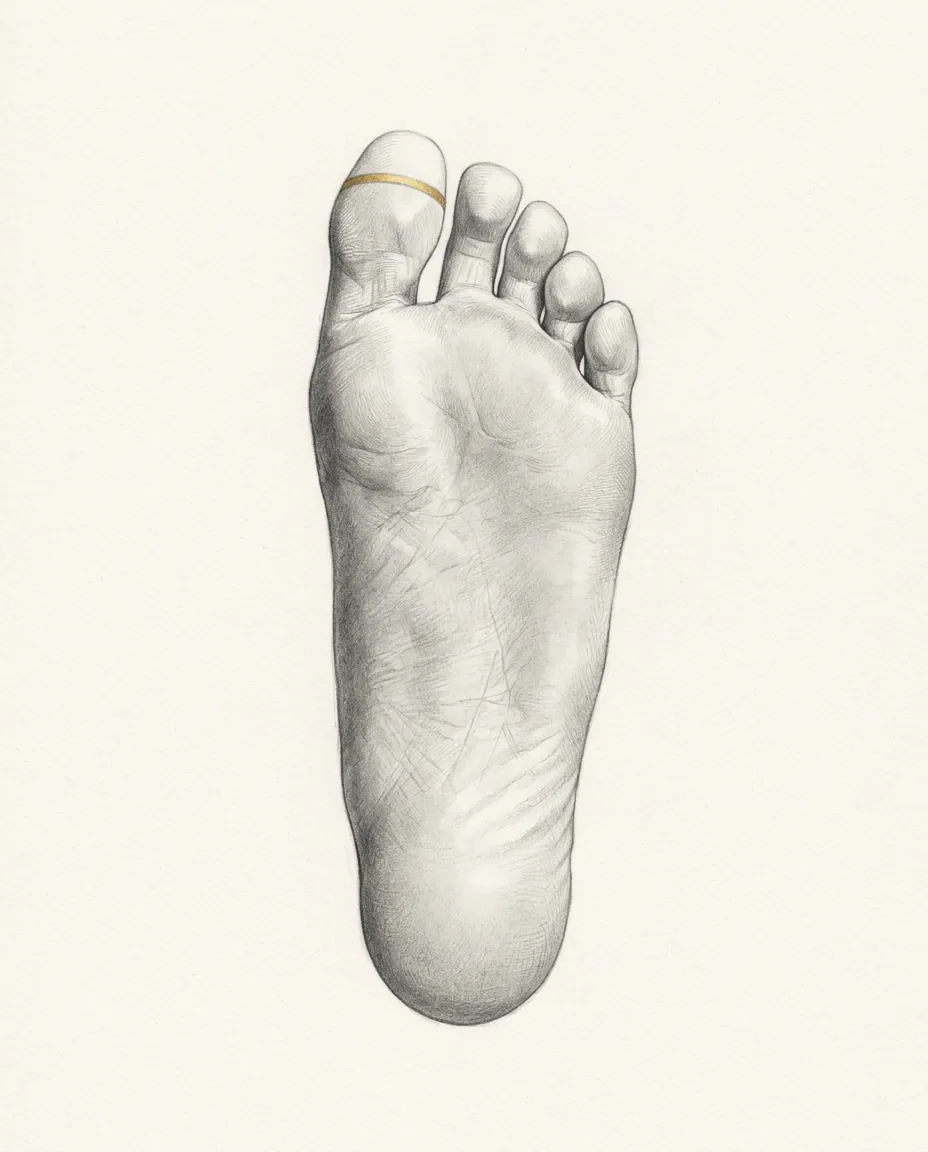
Sole Licking
Added 27 Jun 2026 · Updated 22 Aug 2026
The consensual oral worship of the sole of the foot, treated as a specific act within the broader practice of foot worship. It covers licking, kissing and mouthing the underside. It is one expression of foot fetishism rather than a distinct clinical diagnosis.
- Prevalence
- Uncommon
- Category
- Acts & Activities
- Domain
- Sexual interest
- Confidence
- Low confidence
- Status
- A consensual act within the foot-worship spectrum, not a distinct diagnosis; only the underlying foot interest could be a paraphilia, and then only if it causes distress, impairment, or non-consent.
- Also known as
- foot licking, sole worship (oral)
- Added
- 27 Jun 2026
- Updated
- 22 Aug 2026
Featured in
Overview
Sole licking is the consensual act of using the mouth and tongue on the underside of a partner's foot, tracing the arch, the ball, and the heel, as a focused form of oral foot worship. It is best understood not as a separate condition but as one specific behaviour within the much broader field of foot eroticism. Where foot worship names the wider devotional practice and the sole fetish names an attraction to the underside of the foot in particular, sole licking is the act itself. This article sets out what the behaviour involves, traces its roots in the documented history of foot eroticism, summarises the proposed psychology, and reviews the limited prevalence data and the practical questions of hygiene, consent, and law.
Definition & scope
Sole licking sits at the intersection of partialism (an erotic focus on a non-genital body part) and oral contact. Participants may be drawn to the texture, contour, warmth, or scent of the sole, and the act often carries an added charge of intimacy or symbolic submission. It overlaps with related foot-focused behaviours such as toe sucking and with the general spectrum of foot fetish interest, but is distinguished by its specific focus on the plantar surface, the sole, rather than the toes, arch shape, or footwear.
Is sole licking a fetish?
Not on its own. Sole licking is an act, not a diagnosis. It becomes relevant to the clinical idea of a fetish only when it expresses an underlying foot interest, and even then a foot interest is classed as a disorder only when it causes marked distress, impairment, or involves a non-consenting person. As a consensual behaviour between adults it is a normal-range variation, not a pathology.
Examples
What the term covers. Oral attention paid to the plantar surface itself (the arch, the ball, the heel), whether as one moment inside a longer foot worship session or as the focus of an entire encounter. It appears in two fairly different frames. In one it is sensual, affectionate contact between partners who simply like feet. In the other it is a gesture of deference inside a foot domination dynamic, where kneeling and using the mouth is what carries the meaning, and the sensation matters far less than the posture.
What the term does not cover. Toe sucking is the adjacent oral act, aimed at the toes rather than the underside of the foot; the two are routinely confused because both are oral. A sole fetish is the attraction to the underside of the foot, which plenty of people have without ever wanting oral contact, and a foot odor fetish turns on scent rather than touch. A footjob runs the other way, with the foot doing the stimulating. Trampling uses the foot as an instrument of weight and pressure: the same body part, an unrelated appeal.
How the word is used. Plain descriptive English, current in kink communities and adult-media labelling rather than in any clinical text. There is no Greek-derived coinage for it, because sexology named the interest and never the act: podophilia and partialism describe the underlying attraction, and neither DSM-5-TR nor ICD-11 mentions this or any other specific foot practice.
History & origins
Sole licking has no separate clinical coinage or dated discovery. Its history is the history of foot eroticism, of which oral worship of the foot is a recurring strand. Reverence for and eroticisation of the foot long predate any medical vocabulary. Ancient Greek erotic verse attributed to Philostratus includes poems addressed To a Barefoot Woman and To a Barefoot Boy, and the Hindu Skanda Purana contains a passage in which the god Brahma is captivated by the sight of Parvati's feet.
The most heavily documented cultural instance is the Chinese practice of foot binding, which from roughly the tenth century onward made the bound "lotus foot" an explicitly eroticised object. Historical accounts of that culture describe admirers engaged in licking the soles, sucking the toes, and smelling the foot odour of bound feet, an early and specific record of oral foot worship as a sexual practice. Sigmund Freud later cited Chinese foot binding as a society-wide case of foot fetishism.
The interest entered the clinical literature with nineteenth-century sexology. Richard von Krafft-Ebing's Psychopathia Sexualis, first published in 1886, catalogued foot-focused fetishism and framed such fixations as imprinted in childhood through accidental erotic association. It is the same work that coined sadism and masochism. Across the twentieth century the clinical reading shifted from a Victorian sign of pathology toward a common, benign variation, codified in the modern DSM-5-TR and ICD-11, under which a fetishistic interest counts as a disorder only when it causes marked distress, impairment, or involves a non-consenting person. Sole licking, as a consensual act, is not pathologised in any nosology.
In practice
Among consenting adults, sole licking is typically woven into broader intimacy or into a power-exchange dynamic. Common expressions include:
- Licking and kissing the arch, ball, and heel of a freshly washed foot.
- Combining oral attention to the sole with massage, holding, or worship of the whole foot.
- Pairing the act with a consensual dominant/submissive frame, where worshipping the sole carries symbolic meaning.
- Overlap with adjacent acts such as toe sucking and general foot massage.
The behaviour is reported across sexual orientations and gender groups, though, like most foot-focused interests, it is documented most often in men.
Psychology
No single mechanism is established. Mainstream accounts lean on learning and early-association models: a body part repeatedly paired with arousal can, through conditioning, become a focus of arousal in its own right. A frequently cited neurological idea, popularised by neuroscientist V. S. Ramachandran, observes that the cortical map for the foot lies adjacent to that for the genitals in the brain's sensory homunculus, and speculates that cross-activation could help explain foot eroticism. The hypothesis is elegant but contested and unproven. Survey work has also found that licking and smelling foot odour were rated as arousing because of their perceived intimacy, pointing to the symbolic closeness of the act, rather than any single brain mechanism, as part of its appeal.
Prevalence & culture
There is no dedicated prevalence research for sole licking specifically; figures are inferred from foot-fetish data and scaled down. Feet are by a wide margin the most common body-part fetish. In the large internet-group survey by Scorolli and colleagues (2007), published in the International Journal of Impotence Research and covering at least 5,000 participants across 381 online groups, body parts and features made up 33% of fetish interest, and within that group feet (podophilia) accounted for about 47%, far ahead of body fluids (9%), body size (9%), and hair (7%). In the general population, the survey behind Justin Lehmiller's Tell Me What You Want found that roughly one in seven respondents reported a foot-related sexual interest. Sole licking is one narrow act drawn from that pool, so its own prevalence is far smaller. The act is well represented in adult media and foot-focused online communities, even though academic attention to the specific behaviour is sparse.
Safety, consent & law
Between consenting adults, sole licking is a benign activity with no inherent legal concern, but it is oral contact with skin that routinely touches floors and footwear, so hygiene matters. Practical precautions include washing the feet thoroughly beforehand, keeping toenails clean and smooth, and inspecting for cuts, open sores, warts, athlete's foot, or other fungal or bacterial infections, any of which can be passed through oral contact or aggravated by it. A partner with a cold sore, mouth infection, or broken skin should pause until it resolves. As with any intimate activity, clear and explicit consent is required, and as a non-disordered, consensual act sole licking carries no specific legal restriction beyond the ordinary norms of consent and privacy.
Common questions
Is licking someone's feet safe?
Generally yes, with ordinary precautions, because the risk is hygiene rather than anything intrinsic. Feet touch floors, shoes and shared surfaces, so the usual advice is a thorough wash beforehand and a look for cuts, cracked skin, warts or fungal infection such as athlete's foot, any of which can be spread or aggravated by oral contact. The person doing the licking should also skip it while they have a cold sore, mouth ulcer or broken skin.
What is the difference between sole licking and foot worship?
Sole licking is a specific act; foot worship is the wider devotional practice it can belong to. Worship covers kissing, massage, holding, cleaning and simple reverent attention, and often carries a submissive framing. Licking the sole is one of the things that can happen inside that, and it can also happen entirely outside it, between partners who attach no ceremony to feet at all.
Why the sole specifically rather than the toes?
For most people who have a preference, it is a matter of surface. The sole offers a large, smooth, warm expanse with a distinctive texture and the flex-lines that appear when the foot arches, which is what a sole fetish settles on. The toes present something different (separate, mobile, individually attended to), which is why toe sucking is treated as its own act rather than a variation on this one.
Why is sole licking so often framed as submission?
Because of where it puts the body. The foot is the lowest part of a standing person, so reaching it with the mouth means kneeling or lying beneath someone, and the posture reads as deference in most cultures long before anything erotic is attached to it. That symbolism is what a foot domination dynamic makes use of. It is not obligatory: the act is just as often affectionate and carries no hierarchy at all.
How common is sole licking?
Nobody has measured it directly. The interest it belongs to is well documented: in the online-community survey by Scorolli and colleagues (2007), feet accounted for about 47% of body-part fetishes, and the survey behind Justin Lehmiller's Tell Me What You Want found roughly one in seven respondents reporting a foot-related sexual interest. Sole licking is one narrow act drawn from that pool, so its own prevalence is considerably smaller.
How do I bring this up with a partner?
Plainly, outside the bedroom, and framed as a preference rather than a demand. It helps to name the specific thing you are curious about instead of the general category, to say whether you want to give or receive, and to make it easy to decline. Feet carry a lot of self-consciousness about appearance and smell, so agreeing that either of you can stop without explanation removes most of the awkwardness.
- Foot Worship55/100Power, Roles & ScenariosThe submissive, reverent practice of kissing, massaging, caressing or venerating a partner's feet, usually inside a dominance-and-submission dynamic. It names an activity and a ritual of devotion rather than the underlying attraction, which is the foot fetish.55
- Sole Fetish53/100Body Parts & PartialismSole fetishism is an erotic focus on the underside of the foot, the sole, and especially on its texture and softness. The wrinkles and flex-lines that appear when the foot bends are a particular draw. A narrower form of foot partialism tied to the popular "wrinkled soles" search term.53
- Toe Sucking55/100Acts & ActivitiesOral stimulation of the toes (licking, kissing, or sucking them) for erotic pleasure. A defining foot-focused act within the broader practice of foot worship, popularly nicknamed "shrimping" and given lasting cultural visibility by a 1992 royal tabloid episode.55
- Foot Fetish83/100Podophilia · Body Parts & PartialismA focused erotic interest in feet (their shape, soles, toes, arches, or grooming) as a primary source of attraction. Within partialism (erotic focus on a non-genital body part) it is the example people report most, by a wide margin.83
- Edgeplay44/100Acts & ActivitiesThe community's umbrella term for BDSM practices whose risk cannot be negotiated away: breath play, blades, fire, blood, consensual non-consent. It is defined by where a practice sits on the risk spectrum rather than by what is done, which is why the label shifts between communities and over time.44
- Recording Fetish44/100Acts & ActivitiesAn interest in photographing or recording one's own consensual sexual activity, where capturing the moment and later viewing the imagery is itself arousing. It is benign when every adult depicted consents and the material is kept private.44
Both words are plain English: "sole" (the underside of the foot, from Latin solea via Old English) and "licking" (Old English liccian). "Sole licking" is a descriptive compound naming the act, not a clinical coinage.
oral · foot worship · subset of foot fetishism
Prevalence is computed from the entry's cited population estimate. Rows marked ESTare indicative editorial estimates scored against a fixed anchor rubric, not measured quantities. Method & anchors: methodology.
Uncommon · ≈ 1 in 100
- 01Scorolli et al. (2007), Relative prevalence of different fetishes, Int. J. Impotence Research 19(4):432-437prevalence anchor (feet = 47% of body-part fetishes; sole licking is a narrower act scaled down from this)
- 02Foot fetishism, Wikipediahistory of foot eroticism (Philostratus, Skanda Purana, Chinese foot binding with licking the soles/sucking toes/smelling odour, Freud), the Ramachandran cortical-adjacency hypothesis, the survey finding that licking and smelling foot odour rated arousing for perceived intimacy, and the Lehmiller ~14% general-population figure
- 03Krafft-Ebing, Psychopathia Sexualis (1886), Wikipedia1886 foundational text cataloguing foot-focused fetishism and framing fixations as childhood erotic association
- 04DSM-5-TR, Paraphilic Disorders (American Psychiatric Association, 2022)fetishistic interest is a disorder only with distress, impairment, or non-consent
- 05ICD-11, Paraphilic disorders (World Health Organization)fetishistic interest is a disorder only with distress, impairment, or non-consent