Hand Fetish
Quirofilia
Added 21 Jun 2026 · Updated 22 Aug 2026
A focused erotic interest in hands: their shape, fingers, nails, veins, or expressive gestures. A recognised partialism, less common than foot interest but consistently reported alongside it.
- Prevalence
- Common
- Category
- Body Parts & Partialism
- Clinical term
- Quirofilia
- Domain
- Sexual interest · Paraphilia
- Confidence
- Medium confidence
- Status
- Partialism; benign variation, not a disorder unless it causes distress, impairment, or non-consent.
- Also known as
- cheirophilia, quirofilia, chirophilia, hand partialism
- Added
- 21 Jun 2026
- Updated
- 22 Aug 2026
Overview
Hand fetishism, sometimes called cheirophilia or quirofilia, is a sexual interest in which the hands become a primary focus of attraction. As a partialism, arousal centred on a non-genital body part, it may attach to overall hand shape, to slender or strong fingers, to well-kept or adorned nails, to veins and knuckles, or to the expressive way hands move and gesture. Because hands are on display in nearly every social interaction, many people experience this as a strong aesthetic preference rather than a sharply bounded fetish. This article traces how the clinical category of partialism formed, how hand interest is expressed, the mechanisms proposed to explain it, and how common it is relative to other body-part interests.
Definition & scope
Hand interest is a partialism: the erotic focus is a specific body part rather than the whole person or an inanimate object. It differs from a glove or jewellery fetish, where the charge lives in the worn item, though the two often overlap. It is not, in itself, a paraphilic disorder. Modern nosology treats a consensual, non-distressing feature preference as a normal variant, reserving diagnosis for cases involving significant distress, impairment, or a non-consenting person.
Examples
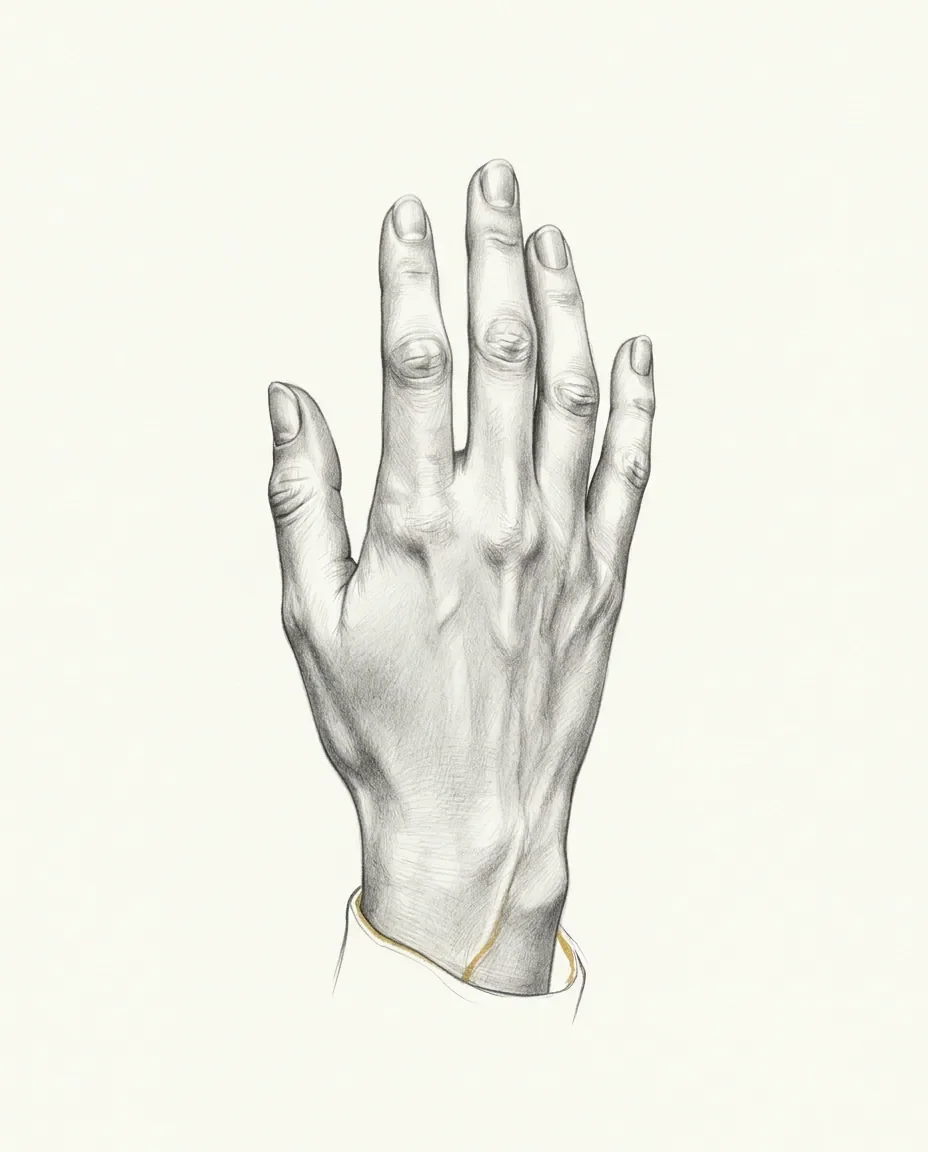
What the term covers. Attention drawn to the shape and proportion of a hand (long fingers, prominent knuckles, visible tendons and veins); to nails, short and well-kept or long, shaped and painted, an emphasis narrow enough to be catalogued separately as nail fetishism; to what hands do, from a gesture to the way someone holds a pen or plays an instrument; and to the wrists and forearms above them, catalogued here separately. Most people who report it describe a persistent aesthetic pull rather than any bounded activity: there is no characteristic scene to point at, which is part of why it has drawn so little clinical study.
What it does not cover. It is not a glove fetish or an interest in leather gloves, where the charge belongs to the worn item rather than the body inside it, though the two overlap constantly. It is not haphephilia, which concerns being touched rather than the hand doing the touching. Nor is it an interest in an act performed with the hands: fisting and a handjob use the hand as an instrument much as a footjob uses the foot, and none of them presupposes the matching partialism. ASMR content features hands heavily and is routinely confused with it, though the response it names is a non-sexual tingling. The interest belongs to the same family as other body-part focuses (feet, legs, necks, hair), all instances of partialism.
How the word is used. "Hand fetish" is plain vernacular and the form nearly everyone uses. The Greek-derived cheirophilia and the Latinised quirofilia appear in online glossaries and paraphilia lists rather than in clinical writing. Neither is a diagnosis: partialism was a discrete DSM category only between 1987 and 2013, and since then hand interest has a clinical name only where it causes marked distress or impairment, or involves someone who has not consented. In ordinary use the phrase is deployed lightly: "I have a thing about hands" is the same claim in idiom.
History & origins
Hand interest has no single documented coiner, but the category it belongs to, partialism, has a well-defined lineage in clinical sexology, and the two evolved along somewhat separate clinical and cultural tracks.
Clinical lineage
- 1886: Richard von Krafft-Ebing's Psychopathia Sexualis, one of the first systematic catalogues of sexual variation, described fixations on discrete bodily features, laying the groundwork for the modern category of feature-focused arousal.
- 1887: the French psychologist Alfred Binet coined fétichisme in an erotic sense in Du fétichisme dans l'amour, giving the conceptual home for arousal attaching to a single bodily cue.
- Early 1900s–1920: Havelock Ellis's Studies in the Psychology of Sex and Magnus Hirschfeld's 1920 theory of "partial attractiveness" argued that erotic attraction is built from individual features rather than the whole person, the direct intellectual ancestor of the term partialism.
- 1987: the DSM-III-R introduced partialism as a discrete diagnosis for arousal focused on a non-genital body part, a status it kept through the DSM-IV.
- 2013: the DSM-5 merged partialism into fetishistic disorder, so hand interest is now only a clinical concern when it causes significant distress, impairment, or harm; the DSM-5-TR (2022) and ICD-11 (2018) reinforce that a benign, consensual preference is not a disorder.
The Greek-rooted label cheirophilia (from cheir, "hand") and the Spanish/Latinised quirofilia, both listed among partialisms on the list of paraphilias, circulate chiefly in popular and online glossaries rather than in formal nosology.
Cultural lineage
The hand's prominence in art and devotional imagery (expressive, carefully rendered hands recur across centuries of portraiture and sculpture) has long made it a culturally charged feature. That visual and gestural significance, sustained today through close-up imagery, gesture and manicure culture, may help explain why the hand recurs as an erotic focal point despite little dedicated clinical study.
In practice
The interest is usually mild and easily integrated into ordinary intimacy: appreciative looking, hand-holding, touch, and attention to gesture. Manicure, jewellery and glove themes sometimes feature, and some people simply find particular hands compelling much as others respond to a face or a voice. It sits naturally alongside related body-focused interests such as foot fetishism and hair fetishism.
Psychology
What causes hand fetishism?
There is no single established cause. As with other partialisms, learning and early-association models are the most common explanatory frameworks: a neutral feature acquires erotic salience through repeated pairing with arousal. The cortical adjacency of the hand to genital representation in the sensory homunculus is sometimes cited as a speculative neurological angle, though this is far more often invoked for feet and remains unproven for hands. The evidence base specific to hand interest is thin, and clinicians generally regard it as a benign variation of normal attraction.
Prevalence & culture
How common is hand fetishism?
Hand interest is reported far less often than foot interest, but it is the second most common body-part focus in the largest survey of its kind. Scorolli and colleagues (2007) analysed 381 online fetish groups covering at least 5,000 people; within body-part preferences, feet and toes dominated at about 47%, while attraction to hands and their features (including fingernails) accounted for roughly 13% (about 669 individuals). That ranking is echoed in the relative-frequency table carried by Wikipedia's sexual-fetishism article.
| Body-part focus | Share of body-part fetishes (Scorolli 2007) |
|---|---|
| Feet / toes | ~47% |
| Hands / nails | ~13% |
| Other parts | remainder |
Broader surveys such as Joyal & Carpentier (2017) confirm that fetishistic interests in general are common in the population rather than rare. Dedicated online communities for hands exist but are modest, cultural visibility is comparatively low, and academic study is sparse, so a firm population figure remains uncertain.
Safety, consent & law
The interest is not a disorder in itself and would warrant clinical attention only if it caused significant distress, impairment, or involved a non-consenting person. Between consenting adults it raises no legal or safety concerns.
Common questions
What is a hand fetish called?
Cheirophilia, from the Greek cheir, "hand", or quirofilia, the same word by a Latinised route. Both circulate in online glossaries and lists of paraphilias rather than in clinical practice, where the interest would simply be described as a partialism, an erotic focus on a non-genital body part. Most people who have it just say "hand fetish".
Is having a hand fetish normal?
Yes, in the sense that matters clinically: a preference for a particular body part is a benign variation, not a disorder. Both DSM-5-TR and ICD-11 reserve diagnosis for interests that cause marked distress or impairment, or that involve a non-consenting person. An attraction to hands that sits comfortably inside ordinary intimacy meets none of those conditions and asks nothing of anyone.
Is a hand fetish a paraphilia?
In the narrow taxonomic sense this catalog uses, yes (it is classified as a partialism, an erotic focus landing outside the genitals), but that is a statement about where attention goes, not a judgement. Partialism was a standalone DSM diagnosis from 1987 until 2013, when it was folded into fetishistic disorder. A paraphilic interest becomes a paraphilic disorder only at the threshold of distress, impairment or non-consent, which a hand preference essentially never reaches.
Why are veiny hands considered attractive?
Veins, tendons and knuckles are the features named most often, and no single explanation is established. The general account for partialisms is associative learning, in which a feature repeatedly present during arousal acquires erotic salience of its own. Hands are unusual in being visible in nearly every social encounter, which gives them far more opportunity to accumulate that salience than parts that are normally covered. The evidence specific to hands is thin.
Does a hand fetish mean you are attracted to hands instead of the person?
No, and this is the most common misreading of partialism. The term describes where attention concentrates, not the replacement of a partner by a body part. The clinical threshold is quite different: a fetishistic interest becomes a concern when arousal genuinely requires the object and the person becomes incidental to it. Ordinary hand interest sits nowhere near that line and coexists with attraction to the whole person.
Can hands be a turn-on without it being a fetish?
Easily, and for most people that is exactly what it is. In casual use "fetish" covers any strong preference; in clinical use it implies the focus is necessary for arousal rather than merely enjoyed. Almost everyone who says they have a hand fetish means the first thing. Nothing follows from the label either way, which is why clinicians attend to distress and impairment rather than to which word someone picks.
How do you tell a partner you have a hand fetish?
It is among the easiest interests to raise, because everything it implies is ordinary: noticing, looking, hand-holding, touch, attention to how someone gestures. There is no scene to negotiate and no equipment involved, so the conversation is usually a matter of saying what you find attractive rather than asking for anything unfamiliar. Manicure, jewellery or glove themes, where they appeal, are simply added preferences.
- Foot Fetish83/100Podophilia · Body Parts & PartialismA focused erotic interest in feet (their shape, soles, toes, arches, or grooming) as a primary source of attraction. Within partialism (erotic focus on a non-genital body part) it is the example people report most, by a wide margin.83
- Hair Fetish52/100Trichophilia · Body Parts & PartialismA focused erotic interest in hair, most often scalp hair, attaching to its length, thickness, texture, colour or styling. It sometimes attaches to acts such as brushing, growing or cutting. Clinically termed trichophilia, it is a recognized but moderately uncommon partialism.52
- Handjob59/100Acts & ActivitiesA non-penetrative act in which one person stimulates a partner's penis by hand. It is among the most common partnered sexual behaviours, used as foreplay, as a complete act in itself, and as a lower-risk alternative to intercourse.59
- Arch Fetish47/100Body Parts & PartialismAn erotic focus on the curved instep or arch of the foot, often with a preference for high arches. A narrower expression of foot partialism that overlaps closely with sole and general foot interest.47
- Muscle Worship45/100Sthenolagnia · Body Parts & PartialismAn erotic interest in muscular physique and displays of physical strength, encompassing admiration of developed musculature. For some, arousal is tied to demonstrations of power and the hands-on appreciation of a partner's muscles.45
- Vulva Fetish52/100Colpophilia · Body Parts & PartialismA pronounced erotic focus on the vulva and external female genitals, their appearance and scent, sometimes termed colpophilia. The act of seeing or stimulating them is part of the focus.52
From Greek cheir ("hand") + -philia ("love, attraction"), giving cheirophilia; the variant quirofilia derives from the same root via Spanish/Latinized spelling. The labels circulate chiefly in popular and online glossaries rather than formal clinical nosology.
upper body · extremities
Prevalence is computed from the entry's cited population estimate. Rows marked ESTare indicative editorial estimates scored against a fixed anchor rubric, not measured quantities. Method & anchors: methodology.
Common · ≈ 1 in 20
- 01Scorolli et al. (2007), Relative prevalence of different fetishes, Int. J. Impotence Research 19(4):432-437prevalence anchor (hands a small minority of body-part fetishes relative to feet at 47%)
- 02Scorolli et al. (2007), Relative prevalence of different fetishes, International Journal of Impotence Research (nature.com)381 online groups, 5,000+ people; hands/nails about 13% (~669 individuals) of body-part fetishes vs feet at ~47%
- 03Sexual fetishism, Wikipedia (carries the Scorolli 2007 relative-frequency table)carries the Scorolli relative-frequency table covering hand partialism
- 04List of paraphilias, Wikipediadefinition/existence of cheirophilia/quirofilia as a partialism
- 05Richard von Krafft-Ebing, Psychopathia Sexualis (1886)1886 early sexological cataloguing of partialism / erotic focus on discrete body parts
- 06Partialism, Wikipediapartialism introduced as discrete diagnosis in DSM-III-R (1987), kept in DSM-IV, merged into fetishistic disorder in DSM-5 (2013); lists hand fetishism (cheirophilia)
- 07Joyal & Carpentier (2017), The Prevalence of Paraphilic Interests and Behaviors in the General Population, J. Sex Research 54(2):161-171fetishistic interests are common in the general population rather than rare
- 08DSM-5-TR, Paraphilic Disorders (American Psychiatric Association, 2022)partialism framed as fetishistic-disorder specifier; benign preference is not a disorder
- 09ICD-11, Paraphilic disorders (World Health Organization)consensual, non-distressing feature-focused interest is not classified as a disorder