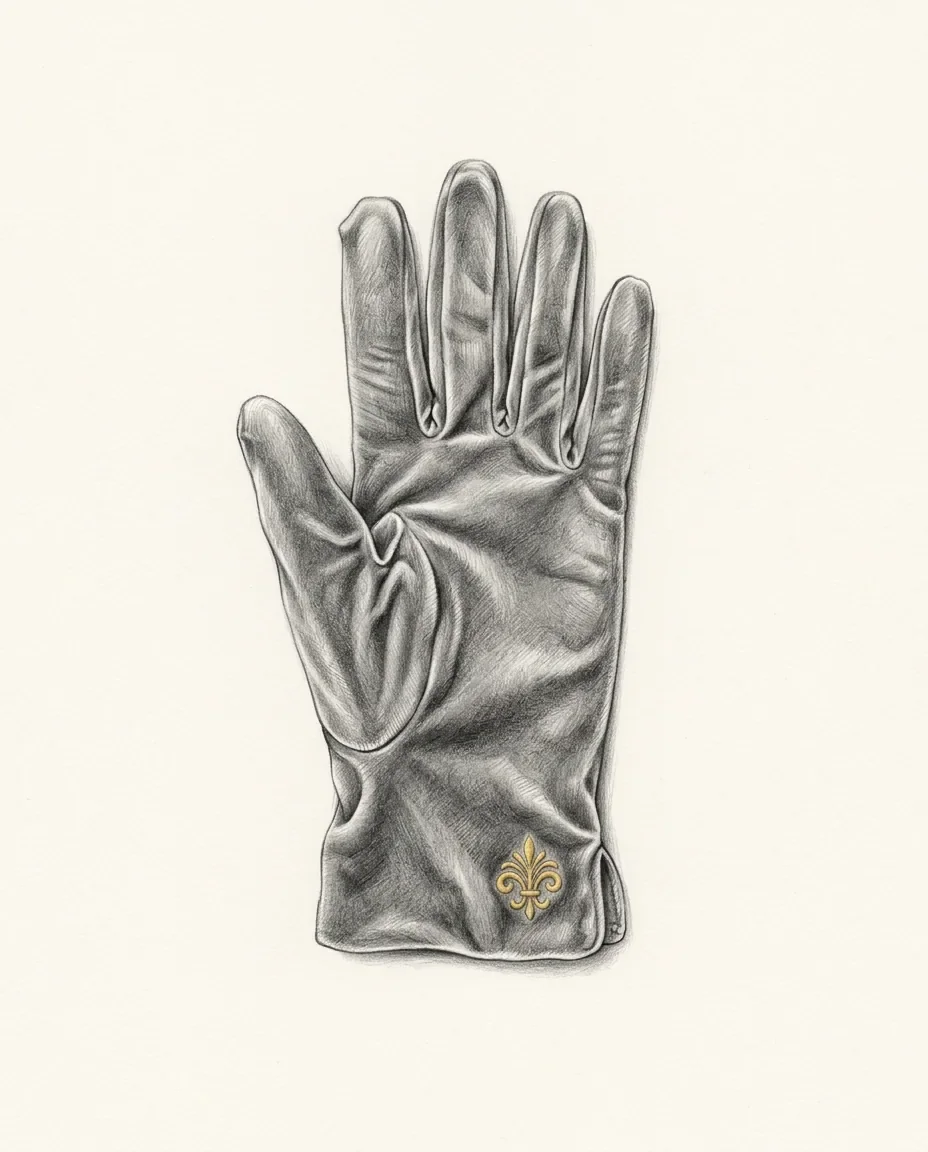
Glove Fetish
Glove fetishism
Added 21 Jun 2026 · Updated 22 Aug 2026
An erotic interest in gloves as worn handwear, valued for their material (leather, satin, latex, lace) and for the way they cover the hands. Associations with elegance, formality, or restraint add to the appeal. An uncommon garment-and-material fetish, not a clinical disorder.
- Prevalence
- Uncommon
- Category
- Clothing & Garments
- Clinical term
- Glove fetishism
- Domain
- Sexual interest
- Confidence
- Low confidence
- Status
- Niche clothing/material fetish; a normal variation, not a disorder unless it causes distress or impairment.
- Also known as
- Glove Fetishism, opera glove kink, leather glove attraction, handwear fetish
- Added
- 21 Jun 2026
- Updated
- 22 Aug 2026
Overview
Glove fetishism is a form of sexual fetishism in which arousal attaches to gloves as worn handwear. The appeal typically fuses the qualities of a material (leather, satin, latex, nitrile, lace, kid, or wool) with the symbolism of covered hands, which can read as refinement, anonymity, control, or careful, mediated touch. Long opera gloves, fitted leather driving gloves, and surgical or household gloves are recurring focal points. This article traces how the interest emerged within the broader study of garment fetishism, how it is typically expressed, and what little quantitative evidence exists for its prevalence.
Glove fetishism is best understood as a focused clothing-and-material preference rather than a disorder. For most people it layers onto otherwise conventional attraction and overlaps heavily with broader material fetishes such as leather and latex.
Examples
What the term covers. Long satin or kid opera gloves, and the small theatre of drawing one off finger by finger; fitted leather driving gloves, a focus specific enough to carry its own entry as a leather glove fetish; latex or nitrile examination gloves, where the appeal often borrows the clinical atmosphere of a medical setting kink; plain household rubber gloves; and collecting particular lengths, cuts and materials. Gloved touch, contact deliberately mediated by a layer, is itself a recurring part of the appeal.
What the term does not cover. A hand fetish is the near neighbour and the usual confusion, but its object is the hand itself: shape, fingers, veins, gesture. A glove interest survives the hand being entirely hidden, and often that concealment is the point, though the two frequently travel together. Leather and latex fetishes attach to a material wherever it is worn, of which gloves are one site among many, and boot, shoe and stocking fetishes are the same idea applied to feet and legs. Uniform fetish is about the role a garment signals rather than its surface, and endytophilia is arousal that requires a partner to stay clothed in general, not an interest in any particular garment. Wearing gloves for hygiene during sex is not the fetish.
How the word is used. Plain descriptive English with no separate clinical coinage. The sexological literature treats it as a sub-type of clothing and material fetishism rather than naming it, and it appears as a category of its own in neither the DSM-5-TR nor the ICD-11. The one peer-reviewed paper to name it directly is a 2010 single-case report.
History & origins
Gloves have carried erotic and social charge for centuries (in courtship rituals, in the etiquette of removing a glove to be kissed, and in fashion as markers of status) but the systematic study of garment fetishes is much younger and never singled out gloves as a separate diagnostic category.
Clinical lineage
- 1886: Richard von Krafft-Ebing's Psychopathia Sexualis catalogues attractions to articles of clothing and to particular fabrics, establishing the template under which handwear later sat alongside footwear, furs, and silk.
- 1887: The French psychologist Alfred Binet, in his essay Le fétichisme dans l'amour, names and theorises fetishism as a psychological phenomenon, framing specific objects and materials as the organising focus of desire. Binet's framing is the reason such interests are grouped as "fetishes" at all.
- Early 1900s: Havelock Ellis's Studies in the Psychology of Sex and, slightly later, the psychoanalytic literature treat clothing fixations as learned or symbolically displaced desire; gloves are noted only in passing as one garment among many.
- 1983: A clinical review of 48 fetishism cases (often cited in the sexual fetishism literature) found clothing the most common focus (about 58%), with rubber, footwear, and soft fabrics following, situating handwear within the dominant clothing-fetish cluster rather than as a standalone interest.
- 2010: In one of the few peer-reviewed reports to name the interest directly, Noguchi and Kato described "A case of Williams syndrome with glove fetishism" in Psychiatry and Clinical Neurosciences, an isolated case study rather than evidence of any broad clinical pattern.
- Present day: The DSM-5-TR and ICD-11 reserve a disorder label only where an interest causes distress, impairment, or harm to self or others, so an ordinary glove preference is not pathologised. The precise coinage of "glove fetishism" as a discrete term is not well documented; it is consistently treated as a sub-type of clothing or material fetishism.
Cultural & subcultural evolution
The erotic charge of gloves in popular culture predates and outpaces any clinical attention. The long opera glove became a Hollywood emblem of glamour and danger (Rita Hayworth's striptease-of-a-glove in Gilda, 1946; the elbow-length evening glove of mid-century couture), while fitted leather gloves carry connotations of authority, the chauffeur, and the noir villain. In contemporary kink culture gloves sit comfortably within the leather and latex/rubber scenes, where they are prized as much for surface and sheen as for what they conceal. Dedicated online communities exist but are small, typically nested inside larger material-fetish spaces rather than forming their own mainstream.
In practice
Expression is generally low-key and non-explicit: a preference for a partner wearing gloves, enjoyment of the visual and tactile experience of gloved hands and gloved gestures, and collecting particular cuts, lengths, or materials. Many enthusiasts emphasise aesthetics and texture (the creak of leather, the sheen of satin or latex) as much as any directly sexual element. Because the focal object is ordinary clothing, the interest is easily woven into otherwise conventional intimacy.
Psychology
What causes a glove fetish?
Glove fetishism fits standard models of fetish formation without requiring a unique explanation. Associative learning can link the garment to a formative arousal experience, after which the glove functions as a conditioned cue. The symbolic resonance gloves carry in fashion and film (glamour, mystery, distance, authority) reinforces that cue, and for some the partial concealment of a normally bare and expressive body part (the hand) is itself the draw. Texture and material sensitivity matter too, which is why glove interest so often travels with leather and latex preferences. The evidence base specific to gloves is thin: most theory is extrapolated from the broader fetishism literature rather than from studies of handwear itself.
Prevalence & culture
How common is glove fetishism?
Gloves are a niche interest, studied mainly within broader clothing fetishism rather than on their own. The most-cited quantitative anchor, Scorolli et al. (2007), counted members of online fetish groups and found garment-focused interests dominated by legwear (about 33%) and footwear (about 32%), with underwear (12%) and whole-body wear (9%) following; handwear does not register as a major share, consistent with its niche status. Gloves nonetheless retain mild mainstream visibility through historical fashion, couture, and cinematic imagery of elegant or enigmatic characters, which keeps the aesthetic culturally legible even to those who do not share the fetish.
Safety, consent & law
Glove fetishism involves ordinary garments and consenting adults, and raises no legal concern; the usual norms of mutual consent, communication, and privacy apply. The one genuine physical caution is material rather than conduct. Latex allergy is common enough to matter, reactions range from local irritation to severe systemic ones, and nitrile or vinyl gloves are the standard substitute for anyone affected. Oil-based lubricants also degrade latex and rubber, so a glove used alongside a condom or dam should be chosen with that in mind. Where gloves are used within leather or latex play or alongside boot-focused dress-up, the relevant safeguards are simply those of the wider material-fetish context, not anything specific to handwear.
Common questions
What is the difference between a glove fetish and a hand fetish?
The object. A hand fetish is about the hand itself, its shape, fingers, veins and gestures, so covering it removes the point. A glove fetish attaches to the garment: the material, the fit, the length, and often the concealment. Someone can have either without the other, and many people have both, which is why the two get treated as one interest more often than they should be.
Why are long opera gloves such a common focus?
Because film and fashion did the work first. The elbow-length evening glove was a mid-century emblem of glamour and formality, and Rita Hayworth peeling one off in Gilda (1946) fixed the removal of a glove as a piece of erotic choreography in popular memory. The garment already carried meanings of status, distance and ceremony before any individual attached arousal to it.
Do you have to be into leather or latex to have a glove fetish?
No. Satin, kid, lace, cotton and wool gloves all have their enthusiasts, and for some people the cut and length matter more than what the glove is made of. Material-specific interests do exist as narrower cases, such as a leather glove fetish, and glove interest often travels with broader leather or latex preferences, but neither is a requirement.
Are latex gloves safe to use during sex?
For most people, yes, but latex allergy is the real caution here. Reactions run from itching and rash to serious systemic responses, and repeated exposure can sensitise someone who was previously fine, so a new rash after gloved contact is worth taking seriously. Nitrile and vinyl are the usual substitutes. Oil-based lubricants degrade latex, which also matters if a condom or dam is in use.
Is a glove fetish a disorder?
No. Both the DSM-5-TR and the ICD-11 reserve a diagnosis for cases where an interest causes the person significant distress or impairment, or harms someone else, and an ordinary preference for gloved hands does none of those things. Gloves are not named in either manual; they fall under the general category of nonliving objects, alongside every other garment anyone has ever found appealing.
Is glove fetishism related to shoe or boot fetishism?
They belong to the same family, garment and material fetishes, and behave similarly, but footwear is enormously more common. In the online-community survey by Scorolli and colleagues (2007), legwear accounted for about 33% of garment-focused interests and footwear about 32%, while handwear did not register as a significant share. The mechanism looks the same; the numbers are not remotely comparable.
- Leather Fetish65/100Leather fetishism · Objects & MaterialsAn erotic attraction to leather as a material: its look, smell, creak, shine, and feel when worn. It overlaps strongly with BDSM gear and is bound up with a recognised, organised leather subculture with its own bars, codes, and titles.65
- Latex Fetish62/100Latex fetishism · Objects & MaterialsAn erotic interest in latex garments and their tight, glossy, second-skin qualities. A common material fetish involving the look, feel, sound, smell, and enveloping sensation of clinging latex on consenting adults.62
- Boot Fetish52/100Clothing & GarmentsA sexual interest in boots, from knee-high and thigh-high fashion styles through riding, work, combat, and military boots. They are valued for their silhouette, materials, and connotations of authority. It overlaps with shoe, leather, and uniform fetishism.52
- Suit and Tie Fetish33/100Clothing & GarmentsAn erotic interest centred on tailored suits, dress shirts and neckties, prized for their formality and perceived masculinity. Power symbolism and crisp tactile detail add to the appeal. It is a niche clothing fetish, not a clinical disorder.33
- Ballet Boot Fetish32/100Clothing & GarmentsAn erotic interest in ballet boots, the fetish footwear that holds the foot fully en pointe on a seven-inch heel. The appeal lies in the leg line, the object itself and the limit it places on walking. A niche within shoe and boot fetishism.32
- Leather Glove Fetish31/100Clothing & GarmentsAn erotic interest focused specifically on leather gloves: their look on the fingers, scent, faint creak, and smooth feel. A material-specific subset of glove fetishism that overlaps leather fetishism; an uncommon preference, not a clinical disorder.31
"Glove" derives from Old English glōf, "covering for the hand." "Fetish" comes via French fétiche from Portuguese feitiço, "charm, sorcery," ultimately Latin facticius, "made by art"; the psychological sense of fetishism was named and theorised by Alfred Binet in his 1887 essay Le fétichisme dans l'amour. "Glove fetishism" itself is a plain descriptive compound with no separate clinical coinage.
handwear · garment fetishism
Prevalence is computed from the entry's cited population estimate. Rows marked ESTare indicative editorial estimates scored against a fixed anchor rubric, not measured quantities. Method & anchors: methodology.
Uncommon · ≈ 1 in 100
- 01Scorolli et al. (2007), Relative prevalence of different fetishes, Int. J. Impotence Research 19(4):432-437prevalence anchor (gloves a minor sub-category among clothing/garment fetishes)
- 02Sexual fetishism, Wikipedia (carries the Scorolli 2007 relative-frequency table)carries the Scorolli relative-frequency table for garment fetishism
- 03List of paraphilias, Wikipediaexistence/definition of glove fetishism as a garment fetish
- 04Richard von Krafft-Ebing, Psychopathia Sexualis (1886)early clinical cataloguing of clothing- and material-focused fetishism (1886)
- 05Glove fetishism, Wikipediadefinition of glove fetishism, the materials involved (leather, satin, latex, nitrile, lace), and its placement within garment fetishism
- 06Alfred Binet, WikipediaBinet named and theorised fetishism in his 1887 essay Le fétichisme dans l'amour
- 07Studies in the Psychology of Sex (Havelock Ellis), Wikipediaearly-1900s cataloguing of clothing and fabric fixations as learned/symbolic desire
- 08Noguchi M, Kato S (2010), A case of Williams syndrome with glove fetishism, Psychiatry and Clinical Neurosciences 64(6):663rare peer-reviewed case report naming glove fetishism directly; an isolated case, not a clinical pattern
- 09DSM-5-TR, Paraphilic Disorders (American Psychiatric Association, 2022)a fetishistic interest is a disorder only when it causes distress, impairment, or harm, an ordinary glove preference is not pathologised
- 10ICD-11, Paraphilic disorders (World Health Organization)modern diagnostic threshold of distress/impairment/harm for paraphilic disorders