Foot Domination
Added 27 Jun 2026 · Updated 22 Aug 2026
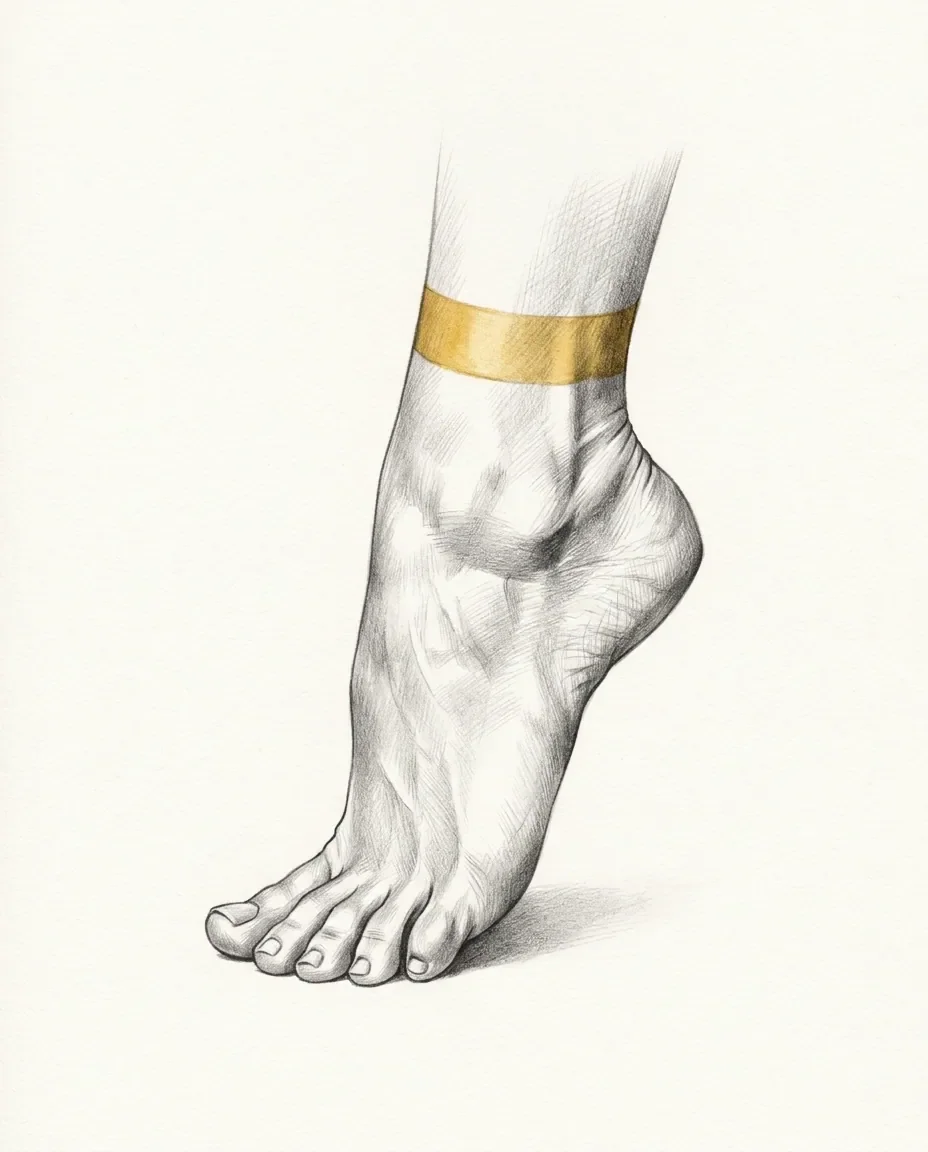
A power-exchange practice in which a dominant uses their feet as the instrument of control over a consenting submissive. Typical acts are directing the submissive to kiss, lick or clean the feet, holding them underfoot, or foot-gagging. It is the dominant-framed counterpart to foot worship.
- Prevalence
- Common
- Category
- Power, Roles & Scenarios
- Domain
- Sexual interest
- Confidence
- Low confidence
- Status
- A consensual BDSM power-exchange practice, not a distinct clinical diagnosis; benign between consenting adults.
- Also known as
- foot slavery, foot-centred domination
- Added
- 27 Jun 2026
- Updated
- 22 Aug 2026
Featured in
Overview
Foot domination is a consensual power-exchange practice in which a dominant partner uses their feet as the primary instrument of authority, humiliation and control over a willing submissive. Where a foot fetish names the underlying erotic attraction to feet, foot domination names the scene framing built around them: the foot becomes a tool of command rather than simply an object of admiration. It is the dominant-side counterpart to submissive foot worship, and much of its charge comes from the symbolism of the foot as the body's lowest, lowliest part. This article sets out what the practice involves, where its conventions come from, and how it relates to neighbouring kinks.
Definition & scope
In foot domination the dominant directs the encounter from a position of elevated authority while the submissive is positioned low, often kneeling or lying beneath the feet. Typical expressions, all between consenting adults, include being made to kiss, lick or clean the dominant's bare feet or footwear; being held "underfoot" with a foot resting on the back, chest or face; or foot-gagging, in which the toes or sole are pressed to the mouth. The defining feature is the direction of control: the dominant commands, and the foot is the means of asserting status and drawing out submission.
Examples
What the term covers. A dominant seated while a submissive kneels to kiss, lick or clean the bare feet; a foot rested on a partner's back, chest or face as a plain statement of rank; footwear presented to be cleaned or polished, which shades into boot fetishism and the leather-community craft of bootblacking; and foot-gagging, in which the toes or sole are pressed to the mouth. Much of it is physically mild and carried almost entirely by posture, position and command, and in ongoing relationships it usually sits inside a wider femdom or master/slave arrangement rather than standing alone.
What it does not cover. Foot worship is the same activity named from the other end (the bottom's reverent perspective against this entry's top-side frame), so the two describe one encounter, not two. Trampling shares the body part but chases weight and sensation rather than obedience, and a crush fetish moves the pressure off the partner onto an object entirely. A footjob is stimulation carrying no hierarchy in itself, though it is often folded into one here, while face-sitting and human furniture run the same status logic through other body parts. The attraction underneath (foot fetishism, or narrower forms such as sole, arch and foot odour interest) is a preference, not a power dynamic. The scene borrows its vocabulary of high and low status from humiliation play and degradation kink without being reducible to either.
How the word is used. Community vocabulary with no coiner and no clinical standing. "Foot slavery" is the older personals-ad phrasing, surviving mainly in advertising by professional dominants, for whom foot domination is a standard service category. It appears in no diagnostic manual: since 2013 the DSM has folded partialism into fetishistic disorder, which applies only where an interest causes marked distress or impairment, or involves someone who has not consented.
History & origins
Foot domination has no single coinage. It is a modern community label for an old convergence of two documented threads: foot eroticism and ritualised submission.
The foot as a symbol of submission
The foot has signified subordination across many cultures long before any kink vocabulary existed. Proskynesis, the act of prostration toward the feet of a superior, is recorded in the ancient Near East and in Greek accounts of the Persian court; ritual foot-washing appears in the New Testament as an act of service and humility. In China, the practice of foot binding made the bound "lotus foot" an eroticised status object over several centuries, before being formally outlawed in the early twentieth century; the cultural history of foot fetishism traces how such traditions fused the foot's erotic and hierarchical meanings. These supply the raw material, the foot as the lowest part of the body, that modern foot domination repurposes for consensual play.
Clinical and subcultural threads
Foot-focused eroticism entered medical writing with Richard von Krafft-Ebing's Psychopathia Sexualis (1886), the same foundational text that coined the terms sadism and masochism and catalogued foot fetishism among its case studies. Krafft-Ebing tied fetish formation to early "imprinting" associations and noted that foot interest often travelled alongside submission. The eroticised foot and the formalised dominant/submissive dynamic were thus described within the same early sexology.
Over the twentieth century the two strands merged in BDSM subculture. The acronym BDSM settled into use in the early 1990s, organising kink around negotiated roles of dominance and submission, and dominant-framed foot and footwear play, including its close relative boot worship, became a staple of female-led (femdom) sessions and professional domination. Foot domination is best understood as the application of that dominance/submission frame to the long-eroticised, long-symbolic foot.
In practice
Like other power exchange, foot domination is negotiated before it is performed. Partners agree roles, limits and a safeword, and the dominant escalates within those bounds, perhaps beginning with a foot held to the chest and progressing to cleaning or foot-gagging only as consent allows. Verbal command, posture (the submissive kept physically low) and tone do much of the work; the activity itself can be mild and largely symbolic. Hygiene is a routine consideration where the mouth is involved, and foot-gagging in particular calls for care that the airway is never obstructed.
Psychology
The appeal rests on consensual status reversal. By making a partner attend to the body's least prestigious part, the scene dramatises a hierarchy that both participants find arousing: the dominant through the experience of being served and obeyed, the submissive through release into a low, cared-for, controlled role. This is the same mechanism that drives humiliation play and degradation kink generally; foot domination localises it on the foot. For most practitioners it is an ordinary, benign variation of erotic interest rather than a sign of pathology, consistent with the modern clinical view that fetishistic interests warrant attention only when they cause distress or impairment or involve a non-consenting person.
Prevalence & culture
Feet are by a wide margin the most common body-part fetish. In the large online survey by Scorolli et al. (2007), which analysed 381 fetish discussion groups with at least 5,000 participants, feet and toes were the single most common target, preferred by roughly 47% of those sampled among body-part interests. Foot domination is a narrower, role-framed slice of that interest, so its prevalence is far lower, estimated here at around 2% of adults, with active but specialised communities on FetLife and adult platforms and a recurring presence in professional domination. Because no survey isolates the dominant-framed practice from foot interest at large, this figure is a low-confidence estimate scaled down from foot-fetish data.
Variations & related interests
Foot domination anchors a small cluster of foot-focused power play: its mirror image is submissive foot worship; its weight-and-sensation neighbour is trampling; and it inherits the status vocabulary of humiliation play and degradation kink. Underlying all of them is the plain erotic attraction described in foot fetish, which is expressed as a physical act in the footjob, an activity that carries no power dynamic in itself, though it is often folded into one here.
Safety, consent & law
Between consenting adults, foot domination is legal and benign, raising no inherent legal concern. As with all power exchange, the essentials are explicit negotiation, a safeword, and attention to physical safety, especially keeping the airway clear during any foot-gagging and observing ordinary hygiene. Because a spoken safeword is useless once the mouth is occupied, agree a non-verbal signal (a dropped object, or a set number of taps) before any foot-gagging begins, and treat weight placed on the chest or throat as a separate, higher-risk decision rather than an extension of the same scene. Conduct it only with informed, enthusiastic, ongoing consent.
Common questions
What is the difference between foot domination and foot worship?
The frame, not the activity. Foot worship describes reverent attention paid to someone's feet from the worshipper's side; foot domination describes the same encounter from the dominant's, where the foot is an instrument of command rather than an object of devotion. A single scene can accurately be called either depending on whose experience is being named, which is why the two entries cross-reference each other instead of competing.
Is foot domination the same as trampling?
No, though they often appear together. Trampling is about weight and sensation (being stood on, walked over, pressed down), and its appeal survives even without a power framing. Foot domination is about obedience, with the foot as the means of asserting rank; the physical contact can be minimal or entirely absent while the scene still works.
Do you need a foot fetish to enjoy foot domination?
No. The two interests overlap heavily but come apart cleanly. Some participants are drawn to the feet themselves and find the hierarchy incidental; others have no particular interest in feet and respond instead to the symbolism of being placed beneath the body's lowest part. The scene works on either motivation, and most people report some mixture of the two.
Why are feet used to signal submission?
Because the association long predates any kink vocabulary. The foot is the body's lowest part and the part that meets the ground, and cultures have used that literally for millennia: prostration toward a superior's feet in the ancient Near East and the Persian court, ritual foot-washing as an act of humility, and the eroticised status object that Chinese foot binding made of the bound foot. Modern practice repurposes that inherited symbolism for consensual play.
Is foot domination safe?
Between consenting adults it is one of the lower-risk power-exchange practices, with two real cautions. Foot-gagging must never obstruct the airway, and since the submissive's mouth may be occupied, a non-verbal safe signal needs to be agreed before it starts. Ordinary foot hygiene matters wherever the mouth is involved: clean feet, and attention to cuts, blisters or fungal infection. Weight placed on a chest or throat is a different order of risk and should be treated as its own decision.
Is foot domination a paraphilia or a disorder?
No. It is a consensual power-exchange practice between adults and appears in no diagnostic manual. The foot interest underneath it is classified as a partialism, which since 2013 has been handled as a specifier of fetishistic disorder rather than a diagnosis in its own right, and that becomes clinically relevant only where the interest causes marked distress or impairment, or involves a non-consenting person.
- Foot Worship55/100Power, Roles & ScenariosThe submissive, reverent practice of kissing, massaging, caressing or venerating a partner's feet, usually inside a dominance-and-submission dynamic. It names an activity and a ritual of devotion rather than the underlying attraction, which is the foot fetish.55
- Trampling43/100Sensation & PainA consensual erotic interest in being stepped on, stood on, or walked over by another person (usually with bare feet or footwear) within a dominance frame. A foot-centred subset of BDSM sensation and power-exchange play that carries real physical risk.43
- Humiliation Play60/100Power, Roles & ScenariosA psychological power-exchange interest in which consenting adults eroticize feelings of embarrassment, degradation, or being put down. Arousal arises from the negotiated experience of vulnerability rather than from real harm.60
- Degradation Kink67/100Power, Roles & ScenariosA consensual power-exchange interest in being demeaned, insulted, or treated as lowered in status for erotic effect, negotiated within BDSM. A common variation, not a disorder.67
- Foot Fetish83/100Podophilia · Body Parts & PartialismA focused erotic interest in feet (their shape, soles, toes, arches, or grooming) as a primary source of attraction. Within partialism (erotic focus on a non-genital body part) it is the example people report most, by a wide margin.83
- Brat Play48/100Power, Roles & ScenariosA submissive style within power exchange in which one partner playfully resists, teases, or defies a dominant partner. That dominant, the "brat tamer", responds by reasserting control. Both the cheek and its taming are consensually scripted between adults.48
dominance & submission · humiliation & degradation · foot-focused play
Prevalence is computed from the entry's cited population estimate. Rows marked ESTare indicative editorial estimates scored against a fixed anchor rubric, not measured quantities. Method & anchors: methodology.
Common · ≈ 1 in 20
- 01Scorolli et al. (2007), Relative prevalence of different fetishes, Int. J. Impotence Research 19(4):432-437prevalence anchor (381 fetish groups, 5,000+ participants; feet = 47% of body-part fetishes; foot domination is a narrower role-framed subset scaled down from this)
- 02Foot fetishism, Wikipediacultural history of foot eroticism, Chinese foot binding and the lotus foot, and the foot as a symbol of submission and dehumanisation in BDSM
- 03Psychopathia Sexualis (1886), Richard von Krafft-Ebing, Wikipedia1886 foundational sexology coining sadism/masochism, imprinting model of fetish formation, and cataloguing foot-focused fetishism
- 04Boot worship, Wikipediarelated dominant-framed foot/footwear submission practice within BDSM and femdom