Shoeplay
Added 27 Jun 2026 · Updated 22 Aug 2026
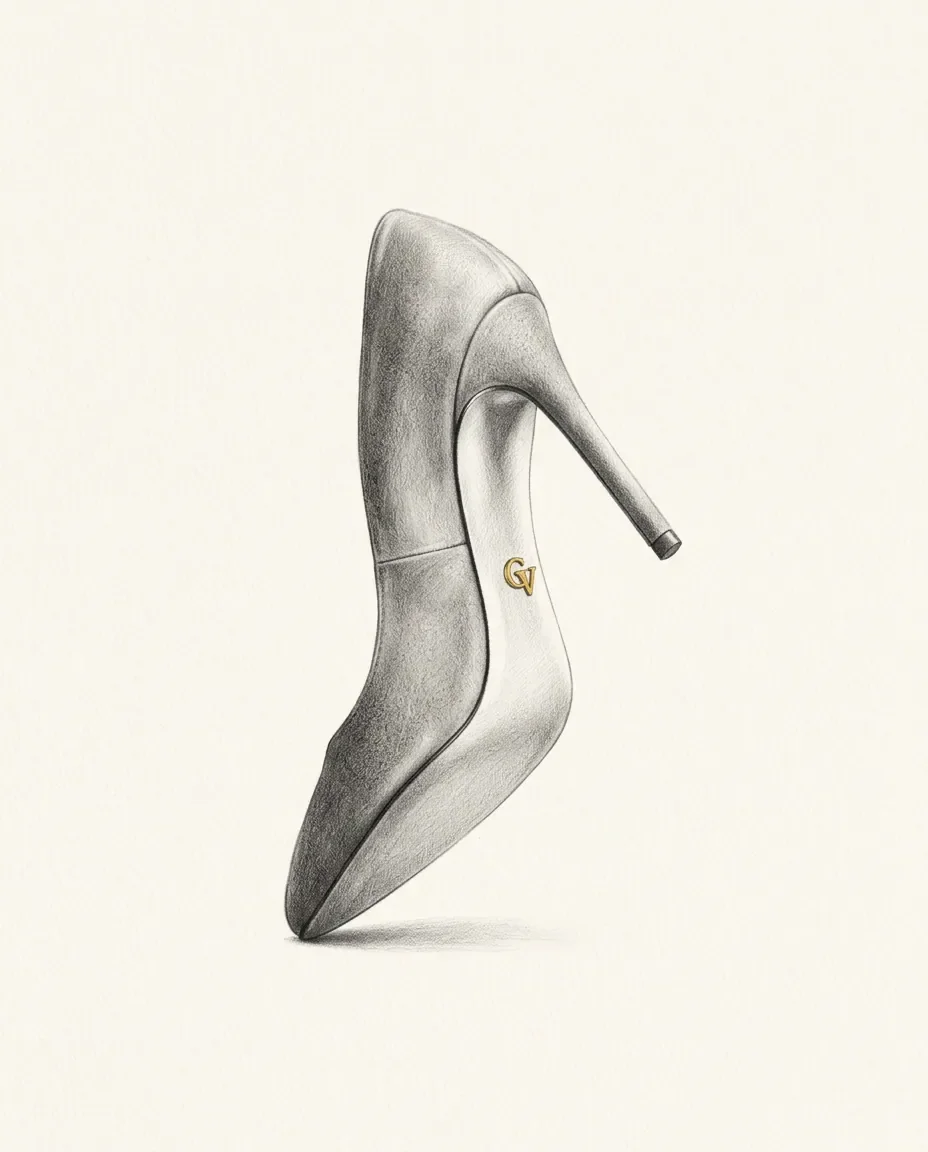
The play of slipping a shoe partly on or off, dangling it from the toes, or dipping the heel out of the back. A defining, often voyeuristic behaviour within shoe and foot interest, frequently observed in public as well as performed deliberately.
- Prevalence
- Uncommon
- Category
- Acts & Activities
- Domain
- Sexual interest
- Confidence
- Low confidence
- Status
- Not a clinical diagnosis; a common behavioural expression within foot and shoe interest, benign between consenting adults.
- Also known as
- dangling, dipping, shoe dangling
- Added
- 27 Jun 2026
- Updated
- 22 Aug 2026
Featured in
Overview
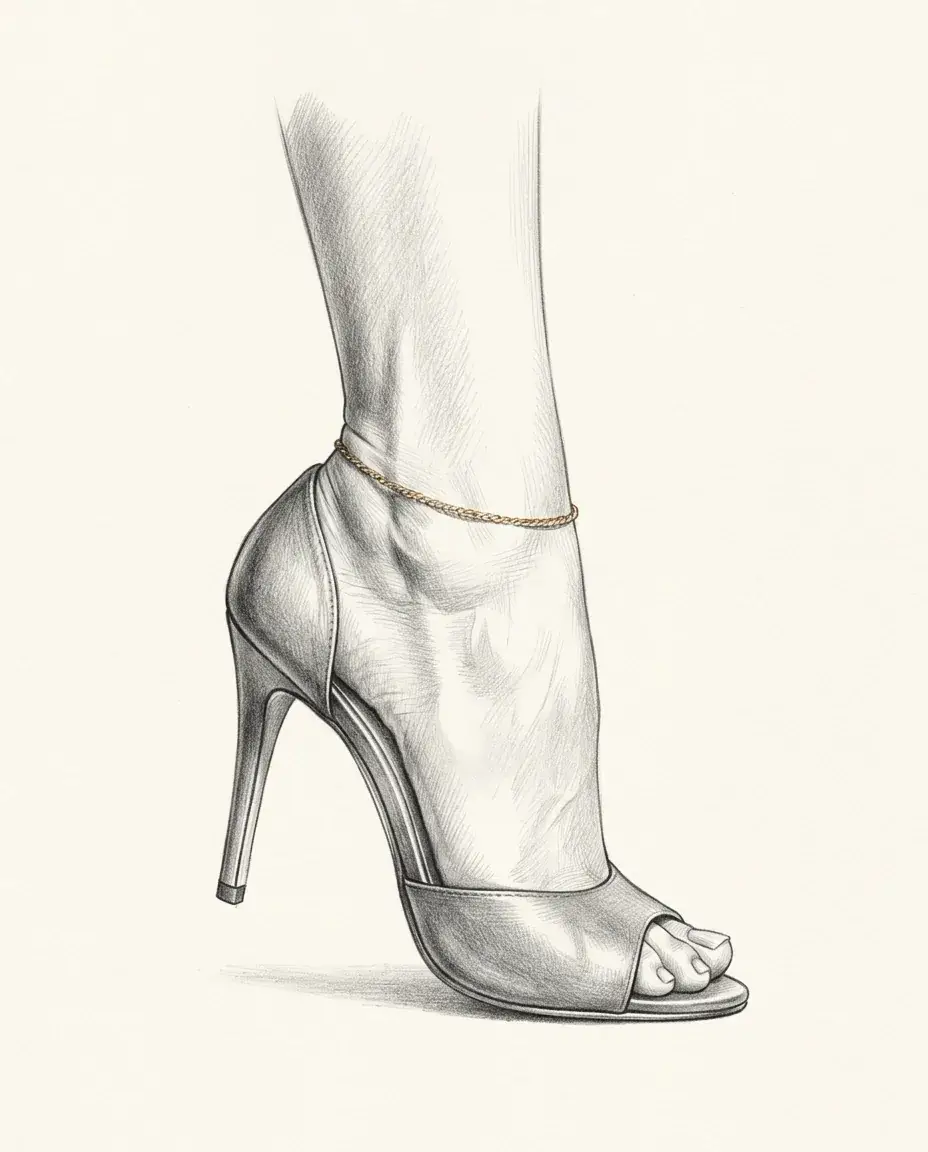
Shoeplay is the small repertoire of foot-and-shoe movements in which a wearer loosens a shoe and toys with it: slipping the heel partly out ("dipping"), letting a mule or pump hang from the toes ("dangling"), or sliding the shoe on and off. Wiktionary defines it plainly as "the act of using one's foot to play with a shoe, lifting and dangling it, etc., regarded as erotic by fetishists." It sits at the meeting point of shoe fetishism and foot fetishism: the shoe is the prop, but the partial reveal of the heel, arch, and toes is much of the charge. Because it often happens unconsciously, in a lecture hall, office, train, or café, shoeplay is also one of the most voyeuristically framed behaviours in the foot-interest world. This article sets out what the term covers, where it comes from, how it is expressed, the psychology proposed for it, and the consent line that public observation must respect.
Definition
Shoeplay is a behaviour, not a body part or an object, which is why it is catalogued here under acts and activities rather than alongside shoe fetishism or high heel fetishism. The cluster of moves it names is consistent across community sources: dangling (balancing a backless or loose shoe on the toes so it swings free of the heel), dipping or "heel popping" (lifting the heel clear of the shoe's back while the toe stays inside), and shoe removal (slipping fully out and dipping the toes back in). The appeal combines the line of the foot as it arches out of the shoe, the rhythmic motion, and the implied intimacy of a normally hidden foot half-revealed in an everyday setting.
Examples
What the term covers. Most shoeplay is unremarkable to the person doing it: a heel lifted clear of a pump under a desk through a long meeting, a loafer left hanging from the toes on a commuter train, a sandal slipped off and toed back on. The same movements are also performed deliberately, as a flirtation between partners who both know what it signals, or staged for a camera and posted to the tags and archives built around the behaviour. Both count. What makes it shoeplay is a worn shoe being loosened and toyed with, not the intent behind it, which is why the identical gesture can be entirely innocent at one end of a room and the object of a stranger's interest at the other.
What the term does not cover. It is a behaviour, not an attraction, so it is not the same as any of the interests that watch for it: shoe fetishism attaches to footwear as an object, high-heel fetishism narrows that to heels, and foot fetishism attaches to the body part, with arch, sole and toe interests narrower again. It is not barefoot interest, which needs no shoe at all, nor the contact-based practices of foot worship, toe sucking and trampling. Following, photographing or filming a stranger for it is voyeurism, not shoeplay.
How the word is used. Folk and community vocabulary. "Shoeplay" is a transparent compound recorded by general reference dictionaries rather than coined by anyone in particular, and the finer terms (dangling, dipping, heel popping) come from enthusiast forums, not from sexology. Neither the word nor the behaviour appears in DSM-5-TR or ICD-11, and no clinical synonym exists for either.
History & origins
A behaviour older than its name
The word "shoeplay" is a transparent modern compound, simply shoe + play, with no clinical coinage or dated medical entry; it appears in lay and community usage rather than the diagnostic manuals. The behaviour, however, belongs to the long, well-documented history of foot and shoe eroticism. The eroticisation of footwear was catalogued by Richard von Krafft-Ebing in Psychopathia Sexualis (1886) and by Havelock Ellis in his Studies in the Psychology of Sex, while the clinical label retifism for shoe interest honours the French novelist Nicolas-Edme Rétif de la Bretonne (1734–1806), whose 1769 novel Le Pied de Fanchette dwelt on women's footwear. The half-on, half-off shoe is a recurring motif in this visual tradition long before the internet gave the gesture a name.
Naming in the internet era
Shoeplay crystallised as a named, organised interest with the rise of online foot communities, where the dangling-versus-foot-fetish distinction is openly discussed: for some enthusiasts the shoe is the focus, while for foot-fetishists the arousal comes, as one community guide puts it, from "seeing the heels and the arches moving" in a voyeuristic situation and the chance of seeing more of the foot as the play intensifies. The term now anchors dedicated forums, social-media tags, and large video archives, but it remains a folk/community category rather than a sexological diagnosis.
In practice
Among consenting adults the interest is expressed through:
- Watching or performing the dangle: a mule, high-heeled pump, flip-flop, or loafer swinging from the toes.
- Dipping / heel popping: lifting the heel out of the back of the shoe, the toe still inside.
- Slipping in and out: repeatedly removing and replacing a loose shoe.
- Capturing or collecting imagery of these motions, often filmed candidly in public or staged deliberately for a partner or audience.
- Deliberate teasing between partners, where one person dangles or dips as a flirtatious cue.
Much shoeplay observed in public is incidental: a wearer easing a tight shoe during a long meeting, with no erotic intent at all. That gap between the wearer's intent and the observer's interest is exactly what makes the consent question below important.
Psychology
No dedicated research isolates shoeplay from the broader literature on foot and shoe interest, so its psychology is read through that lens. Associative learning is the usual account: a once-neutral cue (here, the half-revealed foot in motion) becomes paired with arousal and is reinforced over time. The behaviour also concentrates several established cues at once: the arched foot and toes central to foot partialism, the eroticised shoe of retifism, movement, and the frisson of partial concealment and reveal. The frequently cited cortical-adjacency idea, advanced by V. S. Ramachandran in Phantoms in the Brain (1998), holds that the foot's map on the sensory homunculus lies next to the genital map and that neural "crosstalk" between them could seed foot interest; it is sometimes invoked for foot attraction generally but was offered without experimental evidence, was challenged by a 2013 imaging study, and is not specific to shoeplay. As with most common interests, the evidence base is observational and no single mechanism is established.
Prevalence & culture
No survey measures shoeplay directly, so its reach is inferred from the foot/shoe categories that contain it. In the large internet survey by Scorolli et al. (2007), published in the International Journal of Impotence Research and widely reproduced on Wikipedia's foot-fetishism article, feet were the single most preferred body part (about 47% of body-part preferences) and footwear the leading object focus (about 32%). Shoeplay is a specific behaviour within that very large interest, so its dedicated following is far smaller than the parent categories even though the underlying attraction is common. Culturally the gesture is highly visible online: it sustains active forums, social-media tags such as those on TikTok and YouTube, and large candid and staged video archives, even as it stays largely invisible in mainstream media. The prevalence figure here is calibrated down from foot- and shoe-fetish anchors and carries low confidence.
Safety, consent & law
Between consenting adults, shoeplay is a benign variation of sexual interest with no inherent legal concern; the only practical caveats are ordinary respect for a partner's boundaries and basic foot hygiene. The distinctive issue is public observation. Because shoeplay so often happens unconsciously in shared spaces, an observer's interest must stay strictly non-intrusive: passive, discreet noticing is one thing, but approaching, filming, or photographing a stranger's feet without consent crosses into harassment and, in many jurisdictions, may breach voyeurism, upskirting, or covert-recording laws. The wearer has not consented to being a subject. Keep observation respectful and unobtrusive, never record or pursue identifiable strangers, and confine deliberate, interactive shoeplay to partners who have agreed to it.
Common questions
Is shoeplay a fetish, or just something people do?
Both, depending on which side of it you are on. For most wearers it is an unconscious habit (easing a tight shoe, cooling a foot, fidgeting during a long sit) with no erotic content whatever. For the people who seek it out it is a focused interest, usually an expression of an existing foot or shoe attraction. The behaviour is the same; only the observer's framing differs.
Why do people find shoe dangling attractive?
It concentrates several established cues in one small motion: the arched foot and toes that carry foot partialism, the eroticised shoe of retifism, continuous movement, and the tension of partial concealment as a normally hidden foot is half revealed. Community accounts add the voyeuristic frame: that it usually happens in an everyday public setting and is not being performed for anyone. No research isolates the behaviour, so these are descriptions rather than tested explanations.
How common is shoeplay?
No survey has measured it, so the figure here is scaled down from the parent interests. Scorolli et al. (2007), an online survey of fetish communities, found feet were the most preferred body part at about 47% and footwear the leading object focus at about 32%. Shoeplay is one specific behaviour inside those very large categories, so its dedicated following is far smaller than either, and this entry's estimate carries low confidence.
Is it wrong to watch a stranger's shoeplay in public?
Noticing something that happens in a shared space is not an offence, and passive, discreet attention harms nobody. What changes it is pursuit: staring in a way the person registers, moving seats to get a better view, following, approaching, or making them aware they are being watched. The wearer has not consented to being anyone's subject, and in most cases has no idea the behaviour is of interest to anyone.
Is it illegal to film someone's feet in public?
It can be, and the risk is real rather than theoretical. Many jurisdictions have voyeurism, upskirting or covert-recording offences that turn on whether the subject was identifiable and whether the recording was made for sexual gratification without consent, and "we were in public" is not a general defence to those. Beyond the law, most platforms remove candid footage of identifiable people. Do not record strangers.
Is shoeplay a disorder or a paraphilia?
No. It is a behaviour, and neither it nor the foot and shoe interests behind it appear as diagnoses in DSM-5-TR or ICD-11. Those manuals treat a focused interest as clinically relevant only where it causes the person genuine distress or impairment, or where it involves someone who has not consented, which is why the consent question around public observation, rather than the interest itself, is where the real issue lies.
From the blog
- Shoe Fetish65/100Retifism · Clothing & GarmentsA sexual interest in shoes as objects of attraction or arousal, valued for their style, material, and associations rather than the wearer. Clinically termed retifism, it is among the most frequently documented garment fetishes in survey and case literature.65
- High Heel Fetish56/100Altocalciphilia · Clothing & GarmentsA focused sexual interest in high-heeled shoes (stilettos, pumps, platforms) and the height, posture, and leg line they create. It is a common, generally harmless subtype of shoe fetishism.56
- Foot Fetish83/100Podophilia · Body Parts & PartialismA focused erotic interest in feet (their shape, soles, toes, arches, or grooming) as a primary source of attraction. Within partialism (erotic focus on a non-genital body part) it is the example people report most, by a wide margin.83
- Agonophilia42/100agonophilia · Acts & ActivitiesArousal from a staged struggle: wrestling, pinning and mock resistance between partners who agreed to it. A forensic-glossary term for what most people who do it call wrestling or rough-housing.42
- Frot42/100Acts & ActivitiesA consensual non-penetrative act between men involving direct penis-to-penis contact. Promoted from the late 1990s as an alternative to anal sex, it should not be confused with frotteurism, which is non-consensual rubbing and an offence.42
- Thighjob42/100Intercrural Sex · Acts & ActivitiesA non-penetrative act in which the penis is moved between a partner's closed thighs. Known clinically as intercrural sex, it is documented in ancient Greece, in southern African courtship traditions, and in modern HIV-prevention research as a lower-risk practice.42
A transparent modern English compound of 'shoe' + 'play' (per Wiktionary); there is no clinical coinage. 'Dangling' and 'dipping' are descriptive community terms for the specific motions of letting a shoe hang from the toes or lifting the heel out of the back.
foot play · footwear behaviour · voyeuristic interest
Prevalence is computed from the entry's cited population estimate. Rows marked ESTare indicative editorial estimates scored against a fixed anchor rubric, not measured quantities. Method & anchors: methodology.
Uncommon · ≈ 1 in 100
- 01shoeplay, Wiktionarydefinition of shoeplay ('the act of using one's foot to play with a shoe, lifting and dangling it, etc., regarded as erotic by fetishists') and etymology (shoe + play)
- 02Shoe dangling or shoe play, High Heels Dailycommunity description of dangling/dipping, the dangler-vs-foot-fetishist distinction, and the voyeuristic framing (arousal from seeing heels and arches move)
- 03Scorolli et al. (2007), Relative prevalence of different fetishes, Int. J. Impotence Research 19(4):432-437prevalence anchor for the parent categories (feet 47% of body-part preferences; footwear 32% of object preferences) from which shoeplay is scaled down
- 04Foot fetishism, Wikipediacarries the Scorolli relative-frequency figures, the historical sexological lineage (Krafft-Ebing 1886, Havelock Ellis), and Ramachandran's 1998 sensory-homunculus foot/genital adjacency hypothesis with its 2013 critique
- 05Shoe fetishism, Wikipediashoe fetishism = retifism after Nicolas-Edme Rétif de la Bretonne (1734–1806) and his 1769 novel Le Pied de Fanchette