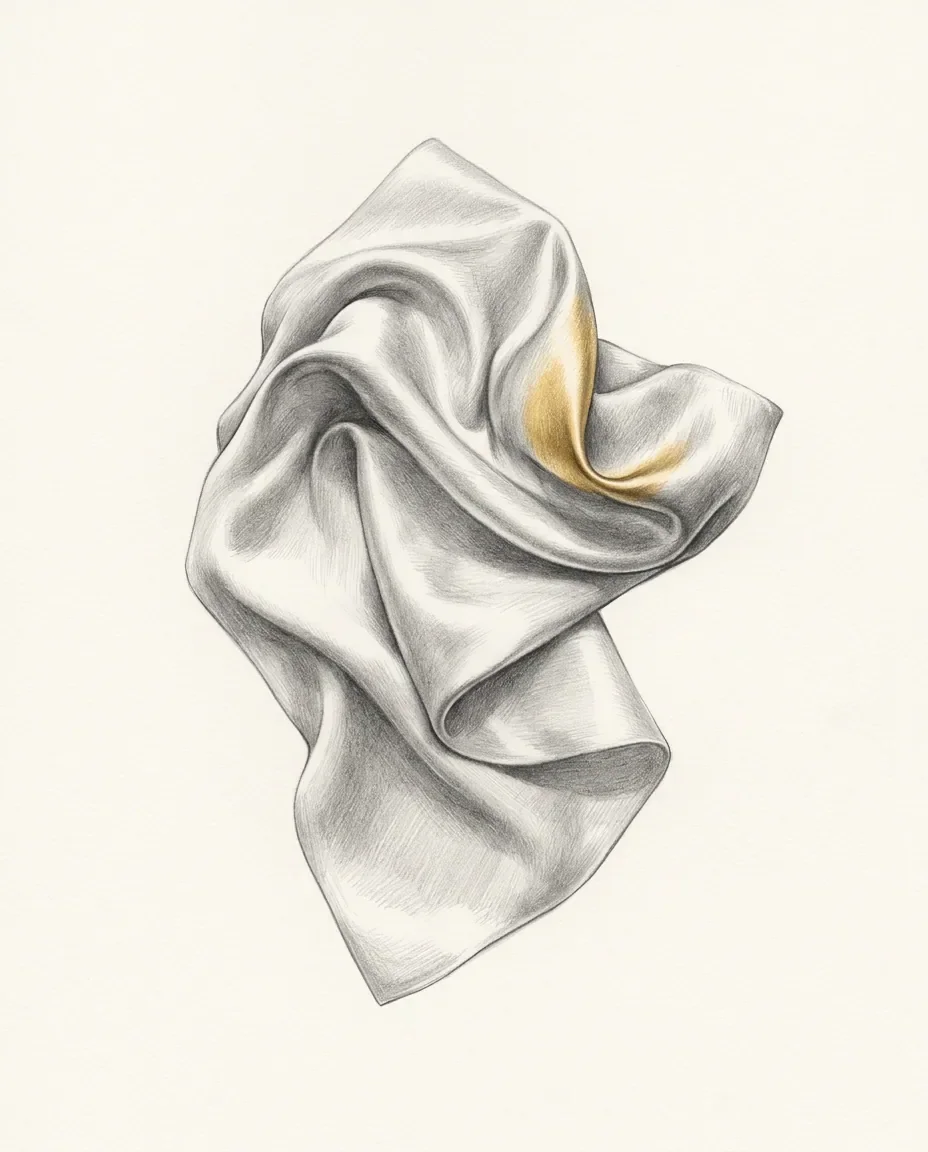
Satin Fetish
Added 21 Jun 2026 · Updated 22 Aug 2026
An erotic attraction to satin centred on its smooth, slippery feel and characteristic sheen, a benign soft-textile material interest. It is not a clinically defined paraphilia, and it overlaps closely with silk and other shiny-fabric preferences.
- Prevalence
- Uncommon
- Category
- Objects & Materials
- Domain
- Sexual interest
- Confidence
- Low confidence
- Status
- Smooth/shiny-material sensory interest; not a recognized paraphilia. Benign common-spectrum preference.
- Also known as
- satin fetishism, shiny fabric fetish, smooth textile fetish
- Added
- 21 Jun 2026
- Updated
- 22 Aug 2026
Featured in

Overview
Satin fetishism is a sexual interest in satin-finish fabric, in which the material's glossy surface and silky-smooth handle become a focus of arousal. The defining appeal joins a tactile element (the cool, slippery glide of the cloth) with a visual one: the mirror-like shine that sets satin apart from matte textiles. This article covers what makes satin distinctive, how the interest is framed within the history of sexology, how it is typically expressed, and what little is known about its prevalence. It is widely regarded as a benign sensory preference rather than a clinical condition.
What "satin" actually is
Strictly, satin names a weave, not a fibre. In a satin weave four or more weft yarns float over a single warp yarn (or vice versa) with the interlacing points staggered, so long unbroken "floats" of thread lie on the surface and reflect light directly: the source of the fabric's signature lustre and its slick, fluid handle. That combination of high sheen plus low surface friction is exactly the sensory profile the interest is built around, and it is why satin shades so readily into silk, nylon and other glossy textiles. Historically satin was woven from silk; today it is as often polyester or acetate, which changes the price and the hand but preserves the shine-plus-slip signature that drives the appeal.
Examples
What the term covers. A preference for satin robes, gloves, blouses, slips or sleepwear, worn by oneself or by a partner; satin sheets and pillowcases kept for how they feel rather than how they look; the specific pleasure of the cloth sliding over skin; and the visual pull of the sheen on its own, which is why some people describe the interest as much through looking as through touching. Because satin is a weave and not a fibre, an inexpensive polyester satin and a silk-satin gown can both satisfy it.
What the term does not cover. Silk is the neighbour it is most often confused with: silk names a fibre and satin a weave, so silk satin belongs to both, but a matte silk crepe is silk and not satin, and a polyester satin is satin and not silk. Lace is openwork and textured rather than smooth, wool is warm and fuzzy, and the glossy synthetics (nylon, spandex, PVC and latex) cling to the body where satin slides across it. Lingerie and panty interests are defined by the garment rather than by the cloth, and texture fixation is the non-sexual pleasure of handling a surface, which many people have with no erotic component at all.
How the word is used. "Satin fetish" is everyday and community vocabulary, not a diagnosis. Neither DSM-5-TR nor ICD-11 names satin; both fold material interests into one broad category and reserve fetishistic disorder for cases marked by distress or impairment. In ordinary speech people are far likelier to say they love the feel of satin than to use the word fetish at all.
History & origins
The material
Satin is far older than any clinical vocabulary for desiring it. The weave is generally traced to medieval China, with the lustrous cloth carried west along Silk Road and maritime trade routes. The English word satin enters via Old French in the mid-14th century; a long-standing tradition derives it from Arabic zaytuni, "of Zaitun", the medieval name for the Chinese port of Quanzhou, though, as Etymonline notes, the Oxford English Dictionary regards that Zaitun derivation as etymologically untenable and prefers an origin in Latin seta, "silk."
Fabric as a fetish object
The framing of fabric attraction as a fetish belongs to early sexology:
- 1882: the psychiatrists Jean-Martin Charcot and Valentin Magnan describe erotic fixation on inanimate objects, laying the groundwork.
- 1886: Richard von Krafft-Ebing's Psychopathia Sexualis catalogues arousal attached to garments and materials among the early sexual case studies.
- 1887: Alfred Binet's essay Le fétichisme dans l'amour, in the Revue philosophique, introduces the modern psychological sense of fétichisme, in which desire fixes on a particular object, quality, or material.
- early 1900s: Havelock Ellis's Studies in the Psychology of Sex further documents garment- and texture-focused erotic interest.
Clinical status today
Satin has never carried a distinct diagnostic label. It is treated as one instance of smooth- and shiny-fabric fetishism: a sub-type of object/material fetishism rather than a separately named entity. In the modern DSM-5-TR and ICD-11 lineage, a fabric interest is a disorder only if it causes distress or impairment; a consensual, untroubled satin preference is not a clinical condition at all, a depathologising shift that mirrors the wider treatment of fabric fetishism on Wikipedia.
In practice
The interest is typically expressed through ordinary contact with satin objects:
- satin clothing such as robes, gloves, dresses, blouses, or sleepwear, worn by oneself or a partner
- satin bedding and sheets
- the sensation of the cool, slippery fabric gliding against skin
It sits close to silk, nylon, and spandex interests and frequently coexists with them, so a satin preference often shades into a broader appetite for glossy, slippery textiles rather than standing alone.
Psychology
Why is satin appealing?
The attraction is generally understood through sensory conditioning and the pleasurable associations of glossy, smooth material, with both the look (sheen) and the feel (slip and coolness) acting as learned cues: the same associative-learning account Binet first sketched in 1887. Because it centres on texture and surface rather than on a person being degraded or coerced, it is regarded as a common-spectrum sensory interest and is not separately classified in diagnostic manuals. The evidence base specific to satin is, however, thin: there are no dedicated studies, and the mechanism is inferred from the broader fetishism literature rather than measured directly.
Prevalence & culture
How common is it?
Satin appears widely in fashion, lingerie, and bedding, giving the material an everyday cultural familiarity that few fetish objects share. Hard prevalence figures for satin specifically do not exist; the nearest empirical anchor is Scorolli et al. (2007), whose analysis of online fetish communities placed clothing- and material-related interests as a real but minority slice of all fetishes (legwear around 33% and footwear around 32% of clothing fetishes), but that study treats fabrics collectively rather than isolating satin. Dedicated satin-specific erotic communities are modest in size and overlap heavily with silk and shiny-fabric groups, so the material rarely sustains a standalone subculture.
Safety, consent & law
The interest is consensual and legal and raises no special safety considerations beyond ordinary care of the fabric and respect for a partner's comfort.
Common questions
Is it a fetish if I just like the way satin feels?
Probably not, in any meaningful sense. Enjoying a smooth, cool fabric is an ordinary sensory preference, and liking it a lot does not make it erotic. The word fetish implies that the material is a real focus of arousal rather than a pleasant background. A purely tactile enjoyment with no sexual charge is closer to texture fixation, which is common and entirely non-sexual.
What is the difference between a satin fetish and a silk fetish?
Satin is a weave and silk is a fibre, so the two interests track different things. A satin interest follows the sheen and the slip, and is satisfied by polyester or acetate just as well as by silk. A silk fetish follows the fibre itself, including matte silk weaves that have no shine. They meet in silk satin, and in practice most people who like one also like the other.
Is a satin fetish a disorder?
No. A consensual, untroubled fabric preference is not a clinical condition, and satin has never had a diagnostic label of its own. Both DSM-5-TR and ICD-11 reserve a fetishistic diagnosis for cases where the interest causes the person genuine distress or impairment, or where it becomes the only route to arousal. Simply liking satin, or preferring a partner to wear it, meets none of that.
Does a satin fetish mean you are attracted to the fabric instead of to people?
Rarely. For most people it works alongside attraction to partners rather than replacing it: the satin heightens an encounter that would have happened anyway. The clinical threshold is precisely about displacement, and it is reached only when the object becomes necessary and the partner becomes incidental. That describes a small minority of anyone who reports a material interest.
How do you bring a satin fetish up with a partner?
Framing it as a preference rather than a confession tends to work better, because that is what it is. Satin robes, gloves and bedding are low-stakes places to start: ordinary objects a partner can try without committing to anything. As with any preference, what matters is that it stays optional for the other person, and that their comfort with the fabric, and with wearing it, is asked rather than assumed.
Are satin fetishes more common in men or in women?
There is no reliable answer. No survey isolates satin: the closest empirical work, Scorolli et al. (2007), grouped clothing and material interests together rather than breaking out individual fabrics, and counted online community membership rather than a population rate. Anything more specific about who holds the interest would be a guess dressed up as a finding.
- Silk Fetish34/100Objects & MaterialsAn erotic attraction to silk, centred on its smooth, soft, cool tactile feel and luminous drape. It is a soft-textile material interest within the broad family of fabric fetishisms rather than a separately defined clinical paraphilia.34
- Nylon Fetish43/100Nylon Fetishism · Objects & MaterialsAn erotic attraction to nylon as a material: the sheer, smooth, faintly glossy synthetic fabric used in hosiery, stockings, tights, and other slick garments. It is a textile-material preference rather than a clinically defined paraphilia.43
- Spandex Fetish36/100Objects & MaterialsAn erotic attraction to spandex and similar stretch fabrics (Lycra, elastane), focused on their tight, second-skin fit and smooth, glossy surface. It is a benign synthetic-material interest rather than a clinically defined paraphilia.36
- Fur Fetish32/100Doraphilia · Objects & MaterialsAn erotic interest in fur, animal skins, or hides, real or faux, valued for their softness, warmth, scent, and sensory feel against the body. Clinically termed doraphilia, it is generally a benign material fetish rather than a disorder.32
- Plushie Fetish30/100Plushophilia · Objects & MaterialsAn erotic or affectional interest in plush toys and stuffed animals, valued for their softness, comfort, and anthropomorphic forms. Clinically a subgenre of object sexuality (plushophilia), it is a benign niche interest often adjacent to furry culture.30
- Balloon Fetish29/100Globophilia · Objects & MaterialsAn erotic or playful fixation on balloons: their look, feel, smell, sound, inflation, and sometimes their popping. Enthusiasts call themselves looners; it is a benign novelty-object fetish related to latex and inflatable interests.29
Satin entered English via Old French in the mid-14th century. A long-standing tradition derives it from Arabic zaytuni ('of Zaitun', the medieval name for the Chinese port of Quanzhou where the lustrous weave was traded), though the Oxford English Dictionary calls that derivation etymologically untenable and prefers an origin in Latin seta ('silk'). 'Fetish' derives from Portuguese feitiço ('charm, sorcery'), adopted into the psychological sense by Alfred Binet in his 1887 essay Le fétichisme dans l'amour.
soft textiles · smooth materials · tactile
Prevalence is computed from the entry's cited population estimate. Rows marked ESTare indicative editorial estimates scored against a fixed anchor rubric, not measured quantities. Method & anchors: methodology.
Uncommon · ≈ 1 in 100
- 01Scorolli et al. (2007), Relative prevalence of different fetishes, Int. J. Impotence Research 19(4):432-437relative-prevalence context: satin sits within clothing/material fetishes, a minor slice below footwear (32%) and legwear (33%)
- 02Sexual fetishism, Wikipedia (carries the Scorolli 2007 relative-frequency table)smooth/soft fabric fetishism (satin, silk) recognized as a material fetish; carries the Scorolli table
- 03List of paraphilias, Wikipediadefinition/existence of fabric/material fetishism
- 04Havelock Ellis, Studies in the Psychology of Sexearly sexological documentation of fabric- and garment-focused erotic interest
- 05Satin, Wikipediadefinition of satin as a weave: four or more weft yarns float over a single warp yarn, with surface floats producing the characteristic sheen and slippery handle; silk, polyester and acetate fibres
- 06Satin, Etymology, Origin & Meaning (Etymonline)mid-14th-century entry via Old French; the traditional Arabic Zaitun/Quanzhou derivation and the OED's preference for Latin seta ('silk') over it
- 07Psychopathia Sexualis (Krafft-Ebing, 1886), Wikipedia1886 sexological catalogue documenting arousal attached to garments and materials
- 08The Origins of the Theory of Sexual Fetishism: Charcot & Magnan (1882) and Alfred Binet (1887)Binet's 1887 essay 'Le fétichisme dans l'amour' introduced the modern psychological sense of fetishism; Charcot & Magnan's 1882 groundwork
- 09DSM-5-TR, Paraphilic Disorders (American Psychiatric Association, 2022)a fabric/material interest is a disorder only where it causes distress or impairment; a consensual untroubled preference is not pathologised
- 10ICD-11, Paraphilic disorders (World Health Organization)modern depathologising framing under which a benign satin preference is not a clinical condition