
Total Power Exchange
Added 22 Jun 2026 · Updated 22 Aug 2026
A consensual BDSM relationship structure in which one partner cedes broad authority over their life to another on an ongoing basis. It extends dominance and submission beyond scenes into everyday living.
- Prevalence
- Uncommon
- Category
- Power, Roles & Scenarios
- Domain
- Sexual interest
- Confidence
- Medium confidence
- Status
- Not a disorder or recognised paraphilia; a consensual relationship structure. Under DSM-5-TR and ICD-11, consensual BDSM is non-pathological absent distress, impairment or non-consent.
- Also known as
- TPE, total power exchange relationship, consensual slavery, 24/7 D/s, absolute power exchange, Master/slave dynamic, Owner/property dynamic
- Added
- 22 Jun 2026
- Updated
- 22 Aug 2026
Featured in
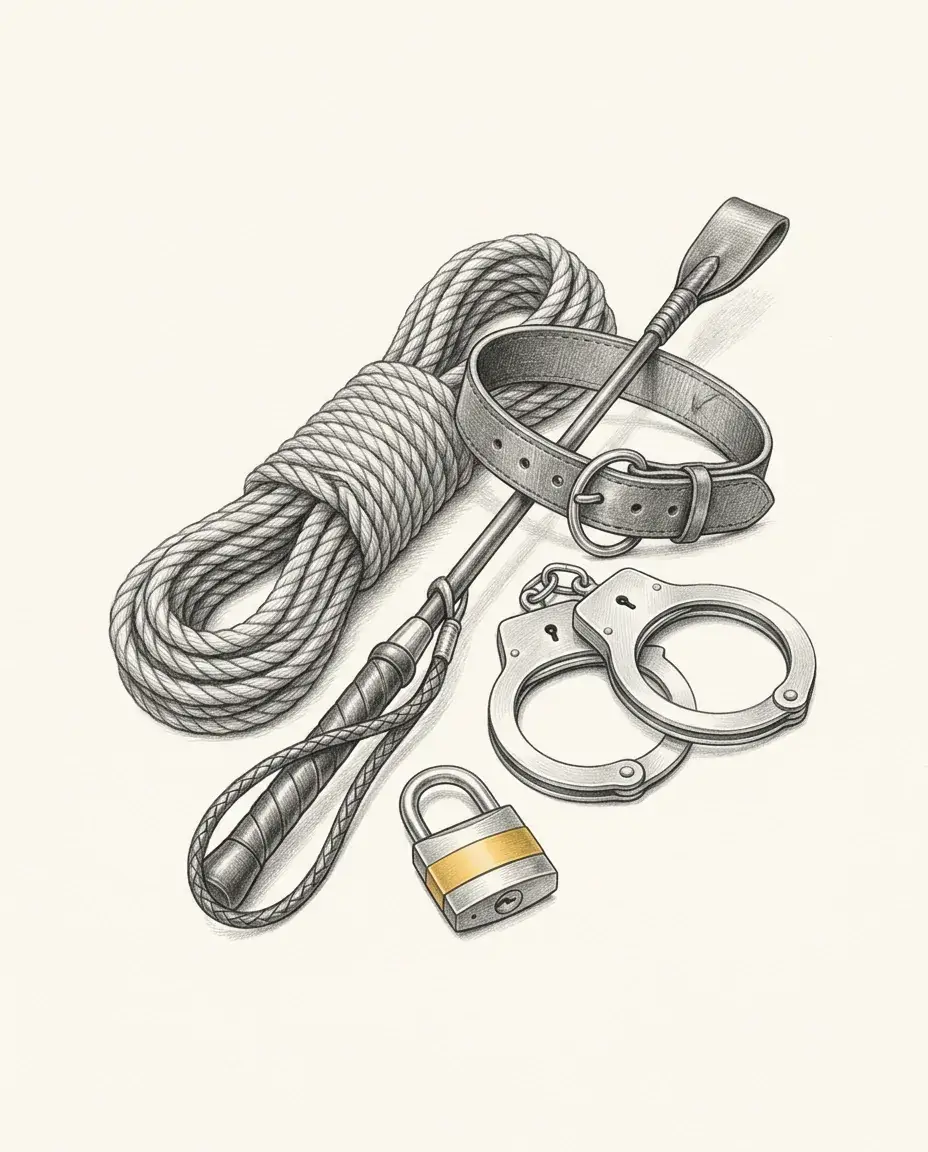
Overview
Total Power Exchange (TPE) is a consensual relationship structure within BDSM in which one partner grants another broad, ongoing authority over significant areas of their life. Unlike scene-limited dominance and submission, a TPE dynamic is intended to permeate everyday living, often described as "24/7", so the agreed power imbalance persists outside any single session. The dominant partner is often styled Master or Owner and the submissive slave or property, and the arrangement is sometimes called "consensual slavery." This article traces where the term came from, how the dynamic is actually practised, what motivates it, and the consent and safety questions its totalising framing raises.
Examples
What the term covers. An agreement under which named domains of life, daily routine, dress and grooming, diet and exercise, finances, the social calendar, sexual availability, are placed under a partner's authority and stay there between scenes rather than only during them. In practice that looks like standing rules and rituals, a collaring ceremony marking the handover, the master/slave vocabulary most such couples adopt, formal high protocol occasions, and service submission as the everyday texture of the thing. Some couples run it alongside domestic discipline; the Gorean subculture is one aesthetic lineage of it.
What the term does not cover. The "total" describes the scope of a negotiated agreement, not an absence of consent. A relationship that cannot be questioned, renegotiated or left is abuse, and TPE is not the word for it. Scene-limited dominance and submission shares the roles but not the continuity, and consensual non-consent stages a bounded scene rather than a standing arrangement. Free use is a standing agreement covering one domain only. Nor does TPE say anything about how many partners are involved: a couple in a TPE dynamic may be monogamous or part of a polyamorous network.
How the word is used. TPE is community jargon, spoken as the acronym and effectively unknown outside kink circles. The alternative phrase "consensual slavery" is used inside those circles and reliably misread outside them, since it names a voluntary and revocable agreement between adults rather than any legal status. Neither the term nor the arrangement appears in DSM-5-TR or ICD-11.
History & origins
Cultural roots
TPE names a structure far older than its acronym. Ongoing, lived-in dominance and ownership draw on the post-war gay leather subculture and its hierarchies of protocol, service and earned rank, and on a broader literary and folk tradition of consensual mastery. The science-fantasy Gor novels of John Norman, beginning with Tarnsman of Gor in 1966, popularised a pervasive master/slave ("Gorean") aesthetic that fed directly into later master/slave communities, even though Norman himself has publicly distanced his work from BDSM.
Coinage of the term
The phrase "total power exchange" itself is community jargon rather than a clinical term, and, notably, it appears to have been coined by a critic of the idea rather than an advocate.
- Mid-1990s: The label crystallised in debates on the Usenet group alt.sex.bondage. As BDSM educators record, "TPE as a term was invented by a critic of the idea," and it remains most used by those whose lineage traces back to that forum, "especially via the late Jon Jacobs." Community accounts name that critic as Steven S. Davis, who introduced the phrase while arguing against the concept with Jacobs.
- Jacobs, a central figure in those discussions, is generally said to have preferred the competing label "Absolute Power Exchange" (APE), so the popular attribution of TPE to him should be read as lineage and influence rather than authorship. The irony that a sceptic's coinage became the movement's standard banner is part of why the term carries a faint edge of provocation even now.
- The contrast the term was built to draw, a whole-life dynamic versus scene-limited play, is the distinction that has stuck, and it is the one the Consent Culture glossary still uses to define TPE today.
Clinical & academic framing
TPE has never been a diagnosis. Under the DSM-5-TR and ICD-11, consensual BDSM is non-pathological absent distress, impairment or non-consent, so a negotiated power-exchange relationship is not a disorder. Scholarly attention is recent: Ofer Parchev's 2025 Sexualities paper analyses TPE as a "pure" power relationship sitting at the edge of mainstream BDSM discourse.
In practice
A TPE arrangement is usually negotiated in advance and may be recorded in a non-binding written agreement or "slave contract," which documents limits and the consensual nature of the relationship rather than creating any enforceable obligation. The ceded domains vary by couple and can touch daily routine, finances, social life, appearance or intimate life. Service and obedience tend to be the core values, distinguishing master/slave dynamics from looser Dominant/submissive ones, and the handover is often marked symbolically: for example through collaring. Despite the totalising framing, healthy practice retains negotiated limits, regular check-ins, aftercare, and the right to renegotiate or end the dynamic.
Psychology
The appeal centres on trust, devotion, structure and the relief of surrendering decision-making to a trusted partner; for the dominant it carries a reciprocal responsibility to lead and protect. The transfer of control can produce a focused, immersive headspace akin to subspace, and for some couples ritualised obedience or degradation deepens the felt asymmetry. Parchev frames TPE as grounded in intimacy and trust rather than purely sexual motivation, the consent that licenses such broad authority is itself an ongoing act of intimacy. The empirical literature on full-time arrangements specifically remains sparse.
Prevalence & culture
TPE is an uncommon, comparatively intense expression of the much broader interest in dominance and submission. Fantasies of dominating or submitting are common in the general population: in Joyal, Cossette & Lapierre (2015), about 64.6% of women and 53.5% of men reported fantasies of being dominated, and submission/domination themes were among the most prevalent studied. Lehmiller's 2018 survey of 4,175 Americans likewise found dominance/submission fantasies near-ubiquitous. Full-time, whole-life arrangements are far rarer than occasional D/s play and concentrate in committed, experienced kink relationships, with presence on community platforms such as FetLife rather than broad mainstream visibility.
Safety, consent & law
Because authority is broad and continuous, TPE carries real psychological risk: dependency, coercion, isolation and eroded judgement can be hard to detect from inside the dynamic. Established communities stress that consent is ongoing and revocable (either partner may withdraw it at any time, nullifying the arrangement) and that "slave" contracts carry social meaning but no legal force. No agreement can create a literal property interest in a person or waive protection from genuine abuse, which the law of most jurisdictions forbids. The distinction that matters in practice is between the scope of what has been agreed and the presence of agreement at all: a very wide arrangement is still consensual, and a narrow one is not consensual if it cannot be refused. The safeguards are accordingly the things a coercive relationship removes first, and they are worth naming: outside friendships and family contact, independent money and identity documents, somewhere to go, and periodic conversations held out of role. A dynamic in which raising a concern is itself punishable has stopped being a power exchange.
Common questions
What is the difference between TPE and an ordinary D/s relationship?
Scope and continuity, not intensity. In most dominance and submission the authority is bounded: it applies during a scene, an evening or a named activity, and outside that the partners are peers. In a TPE arrangement the authority is the default state and the exceptions are the carve-outs. The roles, the language and the acts may look identical from outside; what differs is whether the dynamic switches off when the scene does.
Is total power exchange the same as abuse?
No, and the difference is not the breadth of what is agreed but whether agreement exists at all. A TPE arrangement is negotiated between adults, has limits, and can be ended by either partner at any moment. An abusive relationship is defined by the removal of that exit. Practical markers separate them: whether a concern can be raised without punishment, whether outside friendships, money and documents remain accessible, and whether the submissive partner could leave today if they chose to.
Is a slave contract legally binding?
No, nowhere. Such a document has social and ritual force inside the relationship, since it records what was negotiated, what the limits are, and that both people entered freely, which makes it useful as a shared reference and as a ceremony. It creates no obligation a court would enforce. No agreement can establish a property interest in a person, compel performance, or waive anyone's protection from assault, and the consent recorded in it stays revocable.
How do you end a TPE relationship?
By withdrawing consent, which either partner may do at any time and which ends the authority immediately; nothing further is required for it to lapse. Ending the relationship itself is the harder part, and no different from ending any committed one, except that finances, housing and social life may have been arranged around the dynamic. That is exactly why experienced communities push people to keep independent money, documents and somewhere to go before they need them.
What does 24/7 actually mean in practice?
That the dynamic is the default rather than something switched on for a scene, not that every waking hour is spent in ritual. Jobs, families, illness, travel and neighbours all impose practical carve-outs, and most couples agree in advance which contexts suspend the visible parts of the arrangement while the underlying authority stays in place. The phrase describes continuity of the agreement rather than constant performance of it.
Is TPE always sexual?
Not necessarily. The scholarly treatment of TPE frames it as grounded in intimacy, trust and devotion rather than in sexual motivation specifically, and many arrangements are organised around service, structure and everyday authority rather than around sex. Sexual availability is simply one domain that may or may not be included in what is ceded. For some couples the arrangement is intensely erotic; for others it reads closer to how a household is run.
What is the difference between TPE and a Master/slave relationship?
They describe different things and usually coincide. Master/slave names the role vocabulary and the values a couple works from: ownership, service, obedience. TPE names the scope, meaning how much of life the authority covers and whether it lapses between scenes. Most couples in a TPE dynamic use master/slave language, but the titles are also used for scene-limited play, and an ongoing arrangement can avoid the words entirely.
From the blog
- Collaring63/100Power, Roles & ScenariosThe consensual act of placing a collar on a submissive partner as a negotiated symbol of ownership, commitment, protection or submission. It takes place within a Dominant/submissive relationship and is often likened to a wedding band.63
- Bondage86/100Acts & ActivitiesConsensual binding or restraint of a partner with rope, cuffs, tape or other materials for erotic, aesthetic or sensory pleasure. It is the "B" of BDSM and one of the most widely fantasised-about kinks.86
- Aftercare66/100Acts & ActivitiesThe deliberate emotional, physical and psychological care partners give one another after intense sex or a BDSM scene. It helps everyone come down from heightened arousal and return to a calm, grounded baseline. A widely shared best practice rather than a kink in itself.66
- Subspace64/100Sensation & PainAn altered, often euphoric or trance-like headspace that some submissive or bottoming partners enter during intense BDSM play. It is marked by floating sensations, time distortion, reduced pain awareness and impaired verbal responsiveness.64
- Degradation Kink67/100Power, Roles & ScenariosA consensual power-exchange interest in being demeaned, insulted, or treated as lowered in status for erotic effect, negotiated within BDSM. A common variation, not a disorder.67
- Clothed Sex (CFNM / CMNF)45/100Power, Roles & ScenariosArousal from staying partly or fully clothed during sex, especially the power contrast when one partner is dressed and the other is nude. The two best-known framings are CFNM (clothed female, nude male) and CMNF (clothed male, nude female).45
Plain-English descriptive phrase: total (Latin totus, "whole, entire") + power exchange, the BDSM term for the consensual transfer of authority from a submissive to a dominant partner. The compound and its acronym "TPE" emerged in mid-1990s English-language kink communities, notably the Usenet group alt.sex.bondage, to distinguish a whole-life dynamic from scene-limited power exchange; BDSM educators record that the term was coined by a critic of the idea (community accounts name Steven S. Davis), and its lineage runs especially through the late Jon Jacobs, who himself preferred the rival label "Absolute Power Exchange" (APE).
Dominance & submission · Master/slave dynamics · 24/7 lifestyle relationships · authority exchange
Prevalence is computed from the entry's cited population estimate. Rows marked ESTare indicative editorial estimates scored against a fixed anchor rubric, not measured quantities. Method & anchors: methodology.
Uncommon · ≈ 1 in 100
- 01Master/slave (BDSM), Wikipediadefinition of consensual authority-exchange master/slave relationships; TPE where the master may dictate all aspects of the slave's life even outside play; consensual without legal force; consent revocable at any time; slave contracts have social but no legal value; Gor influence
- 02Parchev, O. (2025), BDSM and Total Power Exchange: Between Inclusion and Exclusion, Sexualities 28(1-2):155-179TPE as a distinct whole-life power relationship in which the submissive yields control of significant life domains; analysis of intimacy/trust as basis of consent; how TPE sits at the edge of mainstream BDSM discourse
- 03Total Power Exchange (TPE), Consent Culture glossaryTPE extends D/s dynamics out of scenes into all parts of a relationship (24/7); submissive usually but not always termed slave and dominant Master; origin in alt.sex.bondage and via Jon Jacobs; 'consensual slavery' as alternative description
- 04Joyal, Cossette & Lapierre (2015), What Exactly Is an Unusual Sexual Fantasy? J. Sexual Medicine 12(2):328-340high general-population prevalence of domination/submission fantasies, contextualising the much narrower full-time TPE structure
- 05Lehmiller (2018), Tell Me What You Want, survey of 4,175 Americanshigh reported rates of dominance/submission fantasy in a large U.S. sample, situating TPE within the broad D/s interest spectrum
- 06Talk:Power exchange (BDSM), WikipediaTPE as a term was invented by a critic of the idea; usage traces to alt.sex.bondage lineage, especially via the late Jon Jacobs
- 07Gor, WikipediaJohn Norman's Gor novels (from Tarnsman of Gor, 1966) popularised a pervasive master/slave aesthetic feeding later BDSM communities; Norman publicly distanced himself from BDSM
- 08DSM-5, Wikipediaconsensual BDSM is non-pathological absent distress, impairment or non-consent; TPE is not a diagnosis
- 09ICD-11, World Health OrganizationICD-11 does not pathologise consensual, non-distressing BDSM relationship structures