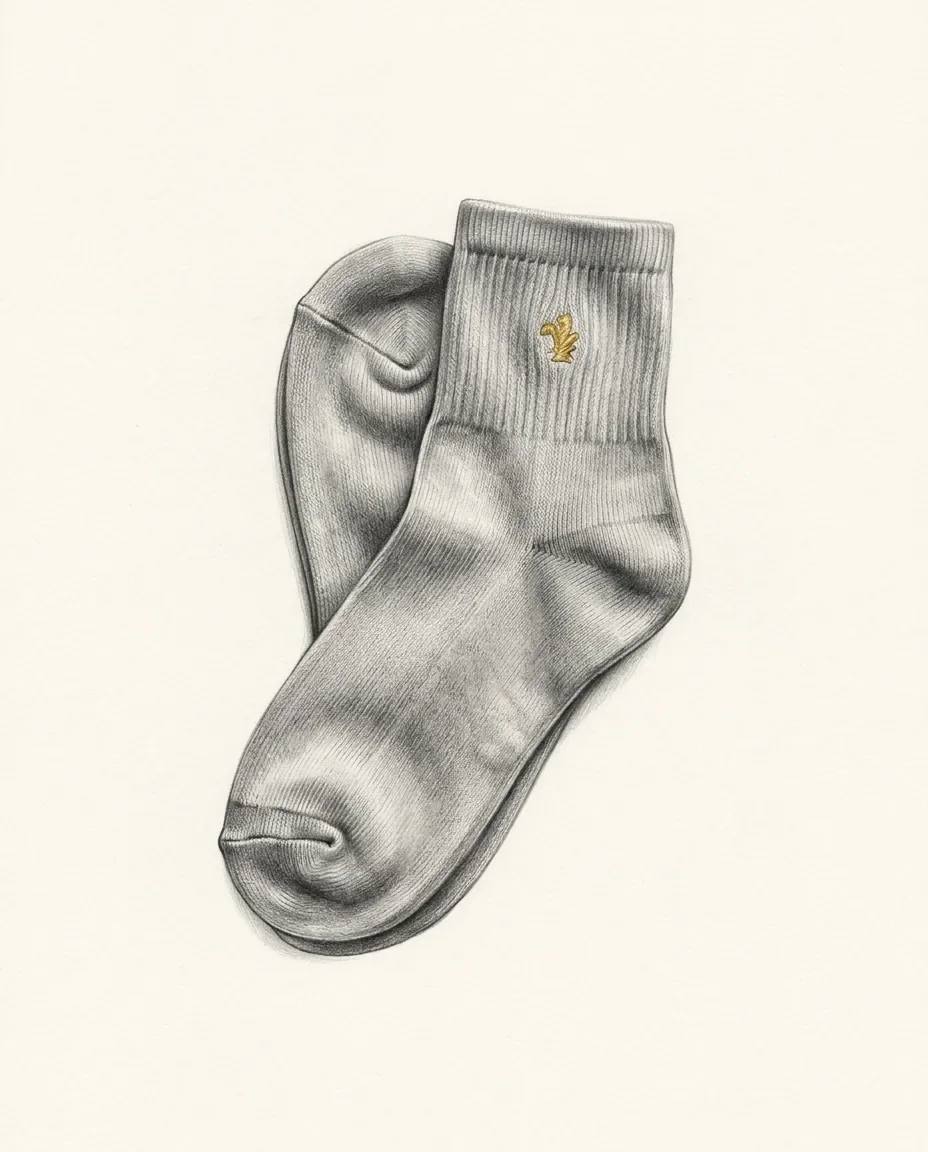
Sock Fetish
Added 22 Jun 2026 · Updated 22 Aug 2026
A sexual interest in socks, in their look, feel, scent, or association with the feet, treated as a benign relative of foot fetishism. It overlaps with hosiery and scent (olfactophilic) interests.
- Prevalence
- Common
- Category
- Clothing & Garments
- Domain
- Sexual interest
- Confidence
- Medium confidence
- Status
- Benign variation of sexual interest; not a distinct disorder, and treated under foot fetishism absent distress, impairment, or non-consent.
- Also known as
- sock fetishism, worn sock fetish, smelly sock fetish, dirty sock kink, hosiery fetish (sock subtype)
- Added
- 22 Jun 2026
- Updated
- 22 Aug 2026
Featured in
Overview
Sock fetishism is an erotic interest in socks, whether prized as a garment in their own right or as an object closely tied to the feet. The appeal can centre on appearance (style, colour, length, fabric) on touch, or on the scent and warmth of socks that have been worn. Because socks sit at the intersection of the foot and the wider world of hosiery, the interest is consistently treated as a benign variation of sexual taste rather than a disorder. This article sets out the clinical lineage it inherits from foot and garment fetishism, how it is typically expressed, the proposed psychology, and what the prevalence evidence can and cannot tell us.
Examples
What the term covers. A preference for a particular kind of sock (crew or ankle length, thick wool or fine cotton, plain white athletic socks or sheer dress socks) admired on a partner, worn oneself, or handled for the feel of the knit. It also covers the warmth and scent of a pair that has been worn all day, which is the whole basis of the small trade in used socks. For some people the sock is a way of approaching the feet indirectly, and the covered foot is the more interesting one; for others the garment holds the interest by itself.
What the term does not cover. It is not foot fetishism, which is an interest in the body part rather than the thing worn on it, and it is the near-opposite of a barefoot fetish, whose premise is the absence of covering. Where scent is the main draw the closer terms are foot odor fetish and the broader olfactophilia. Longer legwear belongs to the stocking, pantyhose and nylon entries, and what is worn over the sock to shoe and boot fetishism. Shoeplay names a behaviour rather than a garment, and sneakerhead culture is a non-sexual collecting scene that merely shares the footwear.
How the word is used. Sock fetish is plain vernacular with no Greek clinical synonym, because socks have never been carved out as a diagnostic category: the sexological literature files them under foot fetishism and worn-garment interest, and neither DSM-5-TR nor ICD-11 names them. Community usage splits along the same line the research does: "clean sock" and "worn sock" describe two fairly different interests that happen to share an object.
History & origins
Clinical lineage
Socks have never been singled out as a separate diagnostic category; they are folded into the much older study of foot fetishism (podophilia) and of worn-garment and odour interests. That parent literature is well documented.
- 1886: Richard von Krafft-Ebing's Psychopathia Sexualis catalogued attraction to body parts and the clothing nearest them, already noting feet and footwear among the most common objects of fascination.
- 1887: The French psychologist Alfred Binet introduced the sexual sense of fétichisme in his essay Du fétichisme dans l'amour (Revue Philosophique), arguing that such preferences are shaped by early association and conditioning, the first framework that would later be used to explain how an object as ordinary as a sock becomes eroticised.
- 1905: Sigmund Freud took up the foot-and-shoe fetish as a central example in his Three Essays on the Theory of Sexuality, reading it through his own (now largely superseded) symbolic theory.
- 1994 to 1995: an empirical survey of 262 foot-fetish respondents by Martin Weinberg, Colin Williams and Cassandra Calhan ("If the shoe fits…", Journal of Sex Research) found that roughly 45% were aroused specifically by smelly socks or foot odour, the clearest documentation that the worn sock, not just the clean garment, is a recognised focus within this family, as also summarised on Wikipedia's Foot fetishism article.
Cultural & subcultural evolution
As online communities formed in the 2000s, socks acquired a small but visible niche of their own alongside foot-focused forums, image boards, and later subreddits. A modest commercial trade in used socks emerged on general marketplaces and dedicated sites, which in turn prompted platform hygiene rules, a cultural marker that the interest had moved from a footnote in foot fetishism toward a recognisable category in its own right.
In practice
Expression varies widely and is typically private. It may involve admiring socks of a particular style, length, or material; enjoying the feel of the fabric; or the scent and warmth of socks that have been worn. A small commercial trade in used socks exists on dedicated online marketplaces, where worn pairs are sold for their scent: an interest that shades into olfactophilia, arousal from smell. Socks also feature in consensual foot-focused play and overlap with adjacent garment interests such as stockings and pantyhose.
Psychology
Sock interest is generally explained through associative conditioning, the Binet tradition, and the symbolic closeness of socks to the feet, a body region already prominent in fetish research. One frequently cited but contested idea is V. S. Ramachandran's cortical-homunculus hypothesis, which notes that the brain's sensory map places foot representation adjacent to the genitals and speculates this proximity could prime foot-related arousal; Ramachandran offered no experimental evidence, and a 2013 study of 800 subjects found little foot-related cortical activation to support it, so it remains unproven. The scent dimension links the interest to broader olfactory arousal, and the evidence base for any single mechanism is thin.
Prevalence & culture
Feet are the single most common target of body-part fetishes, which sets the ceiling for sock interest. In the large internet survey by Scorolli and colleagues (2007), about 47% of body-part fetish groups concerned feet, while among garment-focused groups roughly 33% concerned items worn on the legs or buttocks (such as stockings) and 32% concerned footwear: the closest published anchors for sock-adjacent interest. Justin Lehmiller's 2018 survey of over 4,000 Americans found that a substantial minority had fantasised about feet or toes. Socks are not counted separately in these studies, so any figure for sock interest specifically is an estimate, but the family of foot- and hosiery-related interests is clearly widespread, with steady community presence on FetLife and dedicated subreddits.
Safety, consent & law
Practised privately or with consenting adults, sock fetishism poses no inherent safety, consent, or legal concern. Two ordinary caveats attach to it. Worn socks belong to whoever wore them, so taking or keeping a partner's or a housemate's without asking is a consent and privacy problem rather than a harmless quirk. And buying or selling worn items, while lawful in many jurisdictions, is restricted by some marketplaces on hygiene grounds, so platform rules and ordinary discretion apply.
Common questions
What is the difference between a sock fetish and a foot fetish?
A foot fetish is an interest in the body part; a sock fetish is an interest in the garment. They overlap heavily and often sit in the same person, but they come apart in both directions: some people find a covered foot more compelling than a bare one, and some respond to the sock as a knitted object with little interest in what it has been on. Where scent is the pull, the closer term is foot odor fetish.
Why are worn socks such a common focus rather than clean ones?
Because a worn sock carries warmth and scent that a fresh one does not, and for many people that is the point rather than a by-product. In Weinberg, Williams and Calhan's survey of 262 foot-fetish respondents (Journal of Sex Research, 1995), roughly 45% reported arousal tied specifically to smelly socks or foot odour. That places a large share of the interest inside olfactophilia, where smell itself is the source of arousal.
Is a sock fetish normal, or is it a disorder?
It is a common and benign variation. No diagnostic manual lists sock fetishism, and the parent category becomes a clinical matter only where an interest causes the person genuine distress or impairment, or involves someone who has not consented. Feet and foot-adjacent garments are the most frequently reported fetish objects of all, which makes this a well-populated corner of ordinary sexual variation rather than an unusual one.
Can you have a sock fetish without being interested in feet?
Yes, though it is the less common pattern. Some people respond to the sock as a textile (the ribbing, the tightness, the way a particular fibre feels), which puts the interest nearer to stocking and nylon fetishism than to the body. Others are drawn only to socks that someone has worn, in which case the foot is doing most of the work even while the garment stays on.
Is it legal to buy or sell used socks?
In most places, yes. Worn clothing is ordinary personal property and selling it between adults raises no legal question in itself. The real constraint is platform policy: several large marketplaces restrict or ban sales of worn socks and undergarments on hygiene grounds, which is why the trade has largely moved to dedicated sites. Sellers also face the practical privacy problem of shipping items from a home address.
How do I tell a partner I have a sock fetish?
Outside a sexual moment, in plain language, and framed as something you enjoy rather than something you require. Being specific helps more than being delicate (whether the interest is in how socks look, how they feel or how they smell), because a vague disclosure invites a partner to imagine something far stranger than the reality. Saying what you are not asking for reassures as much as saying what you are.
From the blog
- Foot Fetish83/100Podophilia · Body Parts & PartialismA focused erotic interest in feet (their shape, soles, toes, arches, or grooming) as a primary source of attraction. Within partialism (erotic focus on a non-genital body part) it is the example people report most, by a wide margin.83
- Stocking Fetish57/100Clothing & GarmentsA sexual interest in stockings and hosiery, centered on sheer or textured legwear, seams, garters and the look and feel of nylon and silk. It is among the most common garment and material fetishes.57
- Pantyhose Fetish52/100Garment fetishism (hosiery/legwear subtype) · Clothing & GarmentsA sexual interest in pantyhose and tights, sheer or opaque one-piece nylon legwear, focused on its full-leg coverage, smooth encasing texture, and look. A common close relative of stocking fetishism and one of the more historically recent garment interests.52
- Shoe Fetish65/100Retifism · Clothing & GarmentsA sexual interest in shoes as objects of attraction or arousal, valued for their style, material, and associations rather than the wearer. Clinically termed retifism, it is among the most frequently documented garment fetishes in survey and case literature.65
- Body-Odor Fetish42/100Olfactophilia · Body Functions & FluidsOlfactophilia is a sexual interest in body odors and other smells, where scent itself is a primary source of arousal. Mild responsiveness to a partner's natural scent is near-universal; a defined fetish focus is more niche but rarely clinically significant.42
- Boot Fetish52/100Clothing & GarmentsA sexual interest in boots, from knee-high and thigh-high fashion styles through riding, work, combat, and military boots. They are valued for their silhouette, materials, and connotations of authority. It overlaps with shoe, leather, and uniform fetishism.52
"Sock" descends from Old English socc ("light slipper"), a borrowing of Latin soccus, a low-heeled shoe worn by comic actors, itself taken from Greek sykchos. "Fetish" comes through French fétiche from Portuguese feitiço ("charm, sorcery"), from Latin facticius ("made by art"); Alfred Binet gave it its sexual sense in 1887.
hosiery · foot-adjacent garments · scent fetishism
Prevalence is computed from the entry's cited population estimate. Rows marked ESTare indicative editorial estimates scored against a fixed anchor rubric, not measured quantities. Method & anchors: methodology.
Common · ≈ 1 in 20
- 01Scorolli et al. (2007), Relative prevalence of different fetishes, Int. J. Impotence Research 19(4):432-437prevalence anchor: feet are ~47% of body-part fetish groups; socks fold into foot/garment interests
- 02Scorolli et al. (2007), PubMed abstract (PMID 17304204)feet ~47% of body-part groups; among garment groups ~33% leg/buttock-worn (stockings), ~32% footwear
- 03Psychopathia Sexualis, WikipediaKrafft-Ebing (1886) catalogued attraction to feet and footwear among common fetish objects
- 04Lehmiller, Tell Me What You Want (2018), foot/toe fantasy prevalencea substantial minority of >4,000 surveyed Americans reported a fantasy involving feet or toes
- 05Foot fetishism, Wikipediasocks and worn socks as objects within foot fetishism; scent/odour dimension and conditioning theories; Ramachandran cortical-homunculus hypothesis and the 2013 critique (800 subjects) finding little supporting foot-related activation
- 06Weinberg, Williams & Calhan (1995), "If the shoe fits…": Exploring male homosexual foot fetishism, Journal of Sex Research 32(1):17-27survey of 262 foot-fetish respondents; ~45% aroused specifically by smelly socks or foot odour, documenting the worn sock as a recognised focus
- 07Sexual fetishism, Wikipedia (carries the Scorolli 2007 relative-frequency table)Binet's 1887 coinage of sexual 'fétichisme', Krafft-Ebing/Freud lineage, and the Scorolli body-part table
- 08I sold my used socks on eBay and discovered a fetish underground, The Braglay/journalistic account of the worn-sock trade and marketplace hygiene restrictions