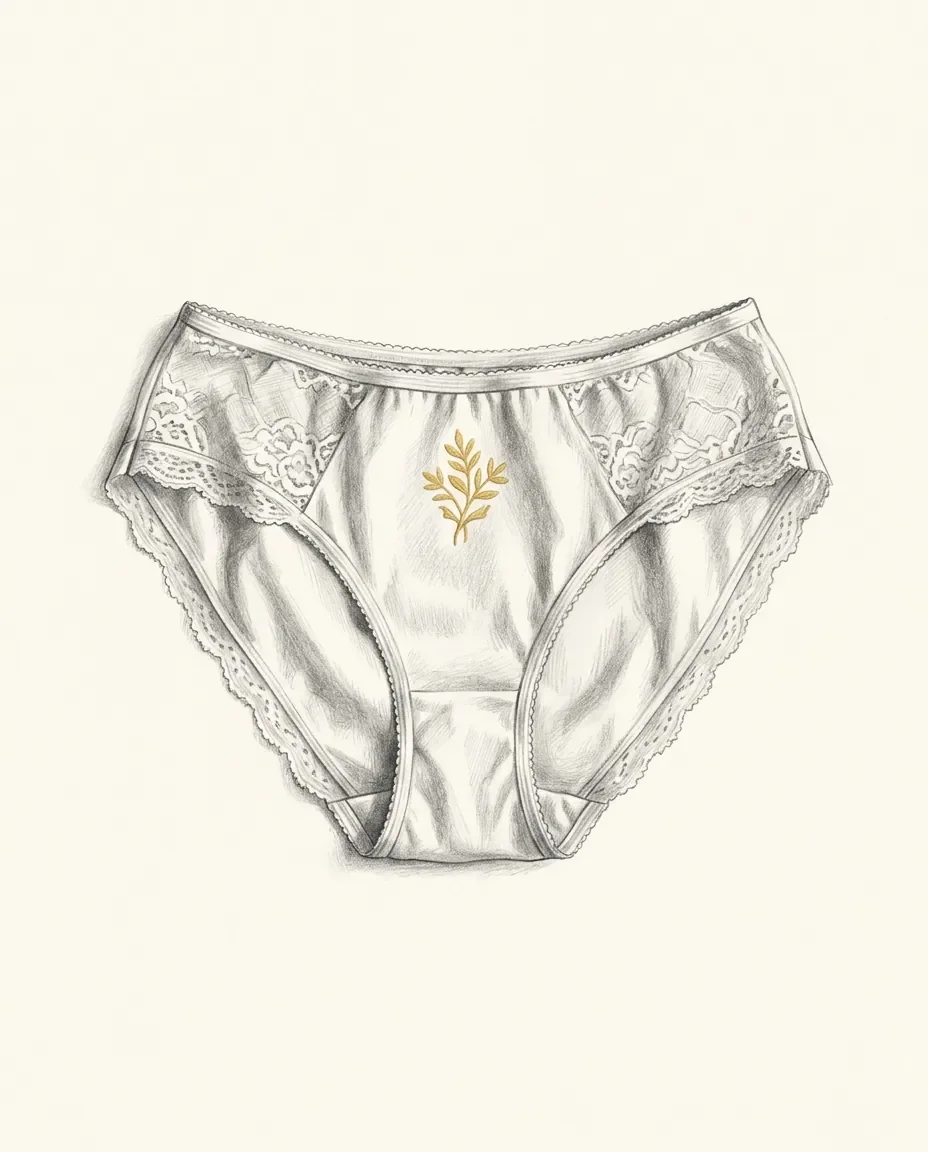
Panty Fetish
Garment fetishism (underwear subtype)
Added 21 Jun 2026 · Updated 22 Aug 2026
An erotic interest in underpants, panties or knickers, valued for their fabric, cut, intimate associations, and sometimes the scent of a worn pair. A common intimate-apparel fetish, not a disorder when it involves consenting adults and one's own or freely given items.
- Prevalence
- Common
- Category
- Clothing & Garments
- Clinical term
- Garment fetishism (underwear subtype)
- Domain
- Sexual interest
- Confidence
- Medium confidence
- Status
- Common intimate-apparel fetish; a normal variation, not a disorder unless it causes distress, impairment, or involves nonconsensual acquisition.
- Also known as
- Panty Fetishism, knicker kink, knicker fetish, underwear collecting (worn), worn-underwear fetish
- Added
- 21 Jun 2026
- Updated
- 22 Aug 2026
Featured in
Overview
Panty fetishism is a clothing-focused erotic interest in which underpants, variously called panties or knickers, become a strong source of arousal or fixation. The appeal can rest on the garment's fabric and cut (lace, cotton, silk, satin), its close contact with the body, its symbolic intimacy as a concealed private item, and, for some, the scent of a worn pair. It sits within the broad clinical category of garment (clothing) fetishism and is among the more frequently reported intimate-apparel interests. This article traces the garment's surprisingly modern history, the clinical lineage that frames the interest, how it is typically expressed, and the consent and legal boundaries that distinguish benign expression from unlawful acquisition.
Definition & scope
Panty fetishism refers to arousal centred on underpants specifically, as distinct from the wider lingerie interest that also takes in bras, corsetry and hosiery. For most people it is a heightened preference within otherwise ordinary attraction rather than a requirement for arousal. A meaningful internal split separates two expressions: interest in the garment itself (its cut, fabric and look, clean and unworn) and interest in a worn pair, where scent and the trace of a specific person carry the charge. Clinically, only the minority of cases that cause distress, impairment, or nonconsensual behaviour cross from interest into disorder.
Examples
What the term covers. A preference for a partner wearing a particular cut or fabric during intimacy; enjoyment of the garment on its own terms (lace, satin, cotton, the trim, the waistband) with nobody in it; collecting; wearing them oneself; and, for a distinct subset, the scent and trace of a worn pair, given by a partner or bought. A great many people's interest is entirely visual and involves acquiring nothing at all. The most useful division inside the interest is between the clean garment, where cut and fabric carry the charge, and the worn one, where a specific person does.
What the term does not cover. Lingerie fetishism is the broader intimate-apparel interest that also takes in bras, corsetry and hosiery; this is its underpants-specific subset. The neighbouring garment interests each have their own object: stockings, pantyhose, garter belts, lace, satin and swimwear. Wearing them oneself shades into cross-dressing where the point is the gendered dress rather than the garment as an object. A general erotic interest in body scent is olfactophilia, and endytophilia (arousal that requires a partner to stay clothed) is a different structure again. It is emphatically not kleptophilia: taking another person's underwear is theft, and arousal attached to the stealing itself is a separate, forensic category.
How the word is used. Plain modern English, with "panty fetish" the American form and "knicker fetish" the British; neither has a clinical pedigree of its own. The clinical placement is garment fetishism, the underwear subtype of the object-focused interests that DSM-5-TR and ICD-11 recognise, but both manuals reserve the diagnosis of Fetishistic Disorder for cases involving distress, impairment or harm to others, so the interest as such names no disorder.
History & origins
The garment is younger than the fetish concept
Unlike feet, hair, or skin, the panty is a recent object: modern women's underpants only took their familiar light, brief form in the twentieth century. The longer Victorian drawers were progressively shortened, resembling modern panties from roughly the 1920s, and continued to slim down through the 1930s and 1940s as cotton and stretch fabrics replaced linen. The cultural and erotic charge the garment now carries is therefore a product of that period; there is no ancient lineage to this specific interest, only the older, general human attachment to intimate clothing.
The vocabulary reflects this recency. Panties began in 1845 as a diminutive of pants (itself clipped from pantaloons), at first denoting men's drawers; the women's-and-children's-underpants sense is first recorded by 1908. The British knickers is a shortening of knickerbockers (1859) and acquired its women's-undergarment meaning by 1882.
Clinical lineage
The term panty fetish itself is plain modern English with no documented clinical coinage, but the category that contains it is well charted. Garment-focused cases were catalogued by Richard von Krafft-Ebing in Psychopathia Sexualis (1886), and sexual fetishism was named the following year by the French psychologist Alfred Binet, whose 1887 essay Le fétichisme dans l'amour built on an 1882 paper by Jean-Martin Charcot and Valentin Magnan and proposed that a fetish forms when an object linked to early, striking sexual emotion comes to dominate desire. Havelock Ellis later discussed clothing and its intimate associations in his Studies in the Psychology of Sex.
- 1882: Charcot and Magnan describe the eroticisation of specific objects, laying the groundwork.
- 1886: Krafft-Ebing's Psychopathia Sexualis documents garment fetishes among its case studies.
- 1887: Binet names le fétichisme dans l'amour, giving the interest its clinical frame.
- c. 1920s: Modern brief panties emerge as drawers are shortened, creating the recognizable garment.
- 20th-21st c.: Diagnostic manuals progressively narrow the disorder: today the DSM-5-TR and ICD-11 treat a fetishistic interest as benign, reserving "Fetishistic Disorder" for cases marked by distress, impairment, or harm to others.
This depathologisation mirrors the wider shift in how consensual kink is understood: the focus has moved from the unusual object to whether the interest causes suffering or violates consent.
In practice
Expression ranges widely and is, by definition, non-explicit in clinical description. It may involve a preference for partners wearing particular styles during consensual intimacy, enjoyment of the look and feel of the garment itself, or collecting underwear. For most people it functions as a heightened preference within otherwise conventional attraction rather than a requirement, and it overlaps substantially with broader lingerie and intimate-apparel interests; some enthusiasts also report adjacent attraction to swimwear.
Psychology
Panty fetishism fits the standard, if incompletely evidenced, models of fetish formation. The dominant account is associative learning: the garment becomes coupled to a formative sexual experience and acquires arousal value through conditioning, the mechanism Binet anticipated in 1887. Overlapping explanations emphasise the symbolic charge of underwear as a concealed, taboo, intensely private item, which heightens its erotic salience. For the subset whose interest centres on a worn pair, olfactory association is often cited, linking scent to a specific person or encounter. As with most fetishes, the causal evidence is thin and largely retrospective, and no single theory is established.
Prevalence & culture
How common is panty fetishism?
Direct, garment-specific prevalence figures are scarce, so estimates are anchored to broader fetishism research, which suggests intimate-apparel interest is common rather than rare. Joyal & Carpentier (2017), a representative provincial survey of 1,040 adults, found that 26% reported interest in fetishism: a level the authors describe as neither rare nor statistically unusual, and not significantly different between men and women. The large internet-based study by Scorolli et al. (2007) found that "objects usually associated with the body," the class that includes underwear and other garments, accounted for about 30% of fetish preferences, second only to body parts.
| Study | Year | Population | Finding relevant to garments |
|---|---|---|---|
| Scorolli et al. | 2007 | ~5,000 online fetish-group members | Body-associated objects (incl. underwear) ≈ 30% of preferences, second to body parts |
| Joyal & Carpentier | 2017 | 1,040 Québec adults | 26% report a fetishistic interest; no significant sex difference |
Culturally, underwear is among the most recognised garment fetishes, widely referenced in media and supporting sizeable online communities and a niche commercial market in worn items; the figures here remain approximations rather than directly measured values for panties alone.
Safety, consent & law
The interest is entirely benign when it involves one's own underwear, gifts, or items obtained from consenting adults, and ordinary norms of mutual consent apply. The one clear boundary is acquisition: taking or obtaining another person's underwear without consent is theft and may also constitute trespass or harassment, and using another person's intimate items without permission disregards their privacy. Documenting the interest is not an endorsement of nonconsensual acquisition, which is unlawful regardless of motive.
Common questions
Why do worn panties appeal to some people more than new ones?
Because a worn pair carries a trace of a specific person rather than of a garment type. The usual explanation is olfactory association: scent binds unusually well to memory and to a particular individual, so the same item that is merely pretty when new becomes personal once worn. It also explains the small commercial market in used underwear, where what is being sold is provenance rather than fabric.
Is it legal to buy or sell used underwear?
Selling one's own worn underwear to another adult is generally lawful, and a small commercial market exists for it, though platform rules and local trading and obscenity regulations vary and are worth checking. The clear illegality lies at the other end: taking someone's underwear without their consent is theft regardless of the motive, and can also amount to trespass or harassment.
What is the difference between a panty fetish and a lingerie fetish?
Scope. Lingerie fetishism covers intimate apparel broadly (bras, slips, corsetry, stockings) while a panty fetish is specifically about underpants. Most people with one have some measure of the other, and the labels are used loosely in practice, but the narrower term earns its keep when the interest genuinely stops at a single garment.
Is it strange for a man to wear panties?
It is common enough to be unremarkable, and it can mean several different things: an interest in the fabric and fit, in the garment as an object, or in wearing clothing coded as feminine, which is cross-dressing. None of these is a disorder in itself, and none reliably indicates anything about a person's sexual orientation or gender identity. Transvestic disorder is diagnosed only where the pattern causes genuine distress or impairment.
Do women have panty fetishes too?
Yes. Joyal and Carpentier's 2017 survey of 1,040 adults found that 26% reported a fetishistic interest, with no significant difference between the sexes, a result that cuts directly against the assumption that garment fetishism is a male phenomenon.
When does a panty fetish become a problem?
On two tests, both of which apply to every fetish. The first is distress or impairment: where the interest is so required for arousal that it damages a relationship, or causes the person real suffering, DSM-5-TR recognises Fetishistic Disorder. The second is consent: obtaining items from someone who has not agreed is theft and a violation of their privacy, whatever the state of mind behind it. Neither test is met by simply having the interest.
- Lingerie Fetish70/100Clothing & GarmentsAn erotic interest in lingerie and intimate apparel in which the garments themselves, their fabrics, and their styling become a focus of arousal. Bras, briefs, stockings, corsets and slips are typical. One of the most common and mainstream garment-related interests.70
- Swimsuit Fetish40/100Clothing & GarmentsAn erotic interest in swimwear valued for its tight stretch-fabric fit, smooth synthetic sheen, and revealing cut. Bikinis, one-piece suits and competitive racing suits are the usual focus. It is a common garment and material fetish, not a clinical disorder.40
- Boot Fetish52/100Clothing & GarmentsA sexual interest in boots, from knee-high and thigh-high fashion styles through riding, work, combat, and military boots. They are valued for their silhouette, materials, and connotations of authority. It overlaps with shoe, leather, and uniform fetishism.52
- High Heel Fetish56/100Altocalciphilia · Clothing & GarmentsA focused sexual interest in high-heeled shoes (stilettos, pumps, platforms) and the height, posture, and leg line they create. It is a common, generally harmless subtype of shoe fetishism.56
- Pantyhose Fetish52/100Garment fetishism (hosiery/legwear subtype) · Clothing & GarmentsA sexual interest in pantyhose and tights, sheer or opaque one-piece nylon legwear, focused on its full-leg coverage, smooth encasing texture, and look. A common close relative of stocking fetishism and one of the more historically recent garment interests.52
- Stocking Fetish57/100Clothing & GarmentsA sexual interest in stockings and hosiery, centered on sheer or textured legwear, seams, garters and the look and feel of nylon and silk. It is among the most common garment and material fetishes.57
A plain modern English compound. 'Panty' is a diminutive of 'pants' (clipped from 'pantaloons'), first recorded in 1845 for men's drawers and shifting to the women's/children's-underpants sense by 1908; the British synonym 'knickers' is a shortening of 'knickerbockers' (1859), gaining its undergarment meaning by 1882. 'Fetish' descends from Portuguese 'feitiço' ('charm, sorcery') via French 'fétiche'. The colloquial name has no distinct clinical derivation of its own.
underwear · intimate apparel · garment fetishism
Prevalence is computed from the entry's cited population estimate. Rows marked ESTare indicative editorial estimates scored against a fixed anchor rubric, not measured quantities. Method & anchors: methodology.
Common · ≈ 1 in 20
- 01Scorolli et al. (2007), Relative prevalence of different fetishes, Int. J. Impotence Research 19(4):432-437prevalence anchor: garments make up a large share of fetishes and underwear/intimate apparel is a leading clothing-fetish category
- 02Sexual fetishism, Wikipedia (carries the Scorolli 2007 relative-frequency table)carries the Scorolli clothing-fetish frequency table that includes underwear as a major garment category
- 03Joyal & Carpentier (2017), The Prevalence of Paraphilic Interests and Behaviors in the General Population, J. Sex Research 54(2):161-171provincial survey of 1,040 adults: 26% reported interest in fetishism, described as neither rare nor statistically unusual and similar across sexes
- 04Sexual fetishism, Wikipedia (history of the concept)Alfred Binet introduced 'le fétichisme dans l'amour' in 1887; Krafft-Ebing and DSM/ICD lineage distinguishing interest from disorder
- 05The Origins of the Theory of Sexual Fetishism: Charcot & Magnan (1882) and Alfred Binet (1887), SpringerBinet's 1887 'Le fétichisme dans l'amour' built on Charcot & Magnan (1882) and named sexual fetishism, proposing early-association origin
- 06Psychopathia Sexualis, Wikipediaconfirms Krafft-Ebing's Psychopathia Sexualis was first published in 1886 and catalogued a wide range of paraphilias including garment fetishes
- 07Panties, Wikipediamodern brief panties emerged from shortened drawers around the 1920s, slimming further through the 1930s-1940s
- 08panties, Etymonline'panties' first recorded 1845 as a diminutive of 'pants'; the women's/children's-underpants sense recorded by 1908
- 09knickers, Etymonline'knickers' is a shortening of 'knickerbockers' (1859) and acquired its women's-undergarment meaning by 1882
- 10DSM-5-TR, American Psychiatric AssociationDSM-5-TR distinguishes a benign fetishistic interest from Fetishistic Disorder, which requires distress, impairment, or harm
- 11ICD-11, World Health OrganizationICD-11 frames consensual fetishistic interest as non-pathological, classing disorders only where there is distress or harm to others