Cock And Ball Torture
Added 21 Jun 2026 · Updated 22 Aug 2026
A consensual BDSM practice involving controlled pain, pressure, restriction, or intense sensation applied to the male genitals. It is typically practised within a dominance-submission dynamic. A high-intensity activity practised by a small subset of kink communities, defined throughout by negotiated consent.
- Prevalence
- Uncommon
- Category
- Sensation & Pain
- Domain
- Sexual interest
- Confidence
- Low confidence
- Status
- Consensual high-intensity BDSM practice; not a disorder when consensual. Overlaps with consensual sexual masochism/sadism.
- Also known as
- Genital Pain Play (CBT), CBT, genital impact play, genital pain play, ball busting
- Added
- 21 Jun 2026
- Updated
- 22 Aug 2026
Featured in
Overview
Genital pain play, commonly abbreviated CBT, refers to the consensual application of pain, pressure, restriction, or intense sensation to the male genitals. It is a focused form of impact and sensation play, usually situated within a broader power-exchange or dominance–submission context rather than pursued in isolation. The defining frame is consent: between informed adults it is a carefully negotiated scene, while any non-consensual infliction of genital pain is assault. This article covers the clinical lineage of the pain interests it draws on, how the practice is expressed and understood psychologically, its place in kink culture, and the substantial safety considerations it carries.
Examples
What the term covers. CBT is a family rather than a single activity, and its members share only a target. At the lighter end sit squeezing, slapping and light restriction; further along, weighted stretchers and parachutes, testicle cuffs, a humbler, clamping and pinching, figging, wax play and low-current electrostimulation. Ballbusting (blunt force delivered by kicking, kneeing or striking) is the best-known named subset and the one with a substantial following of its own. Nearly all of it is performed inside a negotiated dominance and submission frame rather than as sensation for its own sake.
What the term does not cover. Practices that control the genitals without hurting them are a different thing: chastity play, cock warming, orgasm denial and tease and denial all restrict or withhold rather than inflict. Sounding is urethral insertion, with a risk profile of its own and no necessary pain component. Small penis humiliation is genital-themed and purely verbal. A penis fetish is an attraction to the organ, not an interest in acting on it. And genital pain inflicted on anyone who has not agreed to it is assault, a criminal offence, not a variety of this.
How the word is used. It is BDSM community vernacular: no clinician coined it, and neither DSM-5-TR nor ICD-11 names it, listing only sexual masochism and sadism disorders, which require distress, impairment or a non-consenting person. The initialism collides squarely with cognitive behavioural therapy, and context is the only thing separating them; "genital pain play" is the neutral phrasing used where that ambiguity matters.
History & origins
Clinical lineage of consensual pain
The eroticisation of given and received pain has been documented in the clinical literature since the nineteenth century, and CBT inherits that lineage as a localised, genital-focused variant rather than as a separately coined diagnosis.
- 1886: Richard von Krafft-Ebing's Psychopathia Sexualis introduced the paired terms masochism and sadism, naming the former after the novelist Leopold von Sacher-Masoch and the latter after the Marquis de Sade, and described arousal tied to inflicted or received pain.
- 1905: Sigmund Freud's Three Essays on the Theory of Sexuality treated sadism and masochism as paired components of erotic life, situating pain-linked arousal within ordinary psychosexual development rather than as pure pathology.
- 1913: the Viennese analyst Isidor Sadger first fused the two into the single compound sadomasochism, the umbrella under which consensual pain play is now usually grouped.
- Twentieth century: Havelock Ellis's Studies in the Psychology of Sex reframed such interests as continuous with normal eroticism, and the modern diagnostic manuals later separated consensual kink from disorder: the DSM-5-TR and ICD-11 classify sexual masochism and sadism as disorders only when they cause distress, impairment, or harm to non-consenting others.
Cultural & subcultural evolution
Genital-focused pain play is not a separately coined clinical category; the phrase "cock and ball torture" and its abbreviation CBT emerged from late-twentieth-century BDSM subculture as community vernacular for a specialised localised practice. Its precise coinage is not well documented, but it entered wide use alongside the post-1970s growth of organised gay-leather and pansexual kink communities and their educational gatherings, workshops and how-to manuals. A distinct Japanese variant, tamakeri ("ball kicking"), developed its own following, illustrating how the interest recurs across separate erotic cultures.
In practice
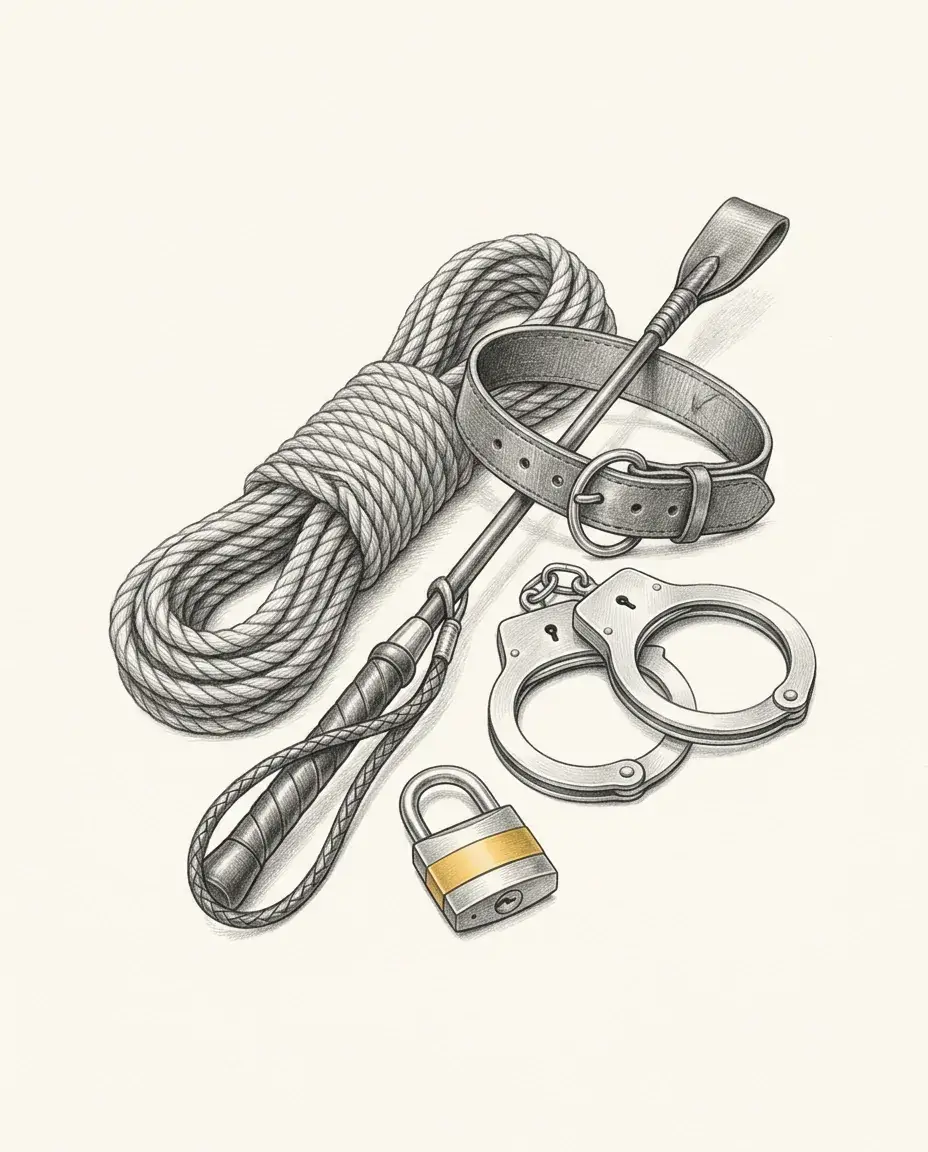
Expression ranges widely in intensity and tends to emphasise psychological dynamics as much as physical sensation: trust, surrender, endurance, and the symbolic vulnerability of an especially sensitive area. Documented implements span a spectrum of purpose:
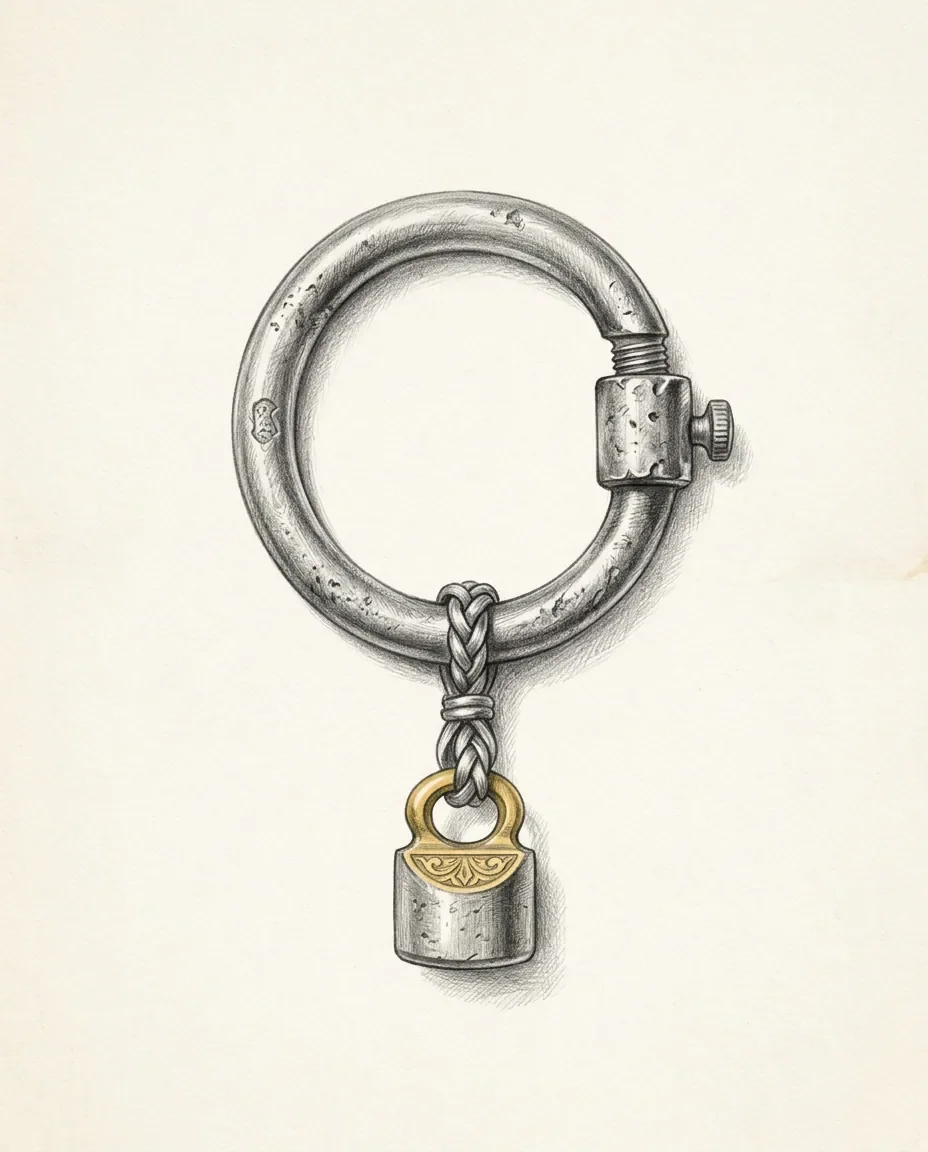
- Stretchers: weighted or rigid rings (commonly leather, rubber, or stainless steel) that elongate the scrotum.
- Parachutes: a collar around the scrotum from which light weights are suspended.
- Restriction devices such as testicle cuffs or a humbler, which enforce a submissive posture and are sometimes read as symbols of "ownership" in a dominance dynamic.
- Impact and sensation: graded striking, and (with separate skill sets) wax play or low-current electrostimulation.
For receiving partners the draw is often the heightened focus and the trust required; for giving partners it is the control and the care involved in managing a delicate scene. Sessions are typically negotiated in advance, escalate conservatively, and rely on agreed signals: overlapping in ethos with the instinctive, unscripted energy of primal play at one end and tightly choreographed protocol at the other. The related Japanese kick-focused practice tamakeri has its own following, and a schoolyard prank called denkianma ("electric massage") shares the anatomical target without the negotiated, erotic frame that defines consensual play.
Psychology
Psychologically the practice overlaps with consensual masochism and sadism and with the broader appeal of intense, edge-of-tolerance sensation. Pain that is consensual and contextualised can be experienced as pleasurable or even transcendent through heightened arousal, endogenous-opioid (endorphin) release, and the meaning assigned within a scene; the same stimulus that would be aversive in another setting is reframed by trust and erotic context. Surveys treat such pain interests as common rather than aberrant: Joyal and Carpentier (2017) found roughly 23% of a general-population sample reported interest in masochism and around 20% in sadism, well above the threshold for "statistically unusual." Sensitivities and limits differ greatly between individuals, and the experience is shaped as much by relational trust as by the stimulus itself.
Prevalence & culture
How common is it?
It is a small, specialised niche. CBT has limited mainstream visibility and a relatively small but well-established niche presence in kink communities, on platforms such as FetLife, and in educational spaces. Dedicated research on this specific practice is minimal, so its prevalence is best estimated from its position as a specialised branch of more widely surveyed BDSM interests. Broad fantasy surveys place general interest in consensual pain far higher than this narrow localised specialty: Lehmiller (2018), sampling 4,175 Americans, found about 65% had fantasised about receiving pain and 60% about inflicting it. CBT represents a small, intense subset of that much broader interest, not the umbrella itself.
Safety, consent & law
This is a high-risk activity given the vulnerability of the tissues involved, with potential for serious injury (including impaired blood flow, testicular torsion, or rupture) if mishandled. Responsible practice depends on thorough anatomical knowledge, conservative escalation, clear and ongoing consent, safewords, and aftercare; it is considered benign only as consensual adult play conducted with informed caution, and any sign of numbness or loss of colour is treated as a medical-emergency warning rather than a measure of intensity. Legally, it is lawful between consenting adults in many jurisdictions, but in some, following precedents such as the United Kingdom's R v Brown, consent may not be a defence where serious bodily injury results. Non-consensual infliction of genital pain is assault.
Common questions
Is CBT dangerous?
Yes, genuinely. The tissues involved are thin, densely innervated and poorly protected, and the documented failure modes are serious: impaired blood flow, testicular torsion and rupture, each a surgical emergency. This is one of the practices where knowledge and conservative escalation reduce the risk without removing it, which is why it carries an extreme-risk flag in this catalog rather than the ordinary caution attached to most consensual kink.
What does CBT stand for?
In a kink context, cock and ball torture: the consensual application of pain, pressure or restriction to the male genitals. The abbreviation is identical to the one used for cognitive behavioural therapy, and there is no relationship whatsoever between the two; which is meant depends entirely on where you are reading it. "Genital pain play" is the neutral phrasing sometimes preferred in educational settings for exactly that reason.
Is CBT the same as ballbusting?
No, ballbusting is one part of it, the blunt-impact subset, delivered by kicking, kneeing, squeezing or striking the testicles. CBT is the wider family and takes in binding, stretching, weights, clamping, heat and electrostimulation, most of which involve no strike at all. Ballbusting has enough of a following, and enough vocabulary of its own, to be treated as a practice in its own right.
Why would anyone want this?
The appeal is rarely about pain in isolation. Consensual pain in an erotic context is reframed by trust, by meaning, and by the body's own response (heightened arousal and endorphin release), so a stimulus that would be intolerable elsewhere reads differently inside a scene. For the receiving partner the draw is usually endurance and surrender in an unusually vulnerable place; for the giving partner, control paired with the care a delicate scene demands.
What are the warning signs that something has gone wrong?
Numbness or loss of sensation, skin turning pale or dark, coldness, swelling, or severe pain that does not subside once pressure is released. Sudden intense testicular pain with nausea and swelling is the presentation associated with testicular torsion, which is time-critical: the organ can be lost if treatment is delayed. None of these should be waited out, and embarrassment about the circumstances is the commonest reason people delay seeking care.
Is CBT legal?
It depends on the jurisdiction and on how much injury results. Between consenting adults it is lawful in many places, but some legal systems limit what a person may consent to: the United Kingdom's R v Brown held that consent is not a defence to assault occasioning bodily harm in a sadomasochistic context, and comparable limits exist elsewhere. Inflicting genital pain on someone who has not agreed is assault under any of these systems.
Is CBT a paraphilia or a mental disorder?
No. It is named in neither DSM-5-TR nor ICD-11. The nearest diagnostic entries, sexual masochism disorder and sexual sadism disorder, apply only where the interest causes marked distress or impairment or is acted on with someone who has not consented. For context, Joyal and Carpentier (2017) found masochistic interest reported by about 23% of a general-population sample and sadistic interest by about 20%, well outside the range of the statistically unusual.
- Dominance and Submission92/100Power, Roles & ScenariosA consensual erotic dynamic in which one partner takes a dominant role and the other a submissive role, exchanging power within agreed limits. It is one of the most widespread elements of BDSM and of human sexual fantasy.92
- Primal Play33/100Identity & TransformationA consensual style of intimacy in which partners drop social restraint and act from an instinctual, animalistic headspace. It most often takes the form of predator-and-prey dynamics. In its feral register it overlaps with therian identity and inner-animal embodiment rather than scripted scenes.33
- Knife Play36/100Sensation & PainA high-risk form of consensual BDSM sensation and fear play using the touch, presence, or threat of a sharp edge such as a knife. The appeal centres on intense sensation, trust, adrenaline and psychological charge within a negotiated frame, not on injury, and it is distinct from blood play.36
- Bastinado / Foot Whipping37/100Sensation & PainConsensual impact play that concentrates strokes on the bare soles of the feet, a foot-centred subset of BDSM sensation play. Because the soles are nerve-dense and lightly padded, it yields intense sensation and carries elevated injury risk, so practitioners keep it firmly risk-aware.37
- Needle Play37/100Sensation & PainConsensual BDSM practice in which fine sterile needles are passed temporarily through the surface of the skin for sensation, ritual, or visual effect. They are removed at the end of the scene. A higher-risk edge practice distinct from permanent body piercing.37
- Wartenberg Wheel Play34/100Sensation & PainSensation play using a Wartenberg wheel, a spiked, freely rotating pinwheel rolled across the skin to produce a prickling, tingling stimulus. The wheel was originally a neurological diagnostic instrument. It sits within broader sensation and impact-adjacent play rather than causing injury when used as intended.34
A plain-English descriptive term from BDSM community vernacular; the abbreviation "CBT" simply initialises the phrase. The underlying clinical concepts it draws on, masochism and sadism, were coined by Richard von Krafft-Ebing in Psychopathia Sexualis (1886), after the novelist Leopold von Sacher-Masoch and the Marquis de Sade respectively, and fused into "sadomasochism" by Isidor Sadger in 1913. The Japanese variant tamakeri means "ball kicking".
localized pain · consensual pain · high-intensity sensation
Prevalence is computed from the entry's cited population estimate. Rows marked ESTare indicative editorial estimates scored against a fixed anchor rubric, not measured quantities. Method & anchors: methodology.
Uncommon · ≈ 1 in 100
- 01Joyal & Carpentier (2017), The Prevalence of Paraphilic Interests and Behaviors in the General Population, J. Sex Research 54(2):161-171general-population active interest in masochism ~23% / sadism ~20%; CBT is a high-intensity localized subset well below the umbrella rate
- 02Lehmiller (2018), Tell Me What You Want, survey of 4,175 Americanspain-play fantasy prevalence (receiving ~65%, inflicting ~60%) frames CBT as a narrow specialty within consensual pain play
- 03An A–Z of Kinks and Fetishes, Glamourlay framing of CBT as a recognized BDSM impact/pain practice
- 04Krafft-Ebing, Psychopathia Sexualis (1886)first clinical coinage of masochism and sadism as eroticized pain, the conceptual lineage of consensual pain play
- 05Sadomasochism, WikipediaKrafft-Ebing's naming of sadism/masochism after de Sade and Sacher-Masoch, and Isidor Sadger's 1913 fusion into the compound 'sadomasochism'
- 06Three Essays on the Theory of Sexuality, WikipediaFreud (1905) framing sadism and masochism as paired components of ordinary psychosexual development
- 07Cock and ball torture (sexual practice), Wikipediadefinition, common implements, the tamakeri variant, undocumented coinage of the term, and medical-emergency risks (impaired blood flow, torsion, rupture)
- 08R v Brown (1993), WikipediaUK precedent that consent is not a defence to assault occasioning bodily harm in consensual sadomasochism
- 09DSM-5-TR, Paraphilic Disorders (American Psychiatric Association, 2022)sexual masochism/sadism are disorders only when they cause distress, impairment, or harm to non-consenting others
- 10ICD-11, Paraphilic disorders (World Health Organization)consensual sadomasochism is distinguished from coercive sadism in the ICD-11 paraphilic disorders framework