Violet Wand Play
Added 26 Jul 2026 · Updated 22 Aug 2026
Violet wand play uses a repurposed early-20th-century electrotherapy device to send a spark through glass or metal electrodes onto the skin. The spark is low-current, high-frequency and high-voltage, producing a tingling, prickling, or crackling sensation.
- Prevalence
- Rare
- Category
- Sensation & Pain
- Domain
- Sexual interest
- Confidence
- Low confidence
- Status
- Not a recognized paraphilia or disorder; a consensual sensation-play practice using a repurposed early-20th-century electrotherapy device, contraindicated for anyone with a pacemaker or other implanted electronic device, epilepsy, or pregnancy.
- Also known as
- violet wand, violet ray, electrostatic wand play
- Added
- 26 Jul 2026
- Updated
- 22 Aug 2026
Featured in
Overview
Violet wand play is a sensation practice built around a device with an unusually documented past: a high-frequency, high-voltage, low-current electrical wand, originally sold as home medical equipment, now repurposed inside BDSM and sensation-play communities. When switched on, the wand's interchangeable glass or metal electrode produces a visible violet-tinted glow and a crackling spark that can be drawn across, or held near, bare skin, producing sensations ranging from a light prickling static to a sharper, localized bite depending on the electrode and distance used. It is closely related to, yet historically and technically distinct from, electro play, which more often relies on direct current delivered through contact pads.
Examples
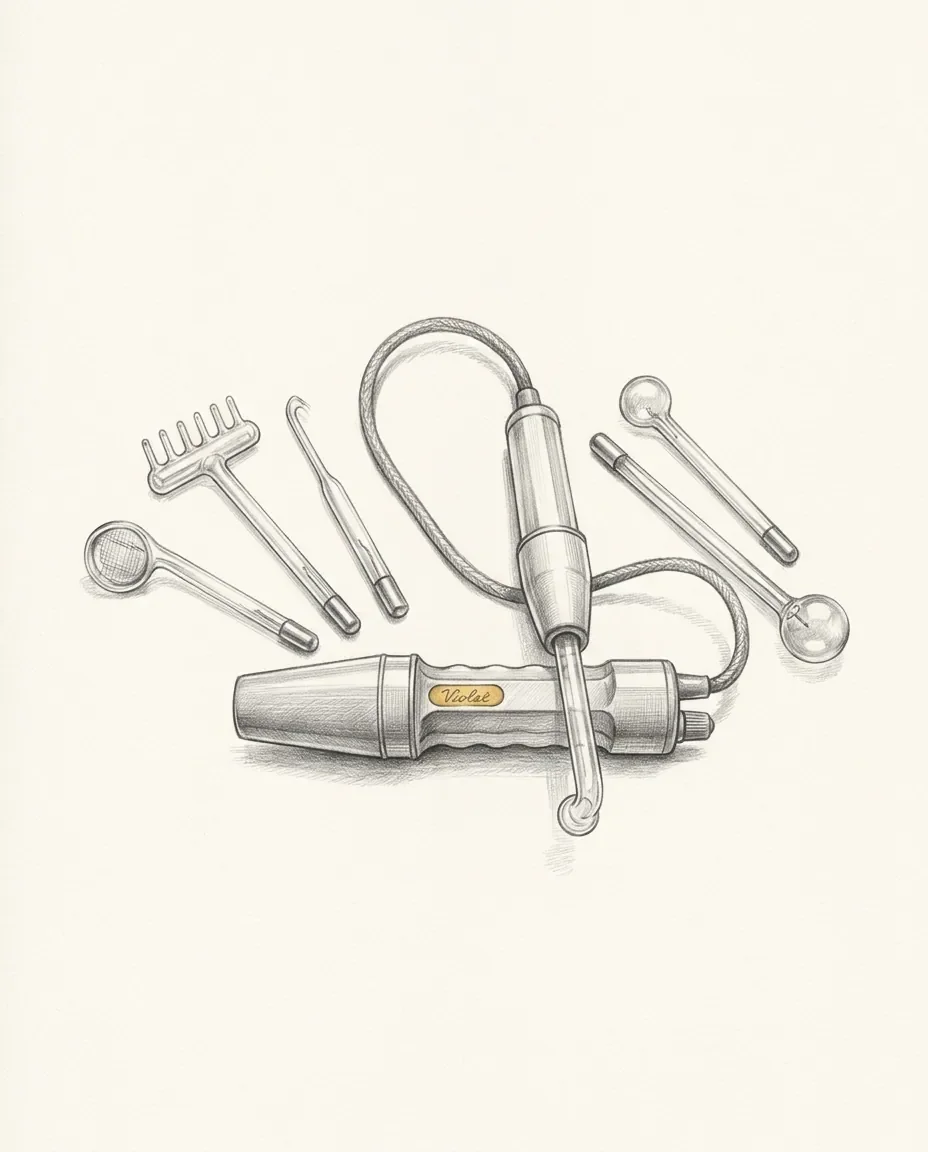
What the term covers. A glass mushroom or comb electrode drawn slowly across a back, thigh or arm in direct contact, giving a diffuse, prickling fizz; the same electrode lifted a few millimetres so the discharge arcs the gap as a sharper, brighter point; a metal electrode used for a more concentrated bite; and the "through-partner" mode, in which the operator holds the unit and the charge passes out of their own fingertips. The theatre counts as much as the sensation: the violet glow inside the evacuated glass, the audible crackle and the faint smell of ozone are all part of what the practice is for.
What the term does not cover. Electro play in the general sense usually means contact pads and a lower-frequency current run through tissue, which can drive involuntary muscle contraction; the violet wand's discharge stays at the skin surface and does not. A Wartenberg wheel produces a comparable prickling with no electricity at all, and temperature play and wax play are the neighbouring sensation practices it is most often grouped with. Its antique-clinical look means the wand turns up inside medical-setting kink and doctor/nurse role-play, but there it is an instrument used in the scene, not a scenario of its own.
How the word is used. "Violet wand" is community jargon dating from the 1990s adoption; "violet ray" is the original manufacturers' name for the same machine, and both name a device rather than a desire. Neither is a clinical term and neither appears in DSM-5-TR, which catalogues attractions, not equipment.
History & origins
Electrotherapy origins
The device traces to the boom in "high-frequency" electrotherapy that followed Nikola Tesla's early-1890s work on resonant coils, technology he showed publicly at the 1893 World's Columbian Exposition. French physician Jacques-Arsène d'Arsonval (1851–1940), a pioneer of electrophysiology, had begun studying the physiological effects of alternating current in 1889 and found that currents above roughly 5,000 Hz could pass through the body without triggering painful muscle contraction, a technique that came to be called "d'Arsonvalization." Working with fellow French physician Paul Marie Oudin, d'Arsonval adapted Tesla's coil into a safer therapeutic instrument, and Oudin built a working prototype of what became the violet-ray device in 1893, according to IEEE Spectrum's history of the machine. An American version followed from inventor Frederick Strong in 1897, and portable units became commercially viable household goods after 1915.
The quack-medicine boom and its collapse
Through the 1920s, American manufacturers including Renulife, Fitzgerald, Fisher, Star Electric, and Master Electric sold violet-ray sets by mail order and in drugstores, promising relief for ailments from "rheumatism and nervous conditions" to "acne and baldness," "brain fog," and "nasal catarrh," applied through differently shaped glass electrodes for the face, scalp, and body, per Wikipedia's account of the device. The psychic Edgar Cayce endorsed violet-ray use in nearly 900 of his roughly 14,000 recorded readings, which is credited with meaningfully boosting consumer sales. The Journal of the American Medical Association dismissed the exaggerated medical claims as early as 1917, and enforcement followed decades later, though the surviving accounts of it differ in their particulars: IEEE Spectrum records that in 1951 a Maryland district court ruled against a manufacturer named Master Appliances on a misbranding charge, finding the device neither an effective treatment nor capable of the results claimed for it, and describes that ruling as effectively ending production in the United States, while Wikipedia records a 1951 lawsuit in Marion, Indiana, against Master Electric, which it calls the last American manufacturer of the machines, and the seizure of its devices by the Food and Drug Administration.
From medical cabinet to dungeon
With therapeutic sales gone, surviving devices drifted into flea markets and collector circles as curiosities. Their second life began in the 1990s, when, per Wikipedia, the same devices became popular under the new name "violet wand" as "relatively safe electrical stimulation devices for erotic electrostimulation." A history of the device's adoption by professional dominatrices, published by Anne O Nomis, points to three overlapping reasons: many dominatrices came from nursing or medical-roleplay backgrounds that made a clinical-looking instrument a natural fit; the buzzing sound, violet glow, and faint ozone smell created a strong psychological effect independent of the physical sensation; and the devices' vintage design and scarcity gave them collectible appeal within kink communities. That combination carried the violet wand into contemporary BDSM munches, workshops, and specialty retailers as a recognized, named tool rather than a generic "electro" device.
In practice
The control unit houses an interrupter and a step-up coil; a handle holds interchangeable evacuated glass or metal electrode attachments, shaped as wands, combs, mushrooms, or rollers, each producing a different spread and intensity of spark. Direct contact, electrode touching skin, gives a milder, diffuse tingling; indirect contact, the electrode held a small distance off so a spark arcs across the gap, gives a sharper, more localized sensation. A "through-partner" mode has the operator hold the wand while touching a partner, passing a milder charge through the operator's own body. Sessions are negotiated in advance around intensity and target areas, on dry, unbroken skin, away from metal jewelry, the eyes, the head, and the chest near the heart.
Psychology
As with other forms of sensation play, part of the appeal lies in a startling, hard-to-predict stimulus that keeps attention locked onto the body in the present moment. The violet wand adds a distinct theatrical layer largely absent from plainer electro-stim units: a visible glow, an audible crackle, and an antique, faintly clinical appearance that can heighten anticipation and a sense of ceremony or ritual before the sensation itself even arrives, an effect O Nomis's history frames explicitly as psychological "mind-fuckery" built on anticipation and mild fear as much as on the physical spark. This overlaps with the same trust, control, and heightened-sensation dynamics documented across temperature play and other sensation-focused BDSM practices, though no dedicated clinical or academic literature exists on violet wand use specifically.
Prevalence & culture
Violet wand play remains a specialty niche even within kink communities: it requires a dedicated device, sold mainly through fetish retailers rather than general adult shops, and is far less commonly reported than mainstream practices such as impact play. Its visibility owes much to its unusual documented medical backstory, which has made it a recurring subject in kink journalism and history writing, including features in Vice on hands-on workshops, alongside its niche but durable following among dominatrices and sensation-play enthusiasts.
Safety, consent & law
The device is contraindicated for anyone with a pacemaker or other implanted electronic device, epilepsy, or who is pregnant, so negotiating medical history in advance is standard practice, along with avoiding the head, eyes, and the area over the heart, and never using it near broken skin or wet surfaces. Educators describe the modern violet wand as comparatively low-risk when these precautions are followed, since the current is low relative to the voltage, unlike direct-current e-stim units that can cause muscle tetany. It is not classified in the DSM-5-TR as a paraphilia or disorder; between consenting adults it is legal, subject to the same consent-to-injury principles that apply to other BDSM sensation play.
Common questions
Does a violet wand hurt?
It can, but the range is wide and two things control it: the electrode and the gap. An electrode resting flat on the skin spreads the discharge over a large area and reads as a warm fizz or tingle. Lift it a few millimetres and the same output concentrates into an arc that reads as a sharp, bright sting on one small point. Metal electrodes concentrate it further still.
Can a violet wand electrocute you?
Not in the way mains current can. The output is high voltage at high frequency and very low current, and the discharge stays at the skin surface rather than passing through the body, which is why it does not cause the muscle contraction that direct-current units can. That is not the same as harmless: it is contraindicated for anyone with a pacemaker or other implanted electronic device, epilepsy or pregnancy, and it is kept away from the eyes, the head and the chest over the heart.
What is the difference between a violet wand and an e-stim or TENS unit?
Different current, different sensation, different risk profile. E-stim and TENS units pass a lower-frequency current between contact pads and through the tissue in between, which can drive muscle contraction. A violet wand produces a surface corona discharge from a single electrode and never completes a circuit through the torso. Electro play is the general term that covers both.
Is a violet wand a Tesla coil?
It is a descendant of one. The technology comes from Nikola Tesla's early-1890s work on resonant coils, adapted into a small medical instrument by the French physicians Jacques-Arsène d'Arsonval and Paul Marie Oudin, who built a working prototype in 1893. A violet wand is a compact handheld version producing a corona discharge at a glass electrode, not the large spark-gap coil the name usually brings to mind.
Can you still use an antique violet ray machine?
The original sets survive in collector circles and flea markets, and their vintage look is part of why the device was adopted for kink at all. They are also a century old: wiring, insulation and glass from that era were never built to a modern electrical-safety standard, and the machines left the market as misbranded medical devices rather than as retired safe ones. Workshops and retailers deal in purpose-built modern wands.
Is violet wand play a fetish or a paraphilia?
Neither, on the usual definitions. It names a tool and what is done with it rather than an attraction to an object: the interest is in the sensation and the theatre, and people who enjoy it generally enjoy other sensation play too. It has no entry in the DSM-5-TR and no distinct clinical classification of any kind.
- Electro Play39/100Sensation & PainA consensual sensation interest in which mild electrical current is used to produce tingling, buzzing, or muscle-twitching sensations on the body. It is practiced within BDSM and sensation-play communities using purpose-built or repurposed devices.39
- Sensation Play45/100Sensation & PainAn interest in heightened, varied skin sensations created with soft, textured, or lightly stimulating implements. Feathers, fur, silk, brushes, ice, or pinwheels are typical, often combined with anticipation and the contrast between soothing and prickling touch. It is a common, gentle form of erotic play.45
- Temperature Play49/100Sensation & PainConsensual sensation play that uses warmth and cold, such as ice, chilled or warmed objects, and contrasting temperatures, to heighten skin sensation. It is a gentle, accessible branch of BDSM sensation play centered on thermal contrast.49
- Pain Play58/100Algolagnia · Sensation & PainPain play (algolagnia) is a clinical umbrella term for sexual arousal connected to physical pain, whether that pain is received or inflicted. The received form is labelled active/masochistic, the inflicted form passive/sadistic. It frames pain itself, not any specific implement, as the source of erotic interest.58
- Impact Play71/100Sensation & PainAn umbrella term for consensual BDSM activities in which one partner strikes another's body with a hand or implement for erotic sensation or power exchange. It spans light spanking through to firmer use of paddles, floggers, crops, and canes within negotiated limits.71
- Sensory Overload Play29/100Sensation & PainA consensual sensation-play practice of deliberately flooding the senses with intense, layered, or competing input. Overlapping touch, temperature, sound, and light produce an overwhelming, disorienting state. It is the mirror image of sensory deprivation.29
Named for the faint violet glow produced when the corona discharge excites the rarefied gas sealed inside the device's evacuated glass electrode; "wand" describes the handheld shape of the interchangeable electrode attachments. The original clinical name "violet ray" dates to the device's early-20th-century electrotherapy marketing; kink communities adopted the rebranded name "violet wand" for the same technology in the 1990s.
electrostimulation · corona discharge · sensation play · bdsm device
Prevalence is computed from the entry's cited population estimate. Rows marked ESTare indicative editorial estimates scored against a fixed anchor rubric, not measured quantities. Method & anchors: methodology.
Rare · ≈ 1 in 1,000
- 01Violet ray, Wikipediadevice construction, 1920s manufacturers, marketed medical claims, Edgar Cayce endorsement, the 1951 Marion, Indiana lawsuit against Master Electric and the FDA seizure of its devices, and the 1990s rebranding as a BDSM "violet wand"
- 02What Was the Violet Ray Machine?, IEEE SpectrumTesla's early-1890s coil work, d'Arsonval/Oudin's 1893 prototype, Frederick Strong's 1897 US version, 1917 JAMA dismissal of medical claims, and the 1951 Maryland district court misbranding ruling against Master Appliances that effectively ended US production
- 03Jacques-Arsène d'Arsonval, Wikipediad'Arsonval's dates and biography, his 1889 research on alternating current, and the therapeutic "d'Arsonvalization" technique behind the device
- 04The Violet Ray: 20th Century Medical History & Modern-Day BDSM Use, Anne O Nomisthe three documented reasons professional dominatrices adopted violet wands, and its psychological "mind-fuckery" appeal
- 05I Took a First Date to be Sexually Electrocuted at a Violet Wand Workshop, Vicecontemporary cultural visibility of violet wand workshops within kink communities
- 06DSM-5-TR, Paraphilic Disorders (American Psychiatric Association, 2022)confirms the practice has no distinct clinical classification as a paraphilia or disorder