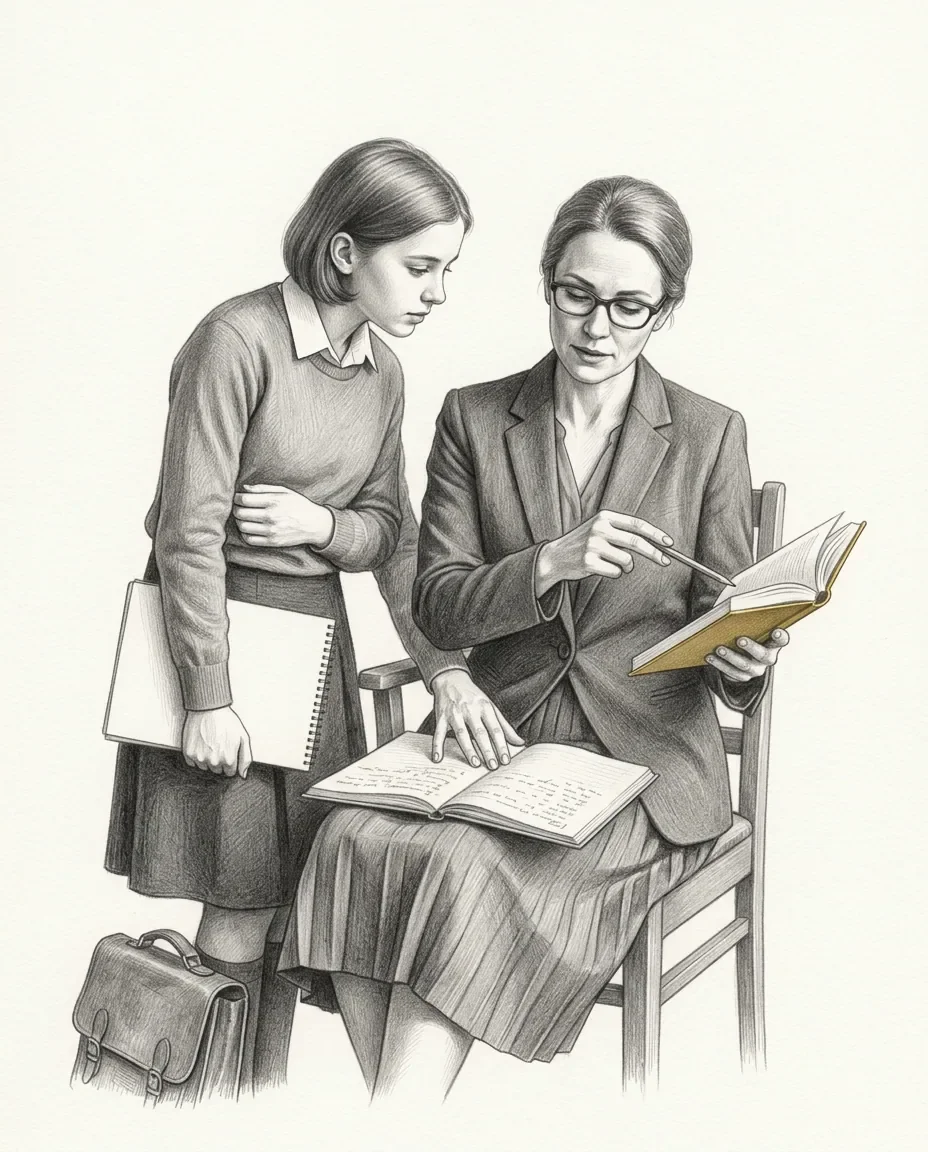
Teacher Roleplay
Added 21 Jun 2026 · Updated 22 Aug 2026
An authority role-play sub-genre built around an imagined power gap between a figure of rank and a subordinate: teacher and student. Professor, boss and employee, and coach are other pairings in the same mode. Arousal comes from the eroticized hierarchy enacted between consenting adults inside a fictional frame.
- Prevalence
- Very common
- Category
- Power, Roles & Scenarios
- Domain
- Sexual interest
- Confidence
- Medium confidence
- Status
- Not a paraphilia or disorder; a common role-play sub-genre among consenting adults.
- Also known as
- Authority/teacher role-play, teacher/student role-play, boss/employee, professor scenario, schoolroom role-play, authority role-play, power-dynamic role-play
- Added
- 21 Jun 2026
- Updated
- 22 Aug 2026
Featured in

Overview
Teacher role-play, more broadly authority role-play, is a category of sexual role-play organized around a difference in institutional or social rank: one consenting adult plays an authority figure (teacher, professor, boss, officer, coach) while another plays a subordinate (student, employee, recruit). The eroticism centres on the imagined power differential, the rules and consequences of an institution, and the frisson of crossing a forbidden boundary: all held safely inside a fictional, negotiated frame between adults.
Examples
What the term covers. Two adults agreeing that, for the length of a scene, one of them outranks the other. The classroom version is the best known (formal address, a stated rule, a consequence for breaking it), but the same structure carries the manager and the employee, the interrogator and the suspect, the coach and the recruit, and the clinician and the patient. Costume usually does the signalling, which is where it meets the uniform fetish, and the consequence half of the script frequently borrows from discipline and spanking. Both participants are adults, and both are playing adults.
What the term does not cover. It is not age play, which reorganises age rather than rank and comes with a caregiving dynamic this does not have. It is emphatically not a euphemism for anything involving real minors: an attraction to actual minors is a separate and entirely different subject, assessed on its own terms, with nothing in common with two adults inventing a hierarchy between them. Nor is it cosplay, where the appeal is the character rather than the rank, or general dominance and submission, which needs no institution to hang on. Most importantly, it is not a real authority relationship: a scene played out with an actual student, employee or subordinate is not this and cannot be, because genuine rank makes free consent impossible.
How the word is used. It is vernacular: a media category label and a heading in lay kink glossaries, with no clinical term behind it and no entry in DSM-5-TR or ICD-11. "Authority role-play" is the more accurate umbrella, since the classroom is only its most recognisable costume; the schoolroom version simply supplies the props everyone can picture.
History & origins
Clinical lineage
The scenario has no single inventor; it is best understood as one expression of older threads that nineteenth- and twentieth-century sexology gradually mapped.
- 1886: Richard von Krafft-Ebing's Psychopathia Sexualis introduced the paired terms sadism and masochism for pleasure taken in dominating or submitting, giving clinicians a vocabulary for eroticized power.
- 1905: Sigmund Freud's Three Essays on the Theory of Sexuality linked adult desire to charged early relationships with authority figures, an idea later popular culture freely borrowed for the teacher/student trope.
- Later twentieth century: As consensual kink was reframed as a normal variation (reflected in the DSM's progressive separation of a consensual interest from a disorder), authority role-play was understood as ordinary fantasy play rather than pathology. The current DSM-5-TR treats such consensual interests as non-disordered unless they cause distress or harm.
Cultural & subcultural evolution
As the Wikipedia overview of sexual roleplay records, authority pairings (teacher/student, doctor/patient, officer/suspect, executive/secretary) are among its most frequently named scripts, and most incorporate a power differential drawn from the wider dominance and submission tradition. The discipline-and-authority motif moved from underground writing into mainstream entertainment over the twentieth century, and the costume-and-classroom version in particular became a pop-culture staple (often signalled by uniform cues). Its precise coinage as a named script is not well documented; it is a vernacular category rather than a clinically defined term.
In practice
It is typically expressed through scripted scenarios, costumes and props that evoke a setting (an office, classroom dressing, formal attire), formal modes of address, and a measured play of command and compliance. It frequently overlaps with dominance and submission and discipline themes, and partners usually negotiate the scene's tone, intensity and limits in advance. The essential move is that both people know the rank is invented: the "teacher" holds no real power over the "student," and either can end the scene.
Psychology
What causes the appeal?
The draw usually lies in three things: the structured power exchange that a clear hierarchy provides, the safe enactment of taboo (an off-limits relationship made acceptable through pretend), and the relief of well-defined roles. As with role-play generally, the fictional frame lets people rehearse dynamics they would never act on in life, separating the thrill of the script from any real relationship. The evidence base approaches this through general fantasy and power-exchange research rather than studies specific to the teacher/student script.
Is it a sign of a problem?
No. Enjoying enacted authority is not a disorder or a marker of poor adjustment. Wismeijer & van Assen (2013), comparing 902 BDSM practitioners with 434 controls, found practitioners were on average less neurotic, more extraverted and conscientious, and higher in subjective well-being, and framed such interests as recreational leisure rather than psychopathology.
Prevalence & culture
How common is it?
Authority scenarios are among the more frequently cited role-play scripts and enjoy strong cultural visibility through mainstream adult media. Population data place the broader behaviour in the common range: per the Wikipedia summary of a 2015 U.S. survey, up to 22% of respondents reported having performed sexual role-play in their lifetime, and many of the most common scripts involve a power differential. Power and submission fantasies more broadly are near-universal: Lehmiller (2018) found only about 4–7% of respondents had never had a BDSM-themed fantasy, while Joyal, Cossette & Lapierre (2015) found domination and submission fantasies (reported by roughly half to two-thirds of respondents) far too common to count as statistically unusual. Teacher/student and boss/employee appear routinely in lay catalogues of mainstream kinks such as Glamour's A–Z. They sit just below generic role-play in prevalence, as one of its more popular specific forms.
Safety, consent & law
The interest is legal and benign when enacted between consenting adults playing fictional roles. Ethically, all participants must be adults playing adult characters, and the depicted power imbalance must remain entirely fictional; the play must never be used to disguise or rationalize actual coercion inside a real hierarchy such as a workplace or school, where genuine authority makes free consent impossible. Understood correctly, it is a normal-variation fantasy, not a disorder.
Common questions
Is teacher/student roleplay legal?
Yes, where it is what it says it is: two consenting adults playing invented roles in private. Nothing about the fiction is regulated. What is not legal is the thing the fiction resembles: a real teacher, manager or officer using their position for sexual access, which is misconduct and in many contexts a criminal offence whatever the subordinate says. The fantasy is lawful precisely because the power inside it is not real.
Does enjoying teacher roleplay mean someone is attracted to students?
No, and the two are not connected. What the script trades on is the rank gap and the invented rule-breaking, not youth and not a school. People who enjoy it cast an adult partner as an adult character and would generally find the real thing repellent. A sexual interest in actual minors is a different matter entirely, assessed on its own terms and never a question of role-play.
What is the difference between teacher roleplay and age play?
They move different variables. Authority role-play changes rank while both people stay adults, and the charge comes from the institution and its rules. Age play changes felt age and usually brings a caregiving dynamic with it, as in littlespace and DDlg arrangements, where the appeal is nurture and dependence rather than hierarchy. Some people enjoy both, but they are answering different fantasies.
How do you start a teacher roleplay scene with a partner?
Agree the shape before anyone is in character: who plays which role, roughly what happens, how intense the consequence half gets, and how it ends. Settle on a word or gesture that steps out of the fiction, and keep it separate from anything a character might plausibly say. Formal address does most of the work, so props can be minimal. Expect a first attempt to feel self-conscious; that is normal and not a verdict on the fantasy.
Is it a bad idea to act this out with a real boss or colleague?
Yes. The whole safety of the scenario rests on the rank being invented, and it stops being invented the moment one person genuinely controls the other's job, grades or reference. Even with enthusiastic agreement on both sides, consent given inside a real hierarchy cannot be freely given or freely withdrawn, and most workplaces treat the relationship itself as misconduct regardless of the play.
Do you need costumes and props for it to work?
No. The rank is carried by language and behaviour (titles, formality, permission being asked for and granted) far more than by clothing. Props help people who find it hard to enter a fiction cold, and a uniform can be its own source of appeal, but a scene with neither works perfectly well if both people commit to the register.
- Roleplay81/100Power, Roles & ScenariosAdopting characters, personas, or imagined scenarios to enact sexual fantasy with a partner. One of the most common and versatile sexual interests, role-play frames or heightens arousal through story, character, and pretend.81
- Dominance and Submission92/100Power, Roles & ScenariosA consensual erotic dynamic in which one partner takes a dominant role and the other a submissive role, exchanging power within agreed limits. It is one of the most widespread elements of BDSM and of human sexual fantasy.92
- Uniform Fetish60/100Uniform Fetishism · Clothing & GarmentsAn erotic interest in uniforms and the authority, role, or status they signal: military, police, medical, school, or service dress. A common clothing-and-role fetish rather than a clinical disorder.60
- Vincilagnia62/100Vincilagnia · Power, Roles & ScenariosVincilagnia is sexual arousal centred on bondage: being tied or restrained, restraining a willing partner, or viewing images of restraint. It names the arousal pattern behind the "B" of BDSM and, between consenting adults, is a common benign interest rather than a disorder.62
- Collaring63/100Power, Roles & ScenariosThe consensual act of placing a collar on a submissive partner as a negotiated symbol of ownership, commitment, protection or submission. It takes place within a Dominant/submissive relationship and is often likened to a wedding band.63
- Praise Kink63/100Power, Roles & ScenariosAn erotic enjoyment of receiving verbal praise, affirmation, or encouragement from a partner, phrases such as "good girl/good boy" or "you're doing so well". The interest often, though not exclusively, sits within dominance and submission dynamics.63
role-play · power dynamic · institutional scenario
Prevalence is computed from the entry's cited population estimate. Rows marked ESTare indicative editorial estimates scored against a fixed anchor rubric, not measured quantities. Method & anchors: methodology.
Very common · ≈ 1 in 7
- 01Lehmiller (2018), Tell Me What You Want, survey of 4,175 Americanspower/role-play fantasies fall under the dominance-submission umbrella that is near-universal as fantasy (only 4-7% never had a BDSM fantasy)
- 02Joyal, Cossette & Lapierre (2015), What Exactly Is an Unusual Sexual Fantasy?, J. Sexual Medicine 12(2):328-340framing of role-play/power scenarios as common rather than statistically rare fantasies
- 03An A–Z of Kinks and Fetishes, Glamourteacher/student and boss/employee role-play as mainstream lay-framed kinks
- 04Krafft-Ebing, Psychopathia Sexualis (1886)coinage of sadism and masochism as paired terms for eroticized dominance and submission, the clinical roots of power-exchange play
- 05Freud, Three Essays on the Theory of Sexuality (1905)early theorizing linking adult desire to charged relationships with authority figures, a cultural antecedent of the teacher/student trope
- 06Sexual roleplay, Wikipediaauthority pairings (teacher/student, doctor/patient, officer/suspect) as the most common roleplay scripts; the 2015 U.S. survey finding that up to 22% had performed sexual role-play in their lifetime
- 07DSM-5-TR, Paraphilic Disorders (American Psychiatric Association, 2022)consensual interests are treated as non-disordered unless they cause distress or harm, framing authority role-play as a normal variation
- 08Wismeijer & van Assen (2013), Psychological Characteristics of BDSM Practitioners, PubMed902 BDSM practitioners vs 434 controls: practitioners less neurotic, more extraverted/conscientious, higher subjective well-being; power-exchange interests framed as recreational leisure not psychopathology