Domestic Discipline
Added 21 Jun 2026 · Updated 22 Aug 2026
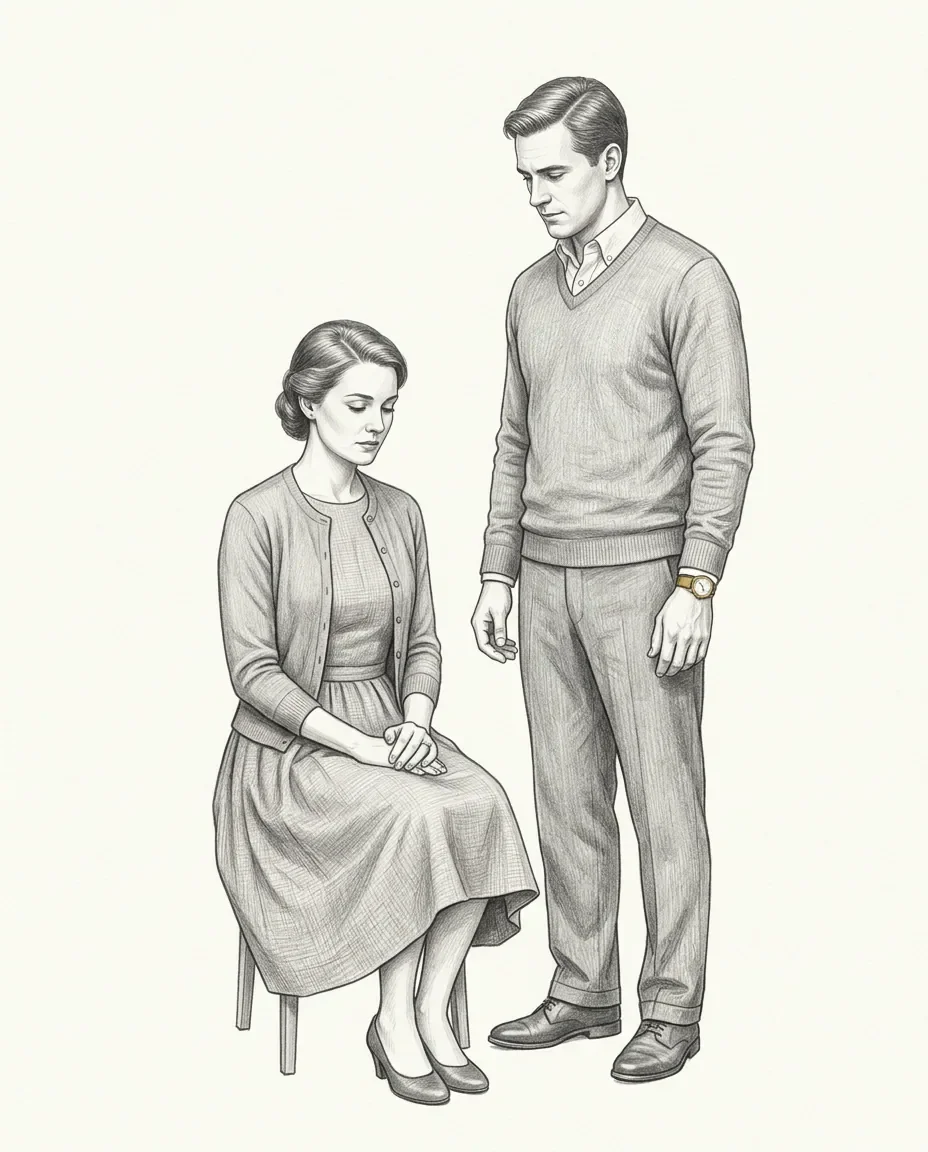
A consensual relationship dynamic in which adult partners agree that one holds authority to set household rules and enforce them. Consequences for breaking a rule are pre-negotiated. It centers on structure, accountability, and disciplinary scenarios rather than any single act.
- Prevalence
- Common
- Category
- Power, Roles & Scenarios
- Domain
- Sexual interest
- Confidence
- Low confidence
- Status
- Not a paraphilia or disorder; a consensual rules-based power-exchange dynamic among adults.
- Also known as
- DD, household discipline, punishment dynamic, disciplinary role-play, domestic discipline dynamic, rules-based discipline
- Added
- 21 Jun 2026
- Updated
- 22 Aug 2026
Featured in
Overview
Domestic discipline (commonly abbreviated DD) is a consensual relationship dynamic in which two adult partners agree that one of them holds an authority role with the power to set household rules and to respond to infractions with pre-negotiated consequences. It is organised around structure, accountability, and the ritual of rules and follow-through rather than around any single act, and it may be lived as an ongoing arrangement or enacted as discrete disciplinary scenes. At its core it is a particular framing of consensual power exchange, a close relative of dominance and submission, with an emphasis on order, correction, and reconciliation. This article traces its documented lineage, how it is typically expressed, its proposed psychology, and the consent and legal questions it raises.
Examples
What the term covers. A stated agreement between adult partners about household expectations and what follows from breaking them; a regular review or check-in at which conduct is discussed; symbolic consequences such as the loss of a privilege, an earlier bedtime or written lines; consensual spanking or other impact play where that has been agreed in advance; and the reconciliation that closes an episode (apology, reassurance, aftercare), which most practitioners describe as the point of the exercise rather than an afterthought. Arrangements run from a standing lifestyle to occasional scenes with no permanent rules at all.
What the term does not cover. Coercive control, which borrows the same vocabulary and is its opposite: rules imposed rather than agreed, consequences delivered in anger, and a person who cannot refuse. It is also distinct from its neighbours. Dominance and submission is the wider family this sits inside; master and slave dynamics and total power exchange extend authority across a whole life rather than over rules and infractions; service submission is organised around tasks performed, not corrections made; discipline names the corrective element wherever it occurs; a female-led relationship specifies who holds authority, not what it is used for; and teacher role-play or brat play are scenes rather than standing household arrangements.
How the word is used. It is community vernacular, abbreviated DD, with the religiously framed variant abbreviated CDD. It has no clinical pedigree and appears in neither the DSM-5-TR nor the ICD-11. The phrase does double duty in ordinary use (naming both the whole relationship structure and any single disciplinary episode within it), so it is worth establishing which sense a conversation means before agreeing to anything.
History & origins
Domestic discipline is best understood as a modern subculture rather than a clinically coined term, and its precise origins are not well documented.
Clinical lineage
The broader idea of eroticised discipline and the authority gradient it relies on is old. Richard von Krafft-Ebing catalogued the linked impulses of dominance and submission in Psychopathia Sexualis (1886), naming them "sadism" (after the Marquis de Sade) and "masochism" (after the novelist Leopold von Sacher-Masoch, whose Venus in Furs appeared in 1869). Havelock Ellis, in his Studies in the Psychology of Sex (issued in volumes from 1897), reframed such impulses as widespread variations rather than rare pathologies, and Sigmund Freud discussed the active and passive poles of these drives in his Three Essays on the Theory of Sexuality (1905). Crucially, domestic discipline as a consensual adult dynamic has never itself been classified as a disorder. The modern diagnostic manuals pathologise power exchange only when it causes the individual marked distress or harm or involves a non-consenting party: the DSM-5-TR requires distress or impairment for any paraphilic diagnosis, and the World Health Organization's ICD-11 removed consensual sadomasochism from its list of disorders entirely when it came into effect in 2022, a change argued for in the ICD-11 paraphilic-disorders proposals that distinguished consensual practice from coercive harm.
Cultural & subcultural evolution
The specific contemporary practice took shape much later, crystallising in online communities from the late 1990s and 2000s, where forums and self-help-style writings codified the language of "rules," "consequences," and household authority. A representative landmark was the Taken In Hand website, which ran from roughly 2003 to 2013 and gathered first-person essays on domestic-discipline and power-exchange relationships before its material was later collected into print. Some framings (notably the religiously inflected "Christian Domestic Discipline" movement, which produced its own how-to literature (for example the self-published guides of author Leah Kelley)) developed in parallel. These religious, male-headship versions are contested, are not representative of the secular, egalitarian negotiation most practitioners describe, and are the framing most often criticised for blurring into coercion. The dynamic gained brief mainstream attention in the 2010s alongside the wider visibility of BDSM, but it has remained a small enacted niche rather than a mass phenomenon.
In practice
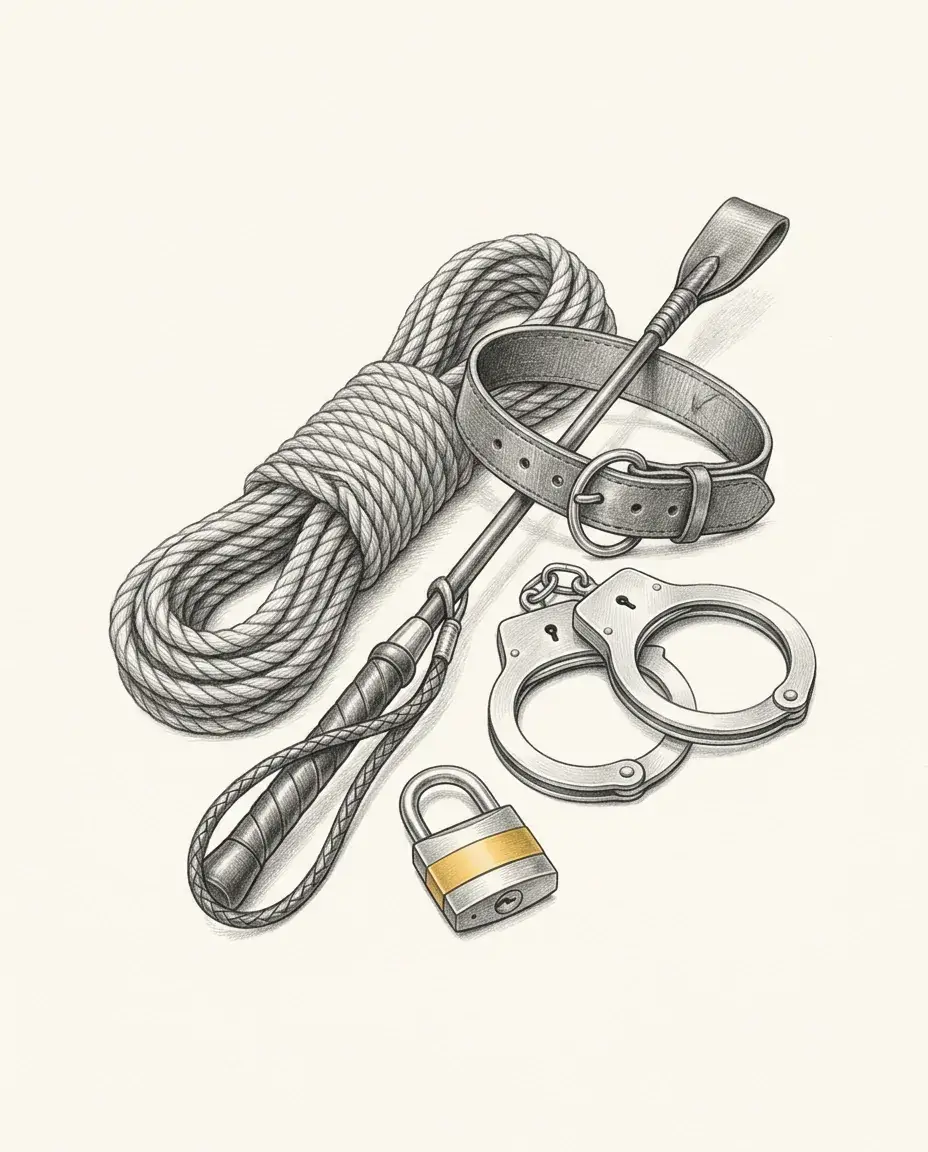
It is expressed through explicit agreements about expectations, periodic check-ins or reviews of conduct, and negotiated responses to broken rules. Responses can range from verbal correction and symbolic penalties (loss of a privilege, written lines) to consensual impact play such as spanking. Many couples ritualise the process with set procedures, and reassurance, reconnection, or aftercare following an episode is a common and valued component. It is not a how-to act so much as a standing framework, and it frequently overlaps with service submission and structured roleplay.
Psychology
The appeal often involves the comfort of clear order, the relief of externalised accountability, and an eroticised authority gradient. For some practitioners the draw is primarily emotional structure and felt security, a sense of being cared for through firm boundaries, while for others the disciplinary scenarios themselves are the erotic core. Proposed mechanisms borrow from the wider literature on power exchange: learned association between submission and arousal, attachment-style relief in surrendering or assuming control, and the symbolic meaning of correction followed by reconciliation. The evidence base specific to domestic discipline is thin; almost all of it is qualitative or anecdotal, and most inferences are extrapolated from broader BDSM research rather than from studies of DD itself.
Prevalence & culture
Domestic discipline has a visible but modest niche presence online (dedicated forums, blogs, and subreddits) sometimes intersecting with particular subcultural or religious framings. It attracts little formal clinical research, so no reliable standalone prevalence figure exists; it is best read against the much larger body of evidence for power exchange generally. Population surveys show that dominance and submission fantasies are extremely common: Joyal, Cossette & Lapierre (2015) found that submission and domination themes were common rather than unusual among 1,516 adults, and Lehmiller (2018), surveying 4,175 Americans, reported BDSM fantasies to be near-universal (only about 4% of women and 7% of men had never had one). Formally structured domestic-discipline arrangements are a small enacted subset of that much larger fantasy population, best understood as a relationship style and power-exchange variation rather than a discrete sexual category.
Safety, consent & law
The dynamic is lawful and benign when fully consensual between adults, with both partners free to set, revise, or revoke the arrangement at any time. Ethical practice depends on genuine ongoing consent, clearly stated limits, and a firm boundary between negotiated discipline and any form of real coercion, control, or abuse, which it must never be used to disguise. Consent withdrawn ends the dynamic; consequences that exceed negotiated limits, or that mask domestic abuse, fall wholly outside the consensual framework and may carry legal liability. As with related impact practices, in many jurisdictions consent does not extend to grievous bodily harm, so partners stay within negotiated, non-injurious limits.
How is domestic discipline different from abuse?
The dividing line is consent, reversibility, and direction of control. In a consensual arrangement both partners negotiate the rules and consequences in advance, either partner can pause or end the dynamic at will, and the disciplinary frame exists to serve a shared goal both people have chosen. Abuse is unilateral: it is imposed rather than agreed, escalates outside any negotiated limit, isolates or frightens the person on the receiving end, and cannot be safely refused. A vocabulary of "rules and consequences" does not by itself make a relationship consensual, and that same vocabulary is what coercive-control abuse often borrows to disguise itself. This is the criticism most often levelled at the male-headship religious framings of the practice, where authority is assigned by doctrine rather than negotiated between equals.
Common questions
What are the warning signs that a domestic discipline arrangement has become abusive?
The markers are unilateral change and the loss of exits. Rules or consequences added without discussion; punishment delivered in anger rather than by agreement; no veto, safeword or pause that is actually honoured; consequences leaving injuries that have to be hidden; being cut off from friends, family, money or transport; being told the arrangement cannot be ended, or that ending it would be a failure of love or of faith. Any one of those places the relationship outside a consensual dynamic, whatever it is called.
Is domestic discipline the same as BDSM?
It is one dialect of it rather than a separate thing. Domestic discipline runs on the same consensual power exchange, but organises it around household rules, infractions and correction instead of around scenes and sensation. Some practitioners consider themselves part of the kink community and use its negotiation tools; others, particularly in religiously framed versions, reject the label outright while doing something structurally very similar.
Does domestic discipline have to involve spanking?
No. Spanking is the consequence most associated with it, but many arrangements use nothing physical at all: lost privileges, early bedtimes, written lines, extra chores, a formal apology, or simply a required conversation about what went wrong. What defines the dynamic is the agreed structure of expectations and follow-through, not the form the follow-through happens to take.
What is Christian Domestic Discipline?
A religiously framed version, usually abbreviated CDD, in which a husband's authority is treated as assigned by doctrine rather than negotiated between equals. It generated its own self-published how-to literature. It is also the framing most criticised inside and outside the kink community, precisely because authority granted by doctrine cannot easily be renegotiated or revoked by the person subject to it, and revocability is what the consensual version depends on.
Is domestic discipline a paraphilia or a disorder?
No. Neither the DSM-5-TR nor the ICD-11 recognises it as a category, and the ICD-11 removed consensual sadomasochism from its list of disorders when it came into effect in 2022. Both manuals reserve disorder status for interests that cause the person marked distress or impairment, or that involve someone who has not consented. A negotiated arrangement between adults meets none of those conditions.
Who decides the rules in a domestic discipline relationship?
Both partners, at least at the outset. That is what separates the arrangement from simply being ordered about. One person is usually given authority to apply the rules day to day, but the rules themselves, the consequences attached to them and the limits on those consequences are negotiated in advance and revisited. An arrangement in which only one person has ever set the terms is not a negotiated dynamic.
Can domestic discipline be non-sexual?
Yes, and a good many practitioners describe theirs that way. For some the draw is structure, accountability and the felt security of firm boundaries rather than arousal, and disciplinary episodes are not treated as sex at all. For others the scenarios are explicitly erotic. The two versions look much the same from outside and are distinguished mainly by what the participants say they get from it.
Is domestic discipline legal?
A consensual arrangement between adults is lawful in itself, with two limits. In many jurisdictions consent is not a defence to serious bodily harm, so any physical consequence has to stay well inside non-injurious limits. And once an arrangement stops being consensual, the name the partners gave it offers no protection: coercion, threats and injury are treated as what they are rather than as a private agreement.
- Dominance and Submission92/100Power, Roles & ScenariosA consensual erotic dynamic in which one partner takes a dominant role and the other a submissive role, exchanging power within agreed limits. It is one of the most widespread elements of BDSM and of human sexual fantasy.92
- Spanking78/100Sensation & PainAn interest in giving or receiving consensual, rhythmic blows to fleshy areas of the body, by hand or with implements such as paddles. People do it for erotic sensation, discipline themes, or power exchange between consenting adults.78
- Teacher Roleplay62/100Power, Roles & ScenariosAn authority role-play sub-genre built around an imagined power gap between a figure of rank and a subordinate: teacher and student. Professor, boss and employee, and coach are other pairings in the same mode. Arousal comes from the eroticized hierarchy enacted between consenting adults inside a fictional frame.62
- Service Submission45/100Power, Roles & ScenariosA submissive style in which fulfillment comes chiefly from attending to a dominant partner's needs through tasks, anticipation, and acts of care. The power exchange is expressed through helpful service and devotion rather than through pain, discipline, or humiliation.45
- Captor/Captive Roleplay44/100Power, Roles & ScenariosA consensual BDSM dynamic in which one partner plays a captor holding and controlling the other, a resisting captive. It is built on sustained confinement rather than a single abduction plot. The “capture” is entirely staged fantasy, negotiated in advance between consenting adults.44
- Hypnokink44/100Power, Roles & ScenariosA consensual psychological power-exchange interest, usually called erotic hypnosis, in which arousal centers on trance and suggestion. The fantasy is of one partner influencing another's mind. It plays with surrender of will between adults using relaxation and suggestion techniques.44
A plain-English descriptive label: "domestic" (from Latin domus, "house, household") plus "discipline" (from Latin disciplina, "instruction, training, correction"). The compound names a household, rules-based corrective dynamic; it has no single documented coiner and arose as community usage.
power exchange · disciplinary scenario · rules-based dynamic
Prevalence is computed from the entry's cited population estimate. Rows marked ESTare indicative editorial estimates scored against a fixed anchor rubric, not measured quantities. Method & anchors: methodology.
Common · ≈ 1 in 20
- 01List of paraphilias, Wikipediaexistence of disciplinary/punishment-based power-exchange dynamics
- 02Lehmiller (2018), Tell Me What You Want, survey of 4,175 Americanscontext that BDSM/power-exchange fantasies are near-universal (only 4-7% never), while formal domestic-discipline structures are a small enacted subset
- 03An A–Z of Kinks and Fetishes, Glamourlay framing of discipline/punishment dynamics as a recognized kink
- 04Krafft-Ebing, Psychopathia Sexualis (1886), Wikipediahistorical cataloguing of dominance/submission impulses (sadism and masochism, named after de Sade and Sacher-Masoch) that underlie disciplinary dynamics
- 05Joyal, Cossette & Lapierre (2015), What Exactly Is an Unusual Sexual Fantasy?, J. Sexual Medicine 12(2):328-340submission and domination fantasies are common rather than unusual among 1,516 adults, the larger population from which structured DD is a small enacted subset
- 06DSM-5-TR, Paraphilic Disorders (American Psychiatric Association, 2022)consensual power exchange is not a disorder unless it causes the individual marked distress or impairment
- 07ICD-11, Paraphilic disorders (World Health Organization)ICD-11 (in effect 2022) removed consensual sadomasochism from its list of paraphilic disorders
- 08Krueger et al. (2017), Proposals for Paraphilic Disorders in the ICD-11, PMCrationale for distinguishing consensual sadomasochistic/power-exchange practice from coercive harm in the ICD-11
- 09Taken In Hand 2003–2013 (archived collection), Internet Archivethe Taken In Hand domestic-discipline / power-exchange website ran c. 2003–2013 and codified DD community language