Barefoot Fetish
Added 27 Jun 2026 · Updated 22 Aug 2026
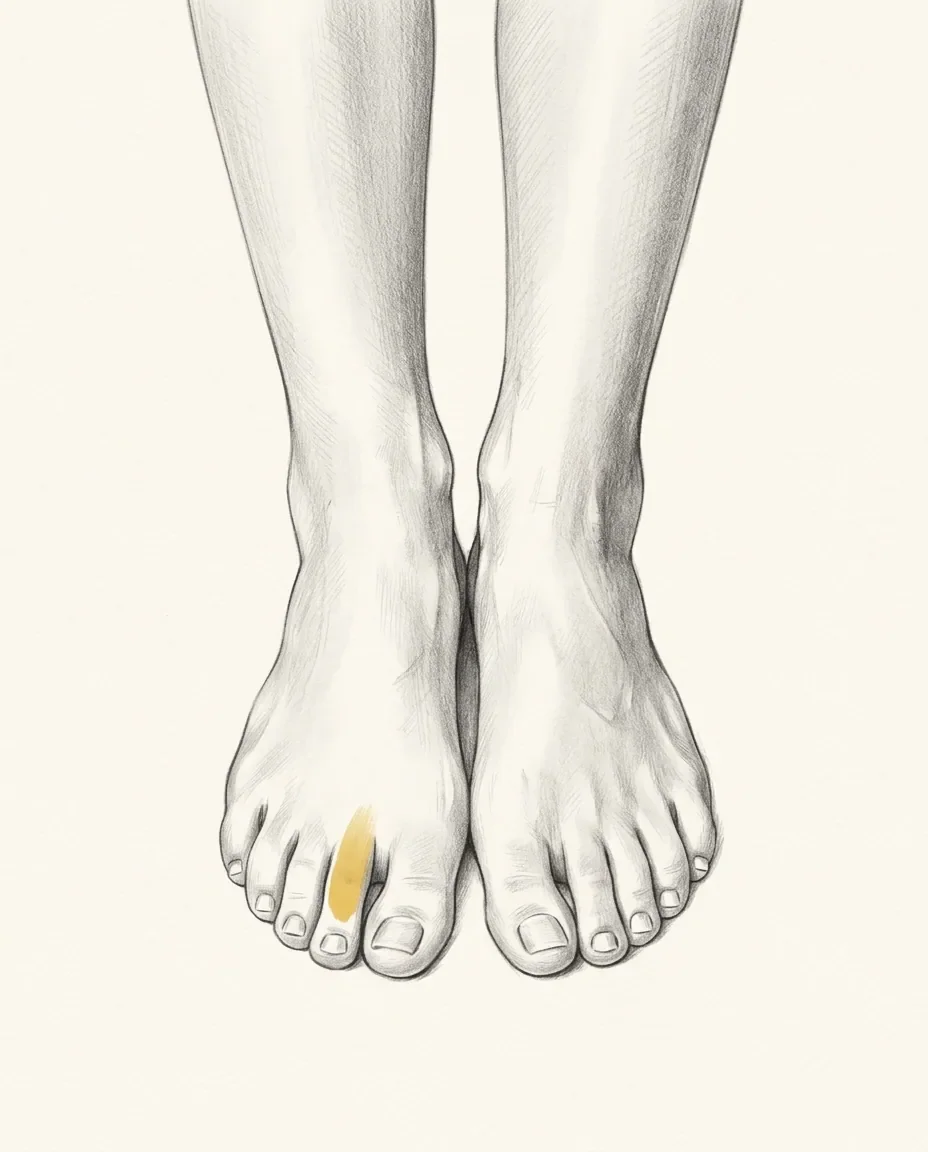
An erotic interest focused specifically on bare, unshod feet rather than feet in shoes or hosiery. A narrower expression of foot partialism, it centres on naked soles and toes, the contrast between clean and dirty feet, and the sight of bare feet in everyday or public settings.
- Prevalence
- Common
- Category
- Body Parts & Partialism
- Domain
- Sexual interest · Paraphilia
- Confidence
- Low confidence
- Status
- A partialism within the foot-fetish spectrum; classified as a paraphilia only if it causes distress, impairment, or harm.
- Also known as
- bare feet fetish, barefootedness interest
- Added
- 27 Jun 2026
- Updated
- 22 Aug 2026
Featured in
Overview
Barefoot fetish is an erotic interest concentrated specifically on the bare, naked foot rather than on the shod foot, on hosiery, or on footwear. It is a narrower expression of the much broader foot fetish (clinically podophilia, a form of partialism): where general foot interest may attach equally to a shoe, a sandalled toe or a stockinged sole, the barefoot variant is animated by the foot in its unclothed state (the exposed sole, the bare arch, the toes uncovered and the skin directly visible). The interest frequently carries an additional axis of preference: the contrast between clean feet (freshly washed, pedicured, smooth) and dirty or well-worn feet, and the particular charge some attach to seeing bare feet in everyday or public contexts. This article places the interest within the documented history of foot eroticism, examines how it is expressed, and reviews what reliable data say about how common it is.
What it is
As a partialism (an erotic focus on a specific, non-genital body part), the barefoot variant is distinguished not by a different body part but by a condition of that part: nakedness. The attraction is to feet as bare, and the removal of shoes, socks or stockings is often itself part of the appeal. Within the foot-fetish community the bare-versus-shod distinction is one of the most basic preference splits, alongside the clean-versus-dirty axis and preferences around size, shape, soles, arches and toes. Many people who report a foot interest gravitate to one pole or the other; the barefoot orientation is among the most commonly expressed, since the bare foot is the most direct object of foot attraction.
Examples
What the term covers. The exposed sole, the bare arch, uncovered toes and the skin itself; the act of undressing the foot, as shoes, socks or stockings come off; bare feet met in ordinary settings, at home, on a beach or in sandals across a summer street; and the clean-versus-dirty axis, which at one end shades into an interest in foot odour. Much of the interest is visual rather than tactile. Where it is enacted, the reverential attention of foot worship is one common form, but no act is required for the attraction to count.
What the term does not cover. The shod pole of the same split: shoes, boots, high heels, socks, stockings and nylons are objects rather than bare skin, and a barefoot preference is defined against them. Shoeplay (dangling or half-removing a shoe) sits deliberately on that boundary, which is much of its appeal. Trampling and foot domination use the foot as an instrument of pressure and control, sharing the body part but not the motive. And bare feet are not general undress: naturism concerns the whole body, whereas this interest stops at the ankle.
How the word is used. Plain descriptive English, appearing as both "barefoot fetish" and "bare feet fetish". There is no clinical coinage for the variant and no dated first use, because the manuals never split foot interest this finely: DSM-5-TR and ICD-11 recognise fetishistic disorder, of which foot partialism is one expression, and only where distress, impairment or a non-consenting person is involved.
History & origins
Pre-clinical antiquity
The bare foot has been an explicitly eroticised object since classical antiquity. Some of the earliest recorded instances of foot eroticism in Western literature are the Greek erotic pieces attributed to Philostratus (writing in the Roman imperial period, roughly the late second to mid-third century AD), among them works addressed To a Barefoot Woman and To a Barefoot Boy; in the latter the writer asks his beloved to walk barefoot so that he might kiss the footprints left behind. That the bareness of the foot is foregrounded in these earliest texts underscores how old the specific appeal of the unshod foot is. The eroticisation of feet recurs across many later cultures; the most consequential single case was the Chinese practice of foot binding, which from roughly the tenth century made the bound foot an explicitly eroticised object and was formally banned in 1912.
Clinical lineage
Foot-focused eroticism entered the medical literature with late-nineteenth-century sexology. In Psychopathia Sexualis (first published 1886), Richard von Krafft-Ebing catalogued foot- and shoe-focused fetishism and proposed that such fixations are "imprinted" in childhood through an accidental erotic association that persists into adulthood. Sigmund Freud, from 1905 onward, read the foot symbolically and discussed foot binding as a culturally amplified instance, notably framing the interest in malodorous, unwashed feet, which maps directly onto the clean-versus-dirty distinction that organises much barefoot interest today. Havelock Ellis treated foot and shoe symbolism in his Studies in the Psychology of Sex (1936). Across the twentieth century the clinical reading shifted from a Victorian sign of pathology toward a common, benign variation. The barefoot form has no separate coinage or dated nosological entry: under the DSM-5-TR the literature treats it within fetishistic disorder as a narrower expression of foot partialism, a clinical concern only when it causes distress, impairment or harm.
The cortical-adjacency thread
The much-repeated neuroscientific hypothesis associated with V. S. Ramachandran (popularised in Phantoms in the Brain, 1998) holds that the foot's representation on the brain's sensory homunculus lies adjacent to that of the genitals, so cross-activation might predispose people to eroticise feet. It is an elegant but contested idea: a later body-mapping survey reported in Cortex (2013) found feet low in erogenous intensity and no clustering between adjacent sites, leaving the cortical story a suggestive hypothesis rather than a settled cause.
In practice
Among consenting adults, expression is usually mild and woven into ordinary intimacy:
- looking at and gently touching bare soles, arches and toes;
- a preference for the removal of shoes, socks or stockings as part of the appeal;
- attention to grooming and condition: the clean, pedicured foot versus the dusty or well-worn one;
- appreciation of bare feet in everyday or public settings (sandals, going shoeless at home, on a beach);
- photography or collection of imagery focused on bare feet;
- the bare foot used for contact rather than looked at, as in a footjob.
Psychology
Alongside the contested cortical-adjacency hypothesis, mainstream accounts emphasise associative learning (an early or memorable pairing of bare feet with arousal that is later reinforced) and the long cultural eroticisation of feet. Krafft-Ebing's "imprinting" intuition prefigures these conditioning models, and Freud's attention to the unwashed foot anticipates the clean-versus-dirty preference. For the great majority the interest functions as an aesthetic preference rather than a compulsion.
Prevalence & culture
How common is barefoot fetish?
No survey isolates the barefoot variant, but feet are by a wide margin the most common body-part fetish, so the bare-foot orientation is among the most commonly expressed erotic interests overall. In the large internet survey by Scorolli and colleagues (2007), published in the International Journal of Impotence Research, feet and toes accounted for about 47% of body-part-focused preferences, while footwear made up a further large share of object-related interest, a split that itself illustrates the bare-versus-shod divide. In the general population the relevant figures are smaller. Justin Lehmiller's Tell Me What You Want (2018) survey of more than 4,000 Americans found roughly 14% reported a sexual experience involving feet, and the representative provincial survey by Joyal and Carpentier (2017) in the Journal of Sex Research found fetishism interested respondents at about 15.9%, a level above the threshold the authors treat as statistically unusual, with no significant difference between men and women. Because the bare foot is the most direct object of foot attraction, the barefoot orientation is one of the most commonly expressed within that broad interest; the figures in this entry are calibrated to foot-fetish data and scaled accordingly.
Safety, consent & law
Between consenting adults, barefoot interest is a benign variation of sexual interest with no inherent legal concern. The only practical considerations are ordinary foot hygiene and the same clear, explicit consent any intimate activity requires.
Common questions
What is the difference between a barefoot fetish and a foot fetish?
One is a subset of the other. A foot fetish is an erotic interest in feet generally, and it may attach just as happily to a shoe, a sandal or a stockinged sole. The barefoot variant is animated specifically by the foot in its unclothed state, and the removal of footwear is often part of the appeal rather than incidental to it.
Is a preference for bare feet more common than a preference for shoes?
No survey splits foot interest that way, so there is no honest figure. What the Scorolli et al. (2007) data show is that feet and footwear are each large categories in their own right, but that measures which object people fixate on, not which state of dress they prefer. Community discussion treats bare-versus-shod as a basic preference split with substantial numbers on both sides.
Why do some people prefer unwashed or dirty feet?
The clean-versus-dirty axis is one of the standard preference splits within foot interest, and it runs in both directions: some are drawn to the freshly washed and pedicured foot, others to the dusty, worn or sweaty one. At the far end it overlaps with an interest in foot odour. Neither pole is better documented than the other, and neither is more common in any measured sense.
Is it a fetish if I only like the look of bare feet?
Probably not, in the strict sense. Sexologists distinguish a preference, which adds to arousal, from a fetish, in which the focus is central to or necessary for it. Noticing that bare feet appeal to you puts you at the preference end, where most people who like feet sit. Nothing practical depends on which label applies.
Is a barefoot fetish a paraphilia or a disorder?
It is a partialism (an erotic focus on a non-genital body part), which makes it technically paraphilic in the broad sense of an interest outside genital contact with a partner. It is not a disorder. Under DSM-5-TR and ICD-11 that threshold requires marked distress, functional impairment, or a non-consenting person, and an interest in bare feet on its own crosses none of them.
Is a barefoot fetish about the feet or about the nakedness?
About the feet in a particular state. The body part is the same one a general foot interest targets; what distinguishes the variant is the condition of bareness, so the appeal is closer to undressing one specific part than to nudity in general. That is why the moment shoes or socks come off carries weight, and why liking bare feet implies nothing about an interest in undress elsewhere.
Are there hygiene risks in barefoot contact?
Ordinary ones. Bare skin-to-skin contact can pass on fungal infections such as athlete's foot, and verrucas spread the same way, so contact is best avoided until a visible infection or an open crack has cleared. Washing beforehand handles most of it. Going barefoot in shared spaces such as changing rooms is where such infections are usually picked up in the first place.
From the blog
- Foot Fetish83/100Podophilia · Body Parts & PartialismA focused erotic interest in feet (their shape, soles, toes, arches, or grooming) as a primary source of attraction. Within partialism (erotic focus on a non-genital body part) it is the example people report most, by a wide margin.83
- Sole Fetish53/100Body Parts & PartialismSole fetishism is an erotic focus on the underside of the foot, the sole, and especially on its texture and softness. The wrinkles and flex-lines that appear when the foot bends are a particular draw. A narrower form of foot partialism tied to the popular "wrinkled soles" search term.53
- Arch Fetish47/100Body Parts & PartialismAn erotic focus on the curved instep or arch of the foot, often with a preference for high arches. A narrower expression of foot partialism that overlaps closely with sole and general foot interest.47
- Stigmatophilia (Tattoos & Piercings)58/100Stigmatophilia · Body Parts & PartialismAn erotic attraction to bodies marked by tattoos, piercings, scarification, and other forms of body modification. The modified or adorned skin is itself a central focus of arousal rather than incidental decoration.58
- Toe Fetish56/100Toe Partialism · Body Parts & PartialismA focused erotic interest specifically in the toes: a narrower subset of foot partialism. The toes' shape, length, arrangement, adornment such as painted nails or toe rings, or related contact are a primary source of attraction.56
- Penis Fetish59/100Phallophilia · Body Parts & PartialismA pronounced sexual attraction centred on the penis: its appearance, size, shape, or symbolism. Because attraction to the penis is so widespread, it is generally an ordinary preference rather than a disorder.59
"Barefoot" is plain English (Old English bærfōt, "with the feet bare"), and "barefoot fetish" is a descriptive compound rather than a clinical coinage; it sits within the foot-partialism family, whose clinical name podophilia combines Greek pous, pod- (foot) with -philia (love of).
lower body · extremities · subset of foot partialism
Prevalence is computed from the entry's cited population estimate. Rows marked ESTare indicative editorial estimates scored against a fixed anchor rubric, not measured quantities. Method & anchors: methodology.
Common · ≈ 1 in 20
- 01Scorolli et al. (2007), Relative prevalence of different fetishes, Int. J. Impotence Research 19(4):432-437prevalence anchor (feet/toes = 47% of body-part fetishes; footwear a large share of object fetishes, illustrating the bare-vs-shod split)
- 02Foot fetishism, WikipediaPhilostratus 'To a Barefoot Woman' / 'To a Barefoot Boy' epigrams and kissing footprints; bare vs shod as a state of dress; Chinese foot binding banned 1912; Freud on malodorous (dirty) feet; Havelock Ellis 1936; Ramachandran hypothesis and the Cortex 2013 study; Lehmiller ~14% figure
- 03Krafft-Ebing, Psychopathia Sexualis (1886), Wikipedia1886 foundational text cataloguing foot/shoe fetishism and the childhood 'imprinting' association model
- 04Partialism, Wikipediadefinition of partialism as an erotic focus on a non-genital body part and its DSM-5 treatment within fetishistic disorder (diagnosed only with distress, impairment, or harm)
- 05Lehmiller (2018), Tell Me What You Want, survey of ~4,175 Americans (as summarised on the Foot fetishism Wikipedia article)general-population foot interest figure (~14% reporting a sexual experience involving feet)
- 06Joyal & Carpentier (2017), The Prevalence of Paraphilic Interests and Behaviors in the General Population: A Provincial Survey, J. Sex Research 54(2):161-171representative survey of 1,040 Quebec adults; fetishism interested ~15.9% of respondents, above the statistically-unusual threshold, with no significant sex difference