Flogging
Added 21 Jun 2026 · Updated 22 Aug 2026
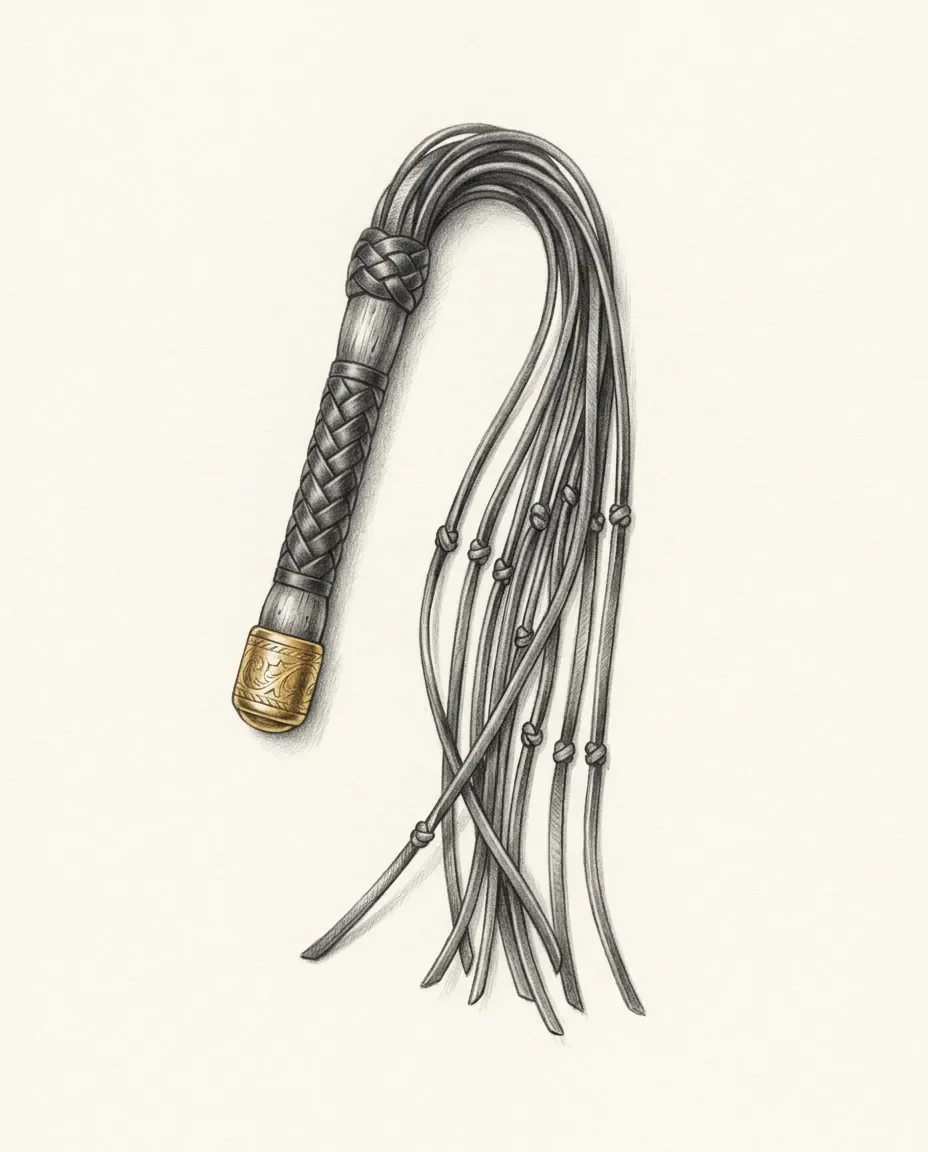
Consensual impact play in which one partner strikes another's body with a multi-tailed flogger, whip, or single-tail. The rhythmic sensation ranges from a broad "thuddy" impact to a sharp, stinging line. It is a common, negotiated element of BDSM sensation play.
- Prevalence
- Very common
- Category
- Sensation & Pain
- Domain
- Sexual interest
- Confidence
- Medium confidence
- Status
- Consensual BDSM sensation play; a common, benign variation rather than a clinical disorder absent distress or non-consent.
- Also known as
- whipping, flagellation, flogger play, single-tail, impact play
- Added
- 21 Jun 2026
- Updated
- 22 Aug 2026
Featured in
Overview
Flogging is a form of consensual impact play in which a striking implement, rather than a bare hand, is used to deliver rhythmic sensation to a partner's body. A flogger has many soft or stiff tails ("falls") that spread force into a broad, dull "thuddy" sensation, while a single-tail whip such as a bullwhip concentrates the energy into a sharp, stinging line. The activity sits within the broader BDSM and sensation-play tradition and overlaps with spanking and other impact practices. This article traces its long lineage from punishment and penance to negotiated recreational kink, how it is practised and understood today, and the consent and safety frame that distinguishes it from assault.
Examples
Flogging is named for its instrument, so its boundaries are mostly questions of which implement is in hand and whether anyone asked for it.
What the term covers. A multi-tailed flogger of suede, leather or rubber, whose many falls spread the force of a stroke into a broad, warm thud; a single-tail whip, which concentrates that same energy into a narrow sting; and the rhythmic, escalating pattern of strokes that distinguishes a flogging scene from a single blow. It usually arrives as one component of a longer scene alongside restraint and other sensation play, and it belongs to the wider family of impact play.
What the term does not cover. Spanking is delivered with the open hand; caning with a rigid rod that bruises in a quite different pattern; bastinado targets the soles of the feet. Non-impact practices such as wax play, temperature play and urtication produce intensity by entirely other means. The clinical words sadism and masochism name dispositions, and in their diagnostic forms disorders, rather than techniques: someone can be a masochist and dislike floggers. Judicial and religious flagellation share the word and the implement while inverting the essential fact, being imposed rather than requested.
How the word is used. In general English flogging still means punishment, and outside kink contexts that is the dominant sense; within them it is neutral shorthand for implement-delivered impact. Flagellation is the older clinical and historical term, the one Krafft-Ebing and Havelock Ellis used. Neither DSM-5-TR nor ICD-11 lists consensual flogging, both having moved consensual sadomasochism out of the diagnostic frame.
History & origins
Flogging's vocabulary is inherited from a punitive past: the act of striking with a lash long predates its consensual, erotic sense, and the words flogging, whipping and flagellation carried only those older meanings for most of their history.
Punishment, discipline and penance
- 5th century BC: Among the earliest images of erotic whipping is the Etruscan Tomb of the Whipping at Tarquinia, showing flagellation in a sexual context.
- Roman antiquity: The flagellum, a multi-tailed scourge sometimes weighted with metal or bone, was an instrument of judicial and military punishment; satirists such as Juvenal (1st–2nd c. AD) reference whipping.
- 13th century: Organised Christian flagellant movements travelled between towns scourging themselves as public penance; during the Black Death, Pope Clement VI permitted the practice in 1348 before later condemning the movement.
- 1530: England's Whipping Act formalised flogging as a judicial punishment; military flogging persisted into the 19th century, with the U.S. Congress banning naval flogging in 1850.
The erotic thread and "the English vice"
A distinctly sexual flagellation tradition is documented in England from at least the 1590s, and references to "flogging schools" appear in the late 17th century. By the Georgian era the practice was so associated with England that it was nicknamed le vice anglais ("the English vice"). John Cleland's Fanny Hill (1749) featured flagellation scenes, and Theresa Berkley, a noted London flagellation specialist who died in 1836, devised the apparatus known as the "Berkley Horse" around 1828.
Clinical naming and depathologisation
- 1886: Richard von Krafft-Ebing's Psychopathia Sexualis catalogued erotic pleasure from giving or receiving whippings, framing it as disorder; he later (c. 1890) introduced the clinical terms sadism and masochism.
- early 1900s: Havelock Ellis's Studies in the Psychology of Sex discussed flagellation as a source of arousal in less moralising terms.
- late 20th century: The modern negotiated practice (with safewords, calibrated intensity and aftercare) took shape within emerging BDSM subcultures.
- 2013 / 2019–2022: Both the DSM-5 and, more decisively, the ICD-11 removed consensual sadomasochism from the roster of disorders, treating consensual impact play as a non-pathological variant absent distress or harm.
In practice
Flogging is typically expressed within a negotiated scene. A top usually "warms up" the skin with lighter strokes before building intensity, reading the bottom's responses and pacing the rhythm; the bottom focuses on breath, sensation and surrender. Implements are chosen for their character (a heavy suede flogger for thud, a single-tail for sting) and skilled use is itself an aesthetic and ritual craft. Motivations practitioners describe range from the sensory "high" and meditative focus of receiving impact, to the trust and power-exchange dynamic, to the pleasure of mastering an implement. This account is clinical and non-instructional.
Psychology
Interest in giving or receiving impact is commonly linked to arousal tied to endorphin and adrenaline release, intense bodily focus, and the symbolism of dominance and submission. For many participants it is less about pain itself than about the trust, attention and altered headspace, sometimes called "subspace", that the exchange produces. Research on BDSM practitioners generally finds them to be psychologically well-adjusted, and contemporary clinical consensus treats consensual impact play as a benign variation rather than a disorder. The precise developmental mechanisms remain under-studied and contested.
Prevalence & culture
Impact play sits within one of the most commonly reported clusters of "atypical" sexual interest. In Joyal & Carpentier's 2017 survey of 1,040 Quebec adults, nearly half expressed interest in at least one paraphilic category and masochism drew interest above the 15.9% "statistically unusual" threshold; Lehmiller's 2018 survey of over 4,000 Americans found BDSM-themed fantasy nearly universal, with spanking and whipping among the most frequently reported. Flogging has substantial visibility within kink communities (dedicated forums, instructional workshops and play-party culture) and moderate mainstream awareness through BDSM imagery in film and fiction. Lay catalogues such as Glamour's A–Z of kinks routinely list flogging and whipping as common consensual impact kinks.
Safety, consent & law
Between consenting adults the practice is legal in most jurisdictions and considered reasonably safe when it is risk-aware, but the risk is real rather than notional. Strokes are kept to well-padded areas (the buttocks, the upper back below the shoulder blades, and the thighs) and away from the kidneys, spine, tailbone, neck, joints and head, where a stray stroke can cause internal or nerve injury. The other recognised hazards are wrapping, in which the tip of a tail curls around the body onto an unintended target, and broken skin: an implement that has drawn blood is treated as single-person equipment, because leather and suede cannot be reliably disinfected and blood-borne infection is a genuine route of transmission. Intensity is negotiated in advance, a safeword and a non-verbal signal for when speech is unavailable are standard, and aftercare is planned rather than improvised, since the adrenaline comedown known as subdrop can arrive hours or days later. Striking a non-consenting person is assault, and in some jurisdictions consent does not legally extend to serious bodily harm, so practitioners typically keep play within reversible-sensation limits. See also caning, wax play and temperature play for related sensation practices.
Common questions
Does flogging hurt?
It is meant to be felt, but the sensation varies enormously with the implement and the force behind it. A heavy suede flogger produces a broad, warm thud that many people describe as closer to deep massage than to pain; a single-tail whip concentrates the same energy into a sharp, narrow sting. Intensity is negotiated beforehand and normally built up gradually rather than started at full strength.
What is the difference between a flogger and a whip?
A flogger has many tails, so the force of a stroke is spread over a wide area and lands as a dull thud. A single-tail whip puts all of it into one narrow line, which stings far more, marks more readily, and is much harder to place accurately. Floggers are consequently the usual starting implement and single-tails a specialist one.
Is flogging safe?
It carries real physical risk, and is generally considered manageable when strokes stay on well-padded areas and away from the kidneys, spine, tailbone, neck, head and joints. The recognised hazards are strokes that wrap around the body onto unintended targets, broken skin, and bruising deeper than intended. Implements that have contacted broken skin are not shared between people, because leather cannot be reliably disinfected.
What marks does flogging leave?
Usually redness and warmth that fade within hours, and sometimes bruising or raised welts lasting several days. How readily someone marks varies a great deal between individuals and with the implement used, so marking is a poor proxy for how hard a scene actually was. Anyone whose work, family or living situation makes visible marks a problem negotiates that before the scene rather than after it.
Is flogging legal?
Between consenting adults it is lawful in most jurisdictions, and striking someone who has not consented is assault whatever the setting. The complication is that several legal systems hold that consent is not a defence to serious bodily harm, so an agreement to be injured may not be recognised even where both people made it freely. Practitioners generally keep play within reversible-sensation limits for exactly that reason.
Do you need a safeword for flogging?
Standard practice is yes, agreed before anything begins, along with a non-verbal signal such as a dropped object for moments when speech is not available. The person being struck cannot always judge accumulating damage in the moment, which is why many pairs also agree on periodic check-ins rather than relying on the safeword alone to catch a problem.
What is aftercare and why does it come up so often with flogging?
Aftercare is the attention that follows a scene: warmth, fluids, quiet, reassurance, and a look at the skin. Intense impact play involves adrenaline and endorphins, and the comedown from that can leave people shaky, cold or tearful, sometimes a day or two later, an effect the community calls subdrop. Planning for it is treated as part of the scene rather than an optional courtesy.
Is flogging the same as sadomasochism?
No. Flogging is a technique, while sadism and masochism name dispositions and, in their diagnostic forms, disorders requiring distress, impairment or a non-consenting person. Plenty of people who enjoy impact play would not describe themselves with either word, and plenty who would have no particular interest in floggers.
From the blog
- Caning48/100Sensation & PainConsensual impact play using a thin, flexible rod such as a rattan cane or switch to deliver sharp, stinging strokes. It is a focused subset of BDSM impact play known for an intense, lingering sensation and carries higher injury risk than padded implements.48
- Pain Play58/100Algolagnia · Sensation & PainPain play (algolagnia) is a clinical umbrella term for sexual arousal connected to physical pain, whether that pain is received or inflicted. The received form is labelled active/masochistic, the inflicted form passive/sadistic. It frames pain itself, not any specific implement, as the source of erotic interest.58
- Wax Play50/100Ceroticism · Sensation & PainConsensual temperature and sensation play in which warm candle wax is dripped onto a partner's skin for a brief heat sensation. A cooling, hardening trace follows. It is a popular, ritualistic element of BDSM sensation play that requires care to avoid burns.50
- Temperature Play49/100Sensation & PainConsensual sensation play that uses warmth and cold, such as ice, chilled or warmed objects, and contrasting temperatures, to heighten skin sensation. It is a gentle, accessible branch of BDSM sensation play centered on thermal contrast.49
- Shibari (Japanese Rope Bondage)59/100Sensation & PainShibari is the Japanese art of binding a partner with rope into intricate patterns, derived from kinbaku ("tight binding"). It blends visual artistry, sensation and restraint with the trust between the person tying (rigger) and the bound partner (bottom).59
- Subdrop58/100Sensation & PainThe emotional and physical low that some people, usually submissives, feel in the hours or days after an intense BDSM scene as heightened arousal subsides. Sadness, fatigue and irritability are typical.58
"Flog" entered English in the late 17th century, probably from Latin *flagellare* ("to whip"); "flagellation" derives directly from Latin *flagellum* ("whip, scourge"), the diminutive of *flagrum*.
impact · implement-delivered · consensual pain
Prevalence is computed from the entry's cited population estimate. Rows marked ESTare indicative editorial estimates scored against a fixed anchor rubric, not measured quantities. Method & anchors: methodology.
Very common · ≈ 1 in 7
- 01Lehmiller (2018), Tell Me What You Want, survey of 4,175 Americansimpact/pain play sits within the BDSM umbrella; spanking/whipping fantasies are highly common (only 4-7% never had a BDSM fantasy)
- 02Joyal & Carpentier (2017), The Prevalence of Paraphilic Interests and Behaviors in the General Population, J. Sex Research 54(2):161-171general-population anchor: ~23% active interest in receiving pain (masochism), bracketing implement-delivered impact play
- 03An A–Z of Kinks and Fetishes, Glamourmainstream lay coverage of flogging/whipping as a common consensual impact kink
- 04Havelock Ellis, Studies in the Psychology of Sexearly sexological discussion of flagellation as a source of erotic arousal alongside Krafft-Ebing
- 05Flagellation, Wikipediahistorical lineage of flogging/whipping as punishment, military discipline, and religious penance; the Roman flagellum, 13th-century flagellants, Pope Clement VI's 1348 permission, the 1530 Whipping Act, 1850 U.S. naval ban, the erotic 'English vice' thread, Fanny Hill (1749), and Theresa Berkley/the Berkley Horse
- 06Impact play, Wikipediadefinition of impact play; flogger vs single-tail implements; 'thuddy' vs 'stingy' sensation; safe target areas (buttocks, upper back, thighs) vs areas to avoid (kidneys, spine, neck, head, joints); Etruscan Tomb of the Whipping (5th c. BC)
- 07Sadomasochism, WikipediaDSM-5 excludes consensual BDSM absent harm or distress; ICD-11 goes further in removing disorders based on consenting behaviour; Krafft-Ebing's clinical coinage of sadism/masochism (c. 1890)
- 08Krafft-Ebing, Psychopathia Sexualis (1886), Wikipedia1886 foundational sexological catalogue describing erotic pleasure from giving or receiving whippings as a sexual disorder