Caning
Added 21 Jun 2026 · Updated 22 Aug 2026
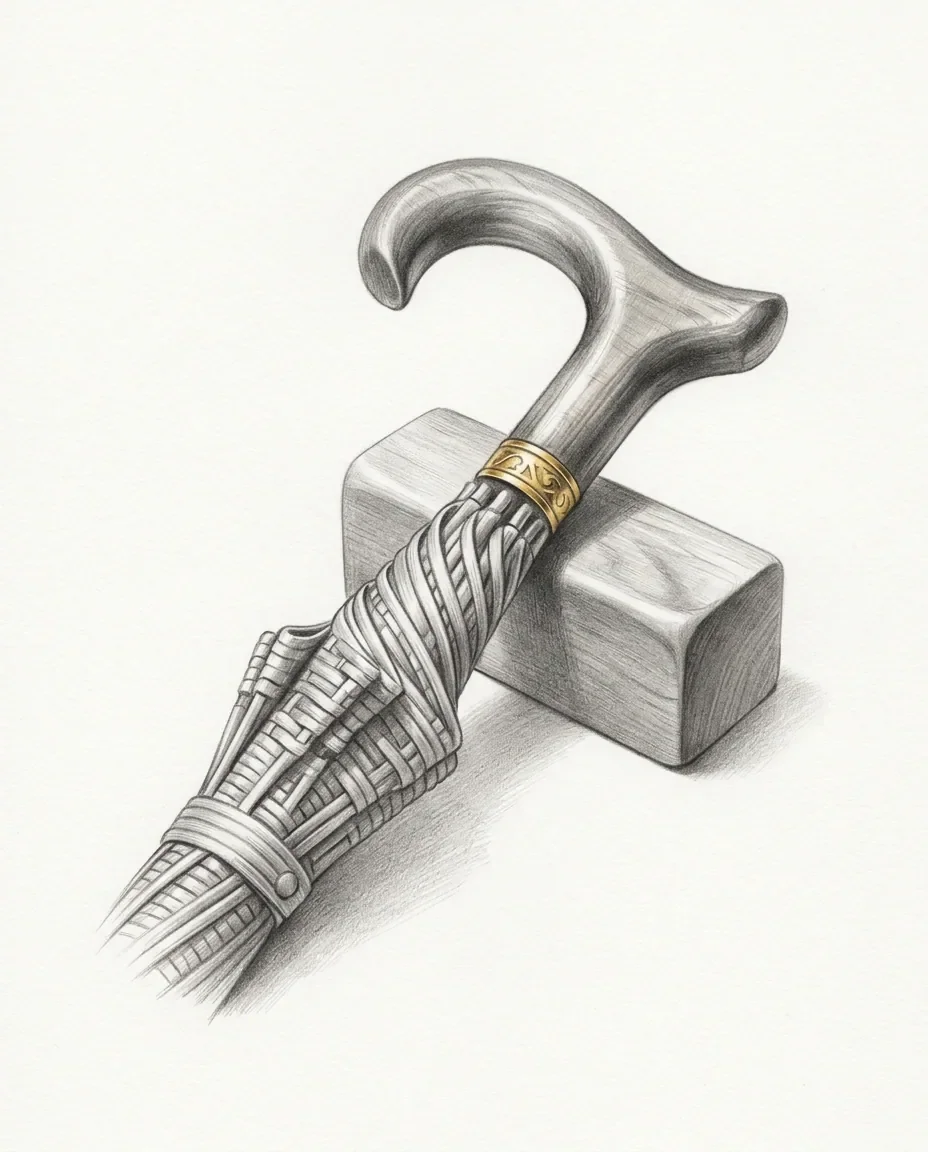
Consensual impact play using a thin, flexible rod such as a rattan cane or switch to deliver sharp, stinging strokes. It is a focused subset of BDSM impact play known for an intense, lingering sensation and carries higher injury risk than padded implements.
- Prevalence
- Common
- Category
- Sensation & Pain
- Domain
- Sexual interest
- Confidence
- Medium confidence
- Status
- Consensual BDSM impact play; benign variation in consenting adults, not a disorder absent distress or non-consent, but recognized as higher-risk.
- Also known as
- cane play, rattan, switch, rattan caning
- Added
- 21 Jun 2026
- Updated
- 22 Aug 2026
Featured in
Overview
Caning is a form of consensual impact play in which a thin, flexible rod, classically a rattan cane or a natural switch, is used to strike a partner. Because the implement is narrow and stiff, it concentrates force into a sharp, biting line of sensation that practitioners often describe as more intense and longer-lasting than that of broader tools such as floggers or paddles. It belongs to the wider BDSM impact-play family and draws much of its symbolic charge from historical corporal-punishment imagery, reinterpreted as consensual erotic ritual between adults. This article traces the cane's disciplinary heritage, its place in the clinical literature on masochism, and how it is practised and understood today.
Definition & scope
Caning names the implement, not a distinct clinical condition: it is one tool within consensual impact play, defined by a slender, flexible rod that delivers a sharp sting rather than a broad thud. It is distinguished from thuddy implements (paddles, heavy floggers) by sensation, and from flogging by the single-line strike of a rigid rod versus the spread of multiple tails. As practised in BDSM, it is a negotiated activity between consenting adults, not the judicial or scholastic punishment from which it borrows its imagery.
Examples
What the term covers. Measured strokes to the buttocks or the backs of the thighs with a rattan cane; the same delivered with a natural switch cut from a branch, a bamboo or acrylic rod, or a bundled birch; a slow, counted, ceremonial delivery inside a punishment-themed scene; and the deliberate quotation of school-discipline imagery, of which the surviving phrase "six of the best" is the most familiar trace. What every form shares is a narrow, stiff implement, which is why the sensation reads as a line rather than a spread.
What it does not cover. Spanking uses the hand or a broad paddle and produces a thuddy, diffuse impact; flogging spreads the force across many tails. Bastinado uses a rod but strikes the soles of the feet, a different target carrying different risks. The general category is impact play, and the wider clinical umbrella for arousal connected to pain is pain play, or algolagnia. Urtication and figging produce a burning sting chemically rather than by impact. And judicial caning, still on the statute book in a number of jurisdictions, is a punishment inflicted on people who have not consented; it shares nothing with the negotiated practice except the implement.
How the word is used. "Caning" is plain descriptive English and belongs to both worlds at once: the same word covers judicial and scholastic corporal punishment and the consensual BDSM practice, with context doing all the disambiguating. It has no clinical synonym and appears in neither DSM-5-TR nor ICD-11. Inside kink communities it is used freely as a verb, and "the cane" names the implement.
History & origins
Disciplinary heritage
The cane as an instrument of discipline long predates any erotic framing, and the rod, birch, and switch appear in punishment imagery far older still. The rattan cane was a tool of colonial rather than domestic British justice: judicial caning was introduced across the British-administered Straits Settlements (Singapore, Penang, and Malacca) and codified in the Straits Settlements Penal Code in 1871, whereas in Britain itself the judicially mandated implements were the birch and the cat-o'-nine-tails until judicial corporal punishment was abolished there under the Criminal Justice Act 1948. The rattan cane nonetheless became a fixture of scholastic discipline across many Commonwealth schools through the 20th century. This punishment heritage, formal, ritualised, and authority-laden, supplied the iconography that consensual caning later reclaimed and eroticised.
Clinical lineage
The erotic dimension of being beaten was documented early in the clinical literature on masochism. The Austrian psychiatrist Richard von Krafft-Ebing catalogued flagellation and the desire to receive blows within his accounts of masochism in Psychopathia Sexualis (1886): the work that coined the term masochism, naming it after the novelist Leopold von Sacher-Masoch, author of Venus in Furs. Sigmund Freud took up beating fantasies directly in his 1919 paper A Child Is Being Beaten, analysing the recurring fantasy of a child being struck by a father or authority figure and its links to guilt and arousal. Havelock Ellis treated the broader category of algolagnia (pleasure in pain) in his Studies in the Psychology of Sex.
Caning is best understood not as a separately coined clinical term but as a specific implement within this broader masochism-and-discipline lineage. Its modern use as a named BDSM practice grew out of 20th-century kink subcultures rather than from any single documented coinage, alongside the depathologisation of consensual sadomasochism in the DSM-5 and ICD-11, which classify sexual masochism as a disorder only when it causes distress or harm.
In practice
Caning is expressed within a negotiated scene, usually targeting padded areas such as the buttocks and the backs of the thighs. The top controls cadence, placement, and escalating intensity while the bottom focuses on the sensation. Many practitioners value the precision and the disciplined, ceremonial quality of measured strokes, and pair caning with power-exchange or punishment-themed role-play. It is frequently grouped with related implement work such as flogging and contrasted with thuddier tools: canes deliver a characteristically sharp, slow-blooming sting rather than the deep thud of a paddle.
Psychology
Why do people enjoy caning?
The appeal often combines endorphin-driven pain processing, intense present-moment focus, trust and surrender, and the symbolic charge of discipline. As with other impact play, the draw is frequently the headspace and the relational dynamic rather than pain in isolation. Contemporary sexology treats consensual masochistic interest as a benign variation rather than a disorder: Joyal and Carpentier (2017) found masochism common enough in the general population to fall outside the "statistically unusual" range, and Joyal, Cossette and Lapierre (2015) reached the same conclusion. The evidence base specific to caning is thin; most claims rest on broader BDSM research rather than implement-level study.
Prevalence & culture
How common is caning?
Caning is well known within kink communities and supports a dedicated instructional culture, though it is more niche than general impact play. Mainstream awareness comes largely from its historical punishment associations and from lay coverage such as Glamour's A–Z of kinks. Direct prevalence data are sparse, so estimates rely on community size and broader BDSM survey proxies. In Lehmiller's (2018) survey of 4,175 Americans, BDSM fantasies were near-universal and roughly two-thirds of respondents reported fantasising about masochism or receiving pain, within which implement-based caning is one specific, smaller practice.
Safety, consent & law
Between consenting adults, caning is legal in most contexts, but it is firmly risk-aware practice that carries a higher injury risk than padded implements. Canes can break skin, bruise deeply, or raise welts, so strokes avoid bones, joints, the spine, kidneys, and head, and intensity is built up gradually rather than opened at full force. Where skin is broken the implement carries a blood-contact risk and is not shared between partners without disinfection. Safewords and aftercare are standard, as is planning for the delayed low mood (subdrop) that can follow an intense scene. Striking a non-consenting person is assault, and in some jurisdictions very severe injury may exceed what consent can lawfully cover.
Common questions
Does caning hurt more than spanking?
Differently, and usually more sharply. A hand or paddle spreads its force over a wide area and lands as a deep, thuddy impact; a cane concentrates the same force into a narrow line, which reads as a sting that arrives a beat late and then keeps building. Many people find a cane stroke harder to absorb for that reason even at lower force, which is why canes are introduced gradually rather than at the intensity a paddle might open at.
Does caning leave marks?
Usually, yes, and that is either part of the appeal or something to plan around. A stroke commonly raises a welt along the line of contact that can stay visible for hours; harder strokes bruise, and bruising from a cane can take a week or more to fade. Skin can be broken at higher intensities. Anyone who needs to be unmarked for work, a medical appointment or a shared changing room should negotiate that as a hard limit beforehand, not afterwards.
Why is a cane considered higher-risk than a paddle?
Geometry, mostly. All the force lands on a narrow strip, so the pressure at the skin is far higher than the same swing delivered by a broad implement, which is what makes splitting the skin possible at all. A cane is also long and flexible, so its tip travels considerably faster than the hand and can wrap around the hip or the outside of the thigh in a way that is easy to misjudge. Placement matters more here than with almost any other impact tool.
What are canes made of?
Rattan is the traditional and still the most common material: light, flexible, and stinging rather than heavy. The word also covers natural switches cut from a branch, bamboo, and modern synthetics such as acrylic and Delrin. They are not interchangeable: heavier, stiffer rods carry more force for the same swing and are far less forgiving of a misplaced stroke, and bamboo can split and splinter with age. Material, length and thickness each change the sensation substantially.
What should happen after a caning session?
Two things, physical and emotional. The skin gets checked for broken surfaces and welts, and anything that has bled needs proper cleaning. Emotionally, aftercare matters here as much as in any intense scene: warmth, contact, and staying with each other while the adrenaline drops away. A delayed low mood over the following day or two, known as subdrop, is common enough to expect rather than be alarmed by.
Is caning legal?
Between consenting adults in private it is lawful in most jurisdictions. Consent has limits, though, and they bite harder here than for gentler play because a cane can cause real injury: in England and Wales the R v Brown ruling established that consent is not a defence to the infliction of actual bodily harm, and comparable limits exist elsewhere. Caning someone who has not agreed to it is assault everywhere. Judicial caning, which still exists as a criminal penalty in some countries, is a separate matter entirely.
Is an interest in caning a paraphilia?
No. Consensual masochistic or sadistic interest is a disorder only when it causes the person genuine distress or impairment, or involves someone who has not consented; that is the explicit threshold in both DSM-5-TR and ICD-11. General-population surveys find interest in receiving pain common enough to fall outside anything statistically unusual. Enjoying a cane says nothing diagnostic about anyone.
- Flogging60/100Sensation & PainConsensual impact play in which one partner strikes another's body with a multi-tailed flogger, whip, or single-tail. The rhythmic sensation ranges from a broad "thuddy" impact to a sharp, stinging line. It is a common, negotiated element of BDSM sensation play.60
- Pain Play58/100Algolagnia · Sensation & PainPain play (algolagnia) is a clinical umbrella term for sexual arousal connected to physical pain, whether that pain is received or inflicted. The received form is labelled active/masochistic, the inflicted form passive/sadistic. It frames pain itself, not any specific implement, as the source of erotic interest.58
- Wax Play50/100Ceroticism · Sensation & PainConsensual temperature and sensation play in which warm candle wax is dripped onto a partner's skin for a brief heat sensation. A cooling, hardening trace follows. It is a popular, ritualistic element of BDSM sensation play that requires care to avoid burns.50
- Temperature Play49/100Sensation & PainConsensual sensation play that uses warmth and cold, such as ice, chilled or warmed objects, and contrasting temperatures, to heighten skin sensation. It is a gentle, accessible branch of BDSM sensation play centered on thermal contrast.49
- Suspension Bondage49/100Sensation & PainA form of consensual bondage in which a restrained person is partly or fully lifted off the ground from one or more overhead suspension points. Rope, webbing, cuffs, or chain carry the load. It is a technically demanding, higher-risk practice within the wider rope-bondage and BDSM world.49
- Scratching46/100Amychesis · Sensation & PainAmychesis is a consensual interest in arousal from scratching or being scratched with the fingernails, producing sharp surface sensation. It sometimes leaves temporary marks. A form of sensation play that links touch with intimacy and marking.46
From the English noun "cane" (a rod of rattan, bamboo, or reed), via Old French "cane" from Latin "canna" and Greek "kánna" ("reed, cane"); the practice name is a plain descriptive term for striking with such a rod and has no separate clinical coinage.
impact · implement-delivered · sharp/stinging sensation
Prevalence is computed from the entry's cited population estimate. Rows marked ESTare indicative editorial estimates scored against a fixed anchor rubric, not measured quantities. Method & anchors: methodology.
Common · ≈ 1 in 20
- 01Lehmiller (2018), Tell Me What You Want, survey of 4,175 Americansbroad pain-play/BDSM fantasy prevalence within which caning is one impact practice
- 02Joyal & Carpentier (2017), The Prevalence of Paraphilic Interests and Behaviors in the General Population, J. Sex Research 54(2):161-171general-population masochism interest (~23%) that bounds the population engaging in implement impact play
- 03An A–Z of Kinks and Fetishes, Glamourmainstream lay framing of caning as a recognized impact-play kink
- 04Krafft-Ebing, Psychopathia Sexualis (1886)early clinical documentation of flagellation and masochistic desire to receive blows, the historical lineage of consensual caning
- 05Caning, Wikipediahistorical judicial and scholastic caning, and the fact that the cane was a colonial rather than domestic British judicial implement (birch and cat-o'-nine-tails until abolition in 1948)
- 06Caning in Singapore, Wikipediaintroduction of judicial rattan caning under the British-administered Straits Settlements and its codification in the Straits Settlements Penal Code (1871)
- 07Freud, 'A Child is Being Beaten' (1919), Standard Edition vol. 17:175, PEP-WebFreud's 1919 paper analysing the beating fantasy and its links to masochistic arousal and guilt
- 08Joyal, Cossette & Lapierre (2015), What Exactly Is an Unusual Sexual Fantasy?, J. Sexual Medicine 12(2):328-340finding that masochism is common enough in the general population to fall outside the 'atypical' range
- 09DSM-5-TR, Paraphilic Disorders (American Psychiatric Association, 2022)depathologisation framing: sexual masochism is a disorder only with distress or harm, not consensual impact play
- 10ICD-11, Paraphilic disorders (World Health Organization)ICD-11 treatment of consensual sadomasochism as non-pathological absent harm