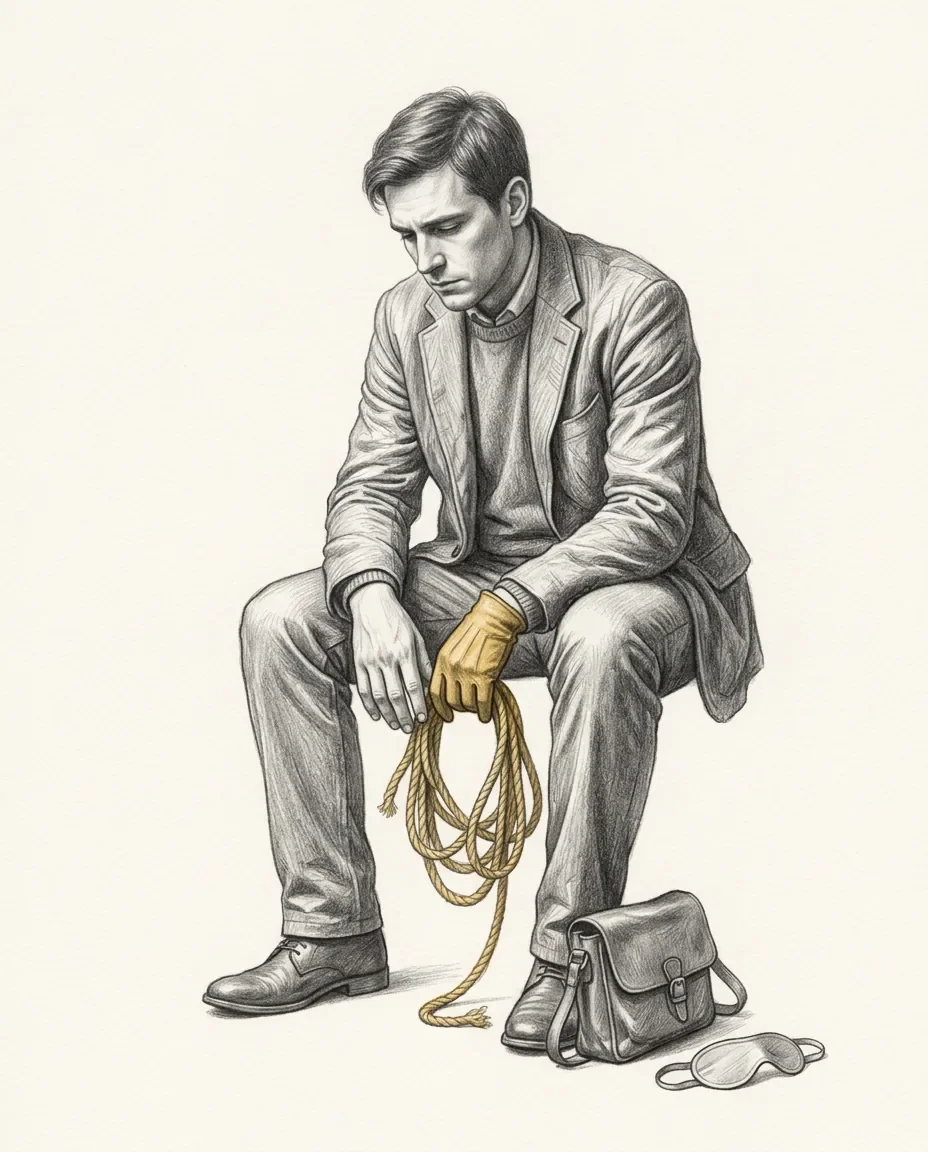
Kidnapping Roleplay
Added 21 Jun 2026 · Updated 22 Aug 2026
A consensual-non-consent role-play sub-genre in which adults stage a captivity, abduction, or interrogation scenario. Arousal is drawn from the imagined helplessness, suspense, and power gap between captor and captive, all bounded by negotiation and a safeword.
- Prevalence
- Common
- Category
- Power, Roles & Scenarios
- Domain
- Sexual interest
- Confidence
- Low confidence
- Status
- Not a paraphilia or disorder; an edge-leaning role-play sub-genre among consenting adults.
- Also known as
- Captivity/interrogation role-play, kidnap fantasy role-play, interrogation scene, captive scenario, hostage role-play, abduction fantasy, consensual non-consent scene
- Added
- 21 Jun 2026
- Updated
- 22 Aug 2026
Featured in

Overview
Kidnapping role-play, also called captivity or interrogation role-play, is a sexual role-play sub-genre built around a fictional scenario of confinement. One partner plays a captor, abductor, or interrogator; the other plays a captive, prisoner, or detainee. The eroticism centres on imagined helplessness, suspense, and a stark power differential, all enacted within a consensual adult frame and a clearly understood fiction. It is one of the more intense expressions of consensual non-consent (CNC), and this article traces its lineage, how it is practised, why it appeals, and the safety and legal boundaries that distinguish the fantasy from the crime it dramatizes.
Definition & scope
Kidnapping role-play is a scenario, not a standalone orientation: a shared fiction that borrows the props and beats of an abduction to structure a scene. It usually combines three ingredients: an asymmetric power dynamic (captor and captive), a narrative of confinement or interrogation, and a consent frame that makes the coercion imaginary. Remove any one and it becomes something else. Without the power gap it is ordinary role-play; without the consent frame it is a crime. It is best treated as one theme within consensual non-consent and dominance and submission, sitting toward the more intense, story-driven end of that spectrum.
Examples
What the term covers. A staged abduction with an agreed beginning and end, one partner playing at seizing and the other at resisting; an interrogation frame in which questioning and pressure stand in for physical struggle; an extended captor-and-captive dynamic sustained across an evening or a weekend; and the props that carry the fiction: restraints, a blindfold, a gag, a room dressed as a holding space, sometimes sensory deprivation to blur time and orientation. A large share of the interest never leaves conversation: the scenario is described rather than enacted.
What the term does not cover. It is not consensual non-consent as such. CNC is the wider ethical frame; kidnapping role-play is one narrative built inside it, so nearly every kidnapping scene is a form of CNC while most CNC is not a kidnapping scene. It is not biastophilia or coercion paraphilia, which name arousal to genuine non-consent and are clinical categories rather than practices. It is not primal play, which is rough and instinctive with no story attached, nor plain role-play, which needs no power gap at all. And it is not abduction: confining a person who has not agreed to it is false imprisonment, and nothing said beforehand converts that into play.
How the word is used. "Kidnapping role-play," "abduction scene," "captivity play" and "hostage role-play" are community labels drawn from kink forums and event listings rather than from any clinical source, and participants usually name the scene rather than claiming the interest as an identity. Neither the scenario nor its literary ancestor, the "ravishment" plot of romance fiction, appears in DSM-5-TR or ICD-11. Within kink communities it is classed as edge play.
History & origins
Kidnapping role-play has no single inventor or datable coinage; it emerged as a named scene type within late-twentieth-century BDSM and consensual-non-consent culture rather than from the clinical literature. Its intellectual roots, however, reach back to the earliest sexological accounts of staged power and surrender.
Clinical lineage
- 1886: Richard von Krafft-Ebing's Psychopathia Sexualis catalogued masochism, a term he coined after the novelist Leopold von Sacher-Masoch, as pleasure taken in submission and the fantasy of being at another's mercy, the conceptual ancestor of the captive role.
- 1897 onward: Havelock Ellis's Studies in the Psychology of Sex described the interplay of dominance and surrender as a common thread in erotic life rather than a discrete disease.
- 1905: Sigmund Freud's Three Essays on the Theory of Sexuality treated fantasies of mastery and submission as ordinary features of the psyche.
- Late 20th century to today: clinical opinion shifted decisively toward depathologisation of consensual kink. The DSM-5-TR distinguishes a paraphilic interest from a paraphilic disorder, the latter requiring distress, impairment, or harm to a non-consenting person. Staged captivity between consenting adults meets none of those criteria and is not a disorder; the ICD-11 similarly narrowed its paraphilic categories to those involving non-consent or significant risk.
Cultural & subcultural evolution
The specific vocabulary of "abduction scenes," "interrogation play," "captive" and "hostage" role-play crystallised inside organised kink communities in the late twentieth century and, later, on online forums and platforms such as FetLife, where elaborate negotiation and safety conventions were codified. The broader category of consensual non-consent, "a mutual agreement to be able to act as if consent has been waived", provided the ethical scaffolding that lets such scenes proceed safely. Culturally, the captivity motif draws on a deep well of thriller, spy, war, and crime fiction; the eroticised abduction is also a long-standing convention of romance and gothic literature, which helped make the theme legible to a wide audience long before it had a kink-community name.
In practice
The scene is expressed through scripted scenarios, themed settings and props (restraints, a blindfold, a staged "holding" space), formal or adversarial dialogue, and a choreographed back-and-forth of pressure and resistance. It frequently overlaps with bondage, dominance and submission, and consensual non-consent, and is treated by responsible participants as theatre with a script and an exit. Before play, partners typically negotiate the storyline, hard limits, the degree of physical restraint, and a safeword or non-verbal safe signal; nothing in the scene proceeds without that prior agreement, which can be revoked at any moment.
Psychology
The appeal is usually described in terms of surrender and the paradoxical relief of having no control, the adrenaline of staged danger, and the safe rehearsal of a frightening situation stripped of real threat. The fictional frame lets people explore an intensity and vulnerability they would never seek in reality, a dynamic researchers connect to the broader human appetite for controlled fear and catharsis found in horror, thrill sports, and dark play. Fantasising about being overpowered is not a wish for real victimisation. In Bivona & Critelli's analysis of women's rape fantasies (2009) and the follow-up empirical evaluation by Bivona, Critelli & Clark (2012), a large share of participants reported such fantasies while explicitly not wanting the event to occur: the eroticism lives in imagined surrender, not in harm. Joyal, Cossette & Lapierre (2015) found the same split, with about half of women who described a submissive fantasy specifying they would not want it to happen in real life.
Prevalence & culture
Direct figures for enacted kidnapping play are scarce, so prevalence is inferred from the broader fantasy literature. Forced-sex and captivity themes are common in fantasy surveys: across studies summarised by Bivona & Critelli, roughly 31–57% of women report fantasies of being forced into sex, with the 2012 study finding around 62% had experienced such a fantasy at least once. Joyal, Cossette & Lapierre (2015) reported that fantasies of being dominated were common, about 64.6% of women and 53.5% of men, placing submission and captivity themes firmly within the statistically normal range. Lehmiller's Tell Me What You Want (2018) survey of 4,175 Americans likewise found power and rough-sex fantasies to be near-universal. As a distinct enacted kink, however, captivity and abduction scenes are practised by a smaller, more advanced minority, sitting below generic role-play and dominance/submission in prevalence, and supported by dedicated FetLife groups. The theme remains highly visible in mainstream thrillers, spy fiction, and adult media, and lay kink guides such as Glamour's A–Z of kinks routinely list it.
Safety, consent & law
The interest is legal and benign when enacted between consenting adults playing fictional roles. Because it dramatizes coercion, it is widely regarded as advanced or "edge" play: careful negotiation, ongoing affirmative consent, robust safewords or safe signals (especially where struggle or gagging makes speech hard), and a clear separation of fiction from reality are essential, as is aftercare. The scenario must never be used to disguise or excuse actual coercion or the restraint of a non-consenting person: false imprisonment and kidnapping are serious crimes everywhere, and prior agreement to play cannot retroactively consent to real harm.
Common questions
Is kidnapping roleplay legal?
Between consenting adults in private, yes: the underlying acts are lawful, and the agreement reached beforehand is what makes them so. Two limits matter. In many jurisdictions consent is not a defence to serious bodily injury, so no arrangement licenses real harm. And a scene that spills into public (a staged snatch on a street, a struggle visible from a window, someone bundled into a vehicle) can be reported and investigated as a genuine abduction, with consequences that arrive long before anyone gets to explain.
How can a safeword work if the captive is gagged?
By agreeing a channel that does not depend on speech. Common arrangements are a held object dropped on the floor, a fixed number of taps or hums, or a squeeze-and-release signal, chosen before anything starts and rehearsed while both people are calm rather than invented mid-scene. The captor's ongoing job is to check that the signal is still available: a hand gone numb in a restraint, or an object that has rolled out of reach, silently removes the exit without anyone noticing.
Can a kidnapping scene start as a surprise?
It can, and this is the detail most often negotiated badly. In the format that works, what is agreed in advance is that a scene will happen inside a stated window; only the exact moment is left unknown. A true surprise (no prior conversation, no agreed window) is not a scene at all, because the person had no opportunity to consent. Partners who use the open-window format normally also agree on places and situations that are off-limits, and a plain out-of-character phrase meaning "not now."
Does fantasising about being kidnapped mean something is wrong with me?
No. Fantasies of being overpowered or captured are among the most commonly reported in the research literature, and researchers have repeatedly found that people who report them are explicit about not wanting the event to occur. The structural reason is simple: a fantasy is authored by the person having it, who controls every detail and can end it instantly, while the thing it depicts is defined by the absence of exactly that control. They are opposites wearing similar imagery.
Why does aftercare matter more in a captivity scene?
Because the scene is built out of disorientation. Restraint, a blindfold, an unfamiliar space and a long stretch of lost time all work by loosening someone's grip on where and who they are, and that does not switch off cleanly when the fiction ends. Re-establishing ordinary footing (names, light, warmth, water, food, physical contact if wanted) is part of the practice rather than an optional courtesy, and a delayed emotional dip in the days afterwards is common enough to be worth expecting. See aftercare and subdrop.
Should anyone outside the scene know it is happening?
For anything beyond a short scene at home with a long-standing partner, yes. The usual arrangement is a person who knows roughly what is planned and a time by which they expect a message, which costs nothing and covers the two failure modes that matter: something going wrong physically, and a bystander calling the police on what looks exactly like a crime. It is standard practice with a new partner, in an unfamiliar location, or where any part of the scene is visible to others.
Is kidnapping roleplay a paraphilia?
No, and the question is usually prompted by the subject matter rather than by anything about the practice. Diagnostic classification does not track how alarming a scenario sounds; it tracks consent and consequences. An interest becomes a disorder only where it causes the person distress or impairment, or where it is acted on with someone who has not agreed, which is precisely what negotiation, safewords and a pre-agreed ending are designed to exclude.
- Consensual Non-Consent64/100Power, Roles & ScenariosA negotiated power-exchange scenario in which adults agree in advance to enact a scene of simulated non-consent. The fiction of resistance or being overpowered is staged while real, ongoing consent underlies the whole encounter. Categorically distinct from actual assault.64
- Teacher Roleplay62/100Power, Roles & ScenariosAn authority role-play sub-genre built around an imagined power gap between a figure of rank and a subordinate: teacher and student. Professor, boss and employee, and coach are other pairings in the same mode. Arousal comes from the eroticized hierarchy enacted between consenting adults inside a fictional frame.62
- Dominance and Submission92/100Power, Roles & ScenariosA consensual erotic dynamic in which one partner takes a dominant role and the other a submissive role, exchanging power within agreed limits. It is one of the most widespread elements of BDSM and of human sexual fantasy.92
- Brat Play48/100Power, Roles & ScenariosA submissive style within power exchange in which one partner playfully resists, teases, or defies a dominant partner. That dominant, the "brat tamer", responds by reasserting control. Both the cheek and its taming are consensually scripted between adults.48
- Female-Led Relationship (FLR)48/100Power, Roles & ScenariosAn ongoing relationship structure in which the woman holds primary decision-making authority over shared life, from finances to household duties. Power is not confined to a single scene. Related to, but broader and more continuous than, femdom.48
- Foot Domination48/100Power, Roles & ScenariosA power-exchange practice in which a dominant uses their feet as the instrument of control over a consenting submissive. Typical acts are directing the submissive to kiss, lick or clean the feet, holding them underfoot, or foot-gagging. It is the dominant-framed counterpart to foot worship.48
A plain-English descriptive name: the scene is named for the act of *kidnapping* (Early Modern English, from *kid*, slang for child, plus *nap*, to snatch or seize) staged as fictional *role-play*. The term is a community label for a captivity scenario, not a clinical coinage; the underlying interest descends from masochism, a word Krafft-Ebing coined in 1886.
role-play · power dynamic · consensual non-consent scenario
Prevalence is computed from the entry's cited population estimate. Rows marked ESTare indicative editorial estimates scored against a fixed anchor rubric, not measured quantities. Method & anchors: methodology.
Common · ≈ 1 in 20
- 01Lehmiller (2018), Tell Me What You Want, survey of 4,175 AmericansBDSM/power-exchange and rough-sex fantasy near-universal; captivity/abduction scenes sit within the consensual-non-consent niche of that umbrella
- 02An A–Z of Kinks and Fetishes, Glamourmainstream lay framing of kidnap/captivity and consensual non-consent role-play as a recognized kink
- 03FetLife, kink community group sizes (community-size proxy)community-size proxy for abduction/captivity role-play interest groups and the platform where CNC negotiation conventions were codified
- 04Krafft-Ebing, Psychopathia Sexualis (1886), Wikipedia1886 coinage of masochism and framing of fantasies of submission/being at another's mercy, the intellectual antecedent of the captive role
- 05Consensual non-consent, Wikipediamodern community framing of CNC ('a mutual agreement to act as if consent has been waived') and captivity/abduction scenes as negotiated, safeword-bounded role-play
- 06Havelock Ellis, Studies in the Psychology of Sex, WikipediaEllis (from 1897) describing dominance/surrender as a common, non-pathological thread of erotic life
- 07Freud, Three Essays on the Theory of Sexuality (1905), Wikipedia1905 framing of mastery/submission fantasies as ordinary features of the psyche
- 08DSM-5-TR, American Psychiatric Associationdistinction between a paraphilic interest and a paraphilic disorder (which requires distress, impairment, or harm to a non-consenting person); consensual captivity role-play is not a disorder
- 09ICD-11, World Health OrganizationICD-11 narrowing of paraphilic categories to those involving non-consent or significant risk, excluding consensual adult role-play
- 10Bivona & Critelli (2009), Women's Erotic Rape Fantasies, Journal of Sex Researchreview finding roughly 31-57% of women report fantasies of being forced into sex, framed as erotic fantasy distinct from a wish for real victimisation
- 11Bivona, Critelli & Clark (2012), Women's Rape Fantasies: An Empirical Evaluation, Archives of Sexual Behaviorabout 62% of women reported having had a rape/forced-sex fantasy at least once, while not wanting the event to occur in reality
- 12Joyal, Cossette & Lapierre (2015), What Exactly Is an Unusual Sexual Fantasy?, J. Sexual Medicine (PubMed)fantasies of being dominated common, ~64.6% of women and 53.5% of men; ~half of women with a submissive fantasy did not want it realised, separating fantasy from real preference