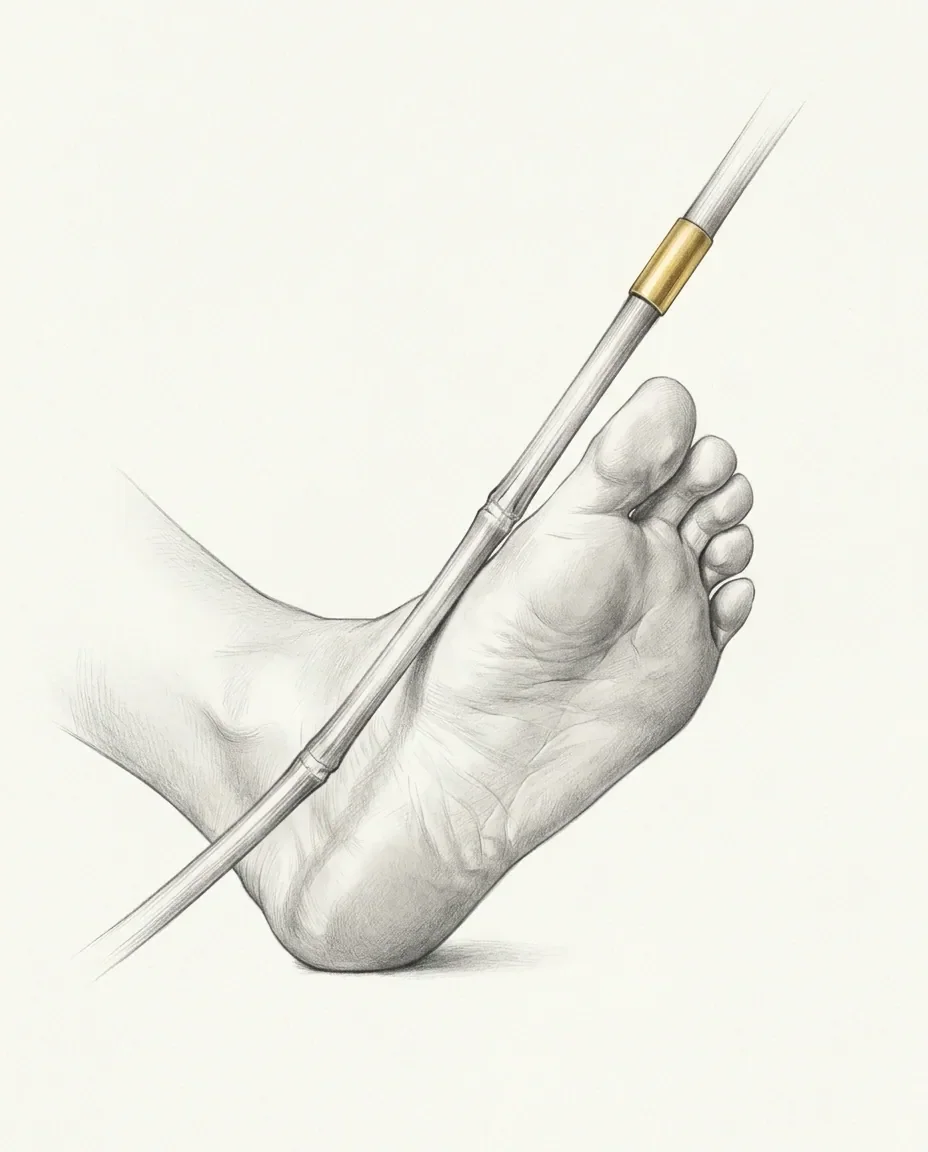
Bastinado / Foot Whipping
Added 22 Jun 2026 · Updated 22 Aug 2026
Consensual impact play that concentrates strokes on the bare soles of the feet, a foot-centred subset of BDSM sensation play. Because the soles are nerve-dense and lightly padded, it yields intense sensation and carries elevated injury risk, so practitioners keep it firmly risk-aware.
- Prevalence
- Uncommon
- Category
- Sensation & Pain
- Domain
- Sexual interest
- Confidence
- Medium confidence
- Status
- Consensual BDSM impact/sensation play; benign variation in consenting adults, not a disorder absent distress or non-consent, but recognised as higher-risk owing to foot anatomy.
- Also known as
- foot whipping, foot caning, sole whipping, falaka, falanga, falaqa, foot bastinado, foot torture (consensual)
- Added
- 22 Jun 2026
- Updated
- 22 Aug 2026
Featured in
Overview
Bastinado, also called foot whipping, is consensual impact play in which strokes are delivered to the bare soles of the feet rather than to the buttocks or back. It sits between BDSM sensation play and foot-focused interest: the soles are among the most nerve-dense, lightly padded surfaces of the body, so even controlled contact produces a sharp, concentrated sensation. The name and much of the ritual are borrowed from an old corporal punishment, reinterpreted as negotiated play between consenting adults. This article covers the term's history, how the consensual practice is expressed, its psychology and prevalence, and, importantly for this higher-risk activity, its safety and legal framing.
Examples
What the term covers. The word names a target, not an implement or an intensity, so what falls under it is wide: a few light taps delivered to the soles inside a longer foot worship scene; a formal, counted caning of the feet with the ankles fixed, borrowing the staging of a judicial punishment; and the version in which the implement is mostly held, tapped and threatened, where anticipation does most of the work. Anything landed on the sole of a consenting adult's foot is bastinado; nothing else is.
What it does not cover. Caning and spanking use much the same implements on the buttocks or back, where fat and muscle absorb the blow, the reason the same stroke is a different event here. Trampling and foot domination put the feet at the other end of the exchange, as the instrument rather than the target, which is the most common mix-up in the foot family. Foot worship and tickling concentrate on the same surface without impact, and sensation play covers the light-implement end of the spectrum generally. A person beaten on the soles who has not agreed to it is being tortured, not played with: falaka remains a documented interrogation method, and consent is the whole of the difference.
How the word is used. In English "bastinado" belongs to two vocabularies at once. In historical, human-rights and forensic writing it names the punishment and the torture technique, still by far its dominant published sense; within BDSM communities it names the consensual practice, usually alongside "foot caning" or the Arabic-derived falaka. There is no clinical coinage for either. Neither DSM-5-TR nor ICD-11 lists it, since consensual sadomasochism is not a disorder in either manual absent distress, impairment or a non-consenting person.
History & origins
Unusually for a kink, bastinado's history is overwhelmingly a history of punishment. The erotic practice is a modern, consensual reappropriation of a brutal judicial method, so the two threads are best read separately.
Etymology & the punitive lineage
The English word bastinado is attested from the 1570s. Per the Online Etymology Dictionary, it comes from the Spanish bastonada ("a beating or cudgelling"), from baston ("stick"), ultimately from Late Latin bastum ("a stout staff"), and from the outset it denoted a beating on the soles of the feet. The same practice is known across the Turkic and Arab world as falaka, falanga or falaqa. Those names derive from the Arabic فَلَقَة (falaqa), originally the wooden plank or frame used to immobilise the feet before beating, a device and term spread widely through the Ottoman Empire.
As corporal punishment, foot whipping is very old and geographically diffuse. According to the Wikipedia survey of foot whipping:
- Imperial China: the bastinado was a common punishment for slight faults, with the number of blows proportioned to the offence, delivered with a bamboo cane or wooden rod.
- 16th century onward: clear written European documentation appears, and falaka becomes an established judicial punishment throughout the Ottoman Empire (including the Balkans) for minor crimes such as theft, vagrancy and expressions of dissent, favoured because the target area recovers relatively quickly and keeps offenders fit for work.
- 20th century to the present: the method persists as a torture technique precisely because it inflicts extreme pain while leaving few external marks; it has been documented in modern interrogation contexts across several countries.
Erotic reappropriation
None of that punitive history is erotic. The consensual kink, which borrows the name, the implements and the immobilised-feet staging, is a contemporary development within BDSM culture, with no separate clinical coinage or diagnostic label. It is documented in community and educational material rather than in the sexological canon of Krafft-Ebing or the DSM-5-TR, which treats consensual sadomasochism as non-disordered absent distress, harm or non-consent.
In practice
Within a negotiated scene the bottom's feet are usually secured, and the top uses a light, flexible implement (a thin cane, switch, crop or paddle) to deliver measured strokes to the soles. Practitioners overwhelmingly favour control, precision and slow escalation over force, valuing the focused, ceremonial quality of the sensation rather than maximal intensity. It is frequently combined with foot fetish interest, bondage and power-exchange role-play, and it overlaps in spirit with other targeted impact practices such as caning.
Psychology
The appeal commonly blends concentrated sensation, endorphin-driven pain processing, intense present-moment focus, and the trust involved in yielding a vulnerable, normally protected part of the body. For many participants the draw is the altered headspace, the subspace that sustained sensation play can induce, rather than pain as such. As with BDSM generally, it is understood as a benign variation rather than a disorder. The specific psychological literature on sole-focused play is thin, so most explanation is extrapolated from broader research on consensual sadomasochism and on foot partialism.
Prevalence & culture
Bastinado is a recognised but niche practice, more specialised than general impact play and bounded by broad BDSM and masochism interest on one side and foot-focused interest on the other. Direct prevalence data are scarce, so estimates rely on proxies. Joyal & Carpentier (2017) found masochistic interest to be within reach of roughly a quarter of adults, common enough not to count as statistically unusual, while Scorolli et al. (2007) reported feet as by far the most common body-part fetish (about 47% of the fetishes sampled). Bastinado lies at the intersection of those two large pools, but only a small fraction of either group engages specifically in sole-focused impact play. Its visibility comes largely from BDSM community spaces and educational writing rather than mainstream media.
Safety, consent & law
This is a higher-risk practice and is documented as such. The feet pack many small bones, tendons, ligaments and nerves into a structure with minimal cushioning, so force transfers directly to the tissues beneath. The forensic literature on falanga torture survivors makes the stakes plain: Edston (2009), in the TORTURE journal and a 2011 forensic-imaging study document serious long-term sequelae, including chronic neuropathic pain, plantar-fascia thickening and scarring, altered gait and compartment problems. That evidence concerns extreme, non-consensual beating, but it is exactly why consensual practitioners stay firmly risk-aware: light flexible implements, careful placement away from bony prominences, low intensity, frequent checking, safewords and aftercare. Between consenting adults the practice is legal in most jurisdictions. Non-consensual use is assault, and under the consent limits recognised in some legal systems, infliction of serious bodily injury can exceed what consent is allowed to cover.
Common questions
Is bastinado safe?
Not in the way lighter impact play is, and practitioners generally say so. The sole has little fat or muscle over a dense structure of small bones, tendons, nerves and the plantar fascia, so force goes straight into tissue the person then has to walk on. Bruising and a day or two of painful walking are ordinary outcomes at moderate intensity, and the forensic literature on foot beating documents lasting nerve pain and fascia damage at higher ones. Low force and careful placement reduce the risk; nothing removes it.
Why does it hurt so much more than being hit elsewhere?
Nerve density and the absence of padding. The soles are among the most densely innervated surfaces of the body (the same property that makes them ticklish), and there is almost nothing between skin and bone to spread the load of a blow. Immobilisation adds to it: in most impact play the body absorbs and shifts away, and with the feet secured it cannot.
Is bastinado just torture?
The technique is, and it has not stopped being one. Foot beating survives as an interrogation method precisely because it inflicts extreme pain while leaving little visible evidence, and as a judicial punishment in some places. The consensual practice borrows the name, the implements and the staging, and is separated from the original by intent, by force, and above all by agreement. Beating the feet of someone who has not consented is assault, not kink.
What are the warning signs that a scene should stop?
Numbness or pins and needles; pain that shifts from stinging to deep and sharp; swelling that does not settle; skin that breaks or discolours unevenly; and any difficulty putting weight on the foot. Pain persisting beyond a day or two, or concentrated in one spot, warrants medical attention, as does anything suggesting damage to the arch. The foot is load-bearing, so an injury that would be trivial elsewhere announces itself with every step.
Do you need a foot fetish to be interested in bastinado?
No. Many practitioners arrive through foot fetishism and the overlap is substantial, but others are drawn by the concentrated sensation, the immobilisation, or the ceremony of a formal punishment scene, with the feet simply the place where very little force produces a very large effect. The reverse holds too: most people with a foot interest have no interest in this at all.
Is bastinado a paraphilia or a disorder?
No. DSM-5-TR treats consensual sadomasochism between adults as non-disordered and reaches for a diagnosis only where there is distress, impairment or a non-consenting person; ICD-11 takes the same approach, and neither manual names bastinado specifically. That is a statement about classification and not about physical risk, which is real and is where the practice actually needs care.
- Foot Fetish83/100Podophilia · Body Parts & PartialismA focused erotic interest in feet (their shape, soles, toes, arches, or grooming) as a primary source of attraction. Within partialism (erotic focus on a non-genital body part) it is the example people report most, by a wide margin.83
- Caning48/100Sensation & PainConsensual impact play using a thin, flexible rod such as a rattan cane or switch to deliver sharp, stinging strokes. It is a focused subset of BDSM impact play known for an intense, lingering sensation and carries higher injury risk than padded implements.48
- Bondage86/100Acts & ActivitiesConsensual binding or restraint of a partner with rope, cuffs, tape or other materials for erotic, aesthetic or sensory pleasure. It is the "B" of BDSM and one of the most widely fantasised-about kinks.86
- Ballbusting41/100Sensation & PainConsensual BDSM activity in which a partner applies blunt force (kicking, kneeing, squeezing or striking) to the testicles. A focused subset of cock-and-ball torture, often within femdom or humiliation play, it carries a real risk of genital injury.41
- Subspace64/100Sensation & PainAn altered, often euphoric or trance-like headspace that some submissive or bottoming partners enter during intense BDSM play. It is marked by floating sensations, time distortion, reduced pain awareness and impaired verbal responsiveness.64
- Needle Play37/100Sensation & PainConsensual BDSM practice in which fine sterile needles are passed temporarily through the surface of the skin for sensation, ritual, or visual effect. They are removed at the end of the scene. A higher-risk edge practice distinct from permanent body piercing.37
English "bastinado" (attested from the 1570s) comes from Spanish "bastonada" ("a beating with a cudgel"), from "baston" ("stick"), ultimately from Late Latin "bastum" ("a stout staff"); from the start it denoted a beating on the soles of the feet. The synonyms falaka / falanga / falaqa derive from Arabic فَلَقَة (falaqa), originally the wooden plank used to immobilise the feet before beating, spread through the Ottoman Empire.
impact · foot-focused · implement-delivered · sharp/stinging sensation
Prevalence is computed from the entry's cited population estimate. Rows marked ESTare indicative editorial estimates scored against a fixed anchor rubric, not measured quantities. Method & anchors: methodology.
Uncommon · ≈ 1 in 100
- 01Foot whipping, Wikipediaetymology of bastinado/falaka, historical corporal-punishment use across China, the Ottoman Empire and Europe, and the anatomical/medical basis for intense pain
- 02Edston (2009), Long-term consequences of falanga torture, what do we know and what do we need to know?, TORTURE Journal 19(1)documented long-term sequelae of foot beating (chronic neuropathic pain, plantar-fascia changes, compartment problems) that ground the physical-risk framing
- 03Falanga torture: characteristic features and diagnostic issues, Forensic Science, Medicine and Pathology (2011)MRI/forensic evidence of plantar-fascia thickening and morphological foot changes from repeated sole beating
- 04Joyal & Carpentier (2017), The Prevalence of Paraphilic Interests and Behaviors in the General Population, J. Sex Research 54(2):161-171general-population masochism interest (~23%) that bounds the population engaging in implement impact play such as bastinado
- 05Scorolli et al. (2007), Relative prevalence of different fetishes, Int. J. Impotence Research 19(4):432-437feet as the most common body-part fetish (~47% of fetishes sampled), the foot-focused interest that bastinado overlaps with
- 06bastinado, Online Etymology Dictionaryetymology of bastinado: Spanish bastonada from baston, Late Latin bastum; English attestation from the 1570s; original sense of a beating on the soles of the feet
- 07Psychopathia Sexualis, Wikipediathe sexological canon (Krafft-Ebing, 1886) in which the consensual practice is not separately coined, marking it as a modern community reappropriation
- 08DSM-5-TR, Paraphilic Disorders (American Psychiatric Association, 2022)consensual sadomasochism is treated as non-disordered absent distress, harm or non-consent