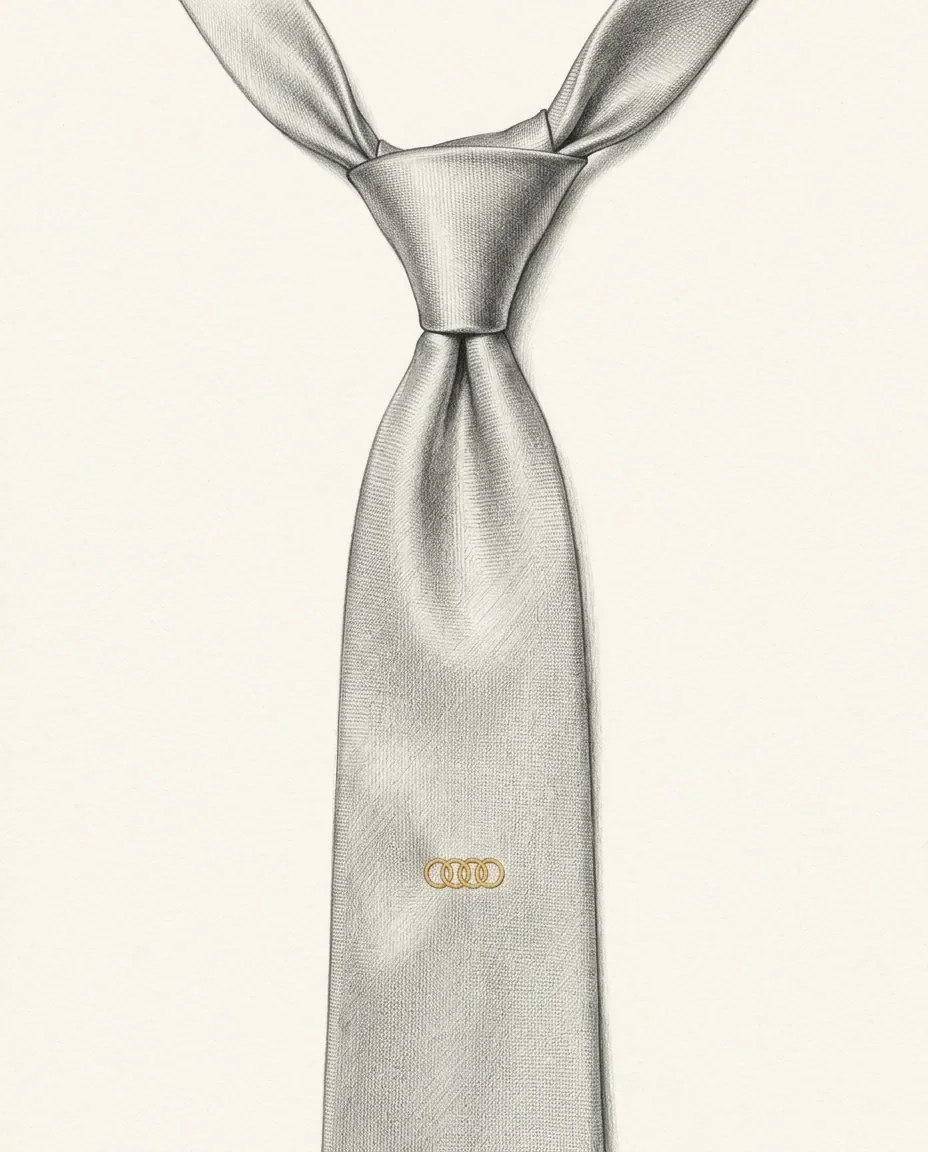
Tie Fetish
Added 21 Jun 2026 · Updated 22 Aug 2026
An erotic interest centered on neckties, dress collars, and the surrounding shirt-and-tie formalwear, valued for their look and constriction. Their authoritative associations are part of the draw. It is a niche clothing fetish, not a clinical disorder.
- Prevalence
- Uncommon
- Category
- Clothing & Garments
- Domain
- Sexual interest
- Confidence
- Low confidence
- Status
- Niche clothing fetish; a normal variation, not a disorder unless it causes distress or impairment.
- Also known as
- necktie fetish, necktie & collar fetishism, shirt-and-tie kink, formalwear collar attraction, collar fetish, neckwear fetish
- Added
- 21 Jun 2026
- Updated
- 22 Aug 2026
Overview
A tie fetish is a clothing-focused erotic interest in which the necktie, the buttoned dress collar, and the broader shirt-and-tie ensemble become a notable source of arousal or fixation. Also described as necktie or collar fetishism, it can rest on the crisp formal aesthetic, the symbolism of office authority and discipline, or the gentle sense of constriction a knotted tie and stiff collar create around the throat. This article covers the garment's cultural lineage, the clinical history of clothing fetishism it belongs to, how the interest is typically expressed, its likely psychology, what is known of its prevalence, and the one genuine safety consideration it raises. For most people it works as a heightened preference layered onto otherwise conventional attraction, not a disorder.
Examples
What the term covers. The necktie itself (silk, knotted, and often knotted by a particular pair of hands) together with the stiff dress collar it sits inside and the shirt, jacket and suit around it; bow ties, cravats, collar bars and tie clips belong to the same family. Three separable pulls travel under the one name. There is the look: crisp tailoring, sheen, the sharp vertical line down a chest. There is the symbolism: office rank, competence, discipline, the tie worn almost as an insignia. And there is the sensation: the deliberate, snug closure of a knot and a starched collar at the throat, felt by the wearer.
What the term does not cover. A suit and tie fetish is the wider sibling, keyed to the whole tailored ensemble rather than to the neckwear and its snugness. Collaring shares a word and almost nothing else: that is the BDSM collar, an emblem of belonging rather than a garment detail. A uniform fetish locates its authority in an institution's insignia rather than in neckwear, and a leather or silk fetish is led by the material wherever it turns up. Making pressure on the throat the point of the exercise is breath play and a choking kink, a different interest with a far more serious risk profile, worth naming here because a necktie is always within arm's reach of it.
How the word is used. Plain English, from kink communities rather than the clinic. There is no Greek or Latin synonym and no necktie-specific entry in DSM-5-TR or ICD-11; a garment preference reaches the diagnostic frame only as fetishistic disorder, which turns on marked distress or impairment that an ordinary taste for shirt and tie does not produce. "Necktie fetish" and "shirt-and-tie kink" are the everyday variants.
History & origins
The garment: from cravat to necktie
The fetish draws on the cultural meaning of an object with a long pedigree. The modern necktie descends from the seventeenth-century cravat: Croatian mercenaries serving in France during the Thirty Years' War (1618–1648) wore knotted neck-cloths that caught Parisian attention, and the French word cravate is an alteration of Croate ("Croat"). A young Louis XIV took up the lace cravat around 1646 and set the fashion for French nobility. The word "tie" first attached to neckwear in the style manual Neckclothitania (1818), which illustrated fourteen ways to knot a cravat. Oxford tailors Castell & Son claim the first modern-style necktie in 1870, and in 1922 the New York tie maker Jesse Langsdorf patented the bias-cut, three-piece construction that gives ties their even drape. Across this history the necktie hardened into a marker of status, competence, business, and formality: the symbolic raw material the fetish recruits.
Clinical lineage of garment fetishism
Clothing fetishism as a clinical category was first described systematically in the late nineteenth century. The word fétichisme entered sexual psychology through Alfred Binet's 1887 essay Du fétichisme dans l'amour, which argued that such interests form when an object becomes bound up with an early or vivid sexual emotion, an associative-learning account that still echoes in modern theory. Binet drew on the case-study tradition of the French psychiatrists Jean-Martin Charcot and Valentin Magnan, and the French term itself had been coined a century earlier by Charles de Brosses for religious object-worship. Richard von Krafft-Ebing's Psychopathia Sexualis (1886) catalogued erotic fixation on particular garments, and Havelock Ellis later treated garment-focused attraction at length in his Studies in the Psychology of Sex. None of these pioneers singled out the necktie, and "tie fetish" has no documented coinage: it is a plain-English label from twentieth-century kink communities rather than the clinical literature. Contemporary diagnostic manuals, the DSM-5-TR and ICD-11, treat ordinary garment preferences as a non-disordered variation unless they cause marked distress or impairment.
In practice
Expression is usually mild and benign:
- A preference for a partner dressed in formal business attire or a sharply knotted tie.
- Enjoyment of tying, adjusting, or being lightly led by a necktie.
- Collecting silk ties for their texture, sheen, and weight.
- Incorporating the garment into role-play built on professional, hierarchical, or dominant-submissive themes, overlapping with the authority cues of a uniform fetish.
Psychology
What causes a tie fetish?
The interest fits standard models of fetish formation. In Binet's associative account, early learning may link formalwear to a formative attraction, while the strong cultural coding of ties and collars as markers of status, competence, and control supplies a ready symbolic charge: the garment reads almost as a wearable insignia of authority. Some people are drawn specifically to the throat-focused sensation of a snug collar or knot, which shades into mild collar-and-ownership and restraint interests, and the tactile pull of silk and leather links it to the texture-driven appeal of a leather fetish. The evidence base specific to neckwear is essentially anecdotal.
Prevalence & culture
How common is a tie fetish?
Necktie and collar fetishism is rarely studied in isolation and sits well below headline clothing fetishes such as footwear and legwear. In the large online survey by Scorolli and colleagues (2007), garment-directed interest was dominated by clothing worn on the legs and buttocks (about 33% of memberships) and footwear (about 32%), with neckwear forming only a tiny residual share, a distribution reproduced in the relative-frequency table on Wikipedia's Sexual fetishism article. Lay guides such as Glamour's A–Z of kinks treat formalwear interests as an uncommon mainstream curiosity. Dedicated online communities exist but are small. Because ties and collars have very high everyday visibility, many people hold faint formalwear associations without ever identifying a fetish.
Safety, consent & law
There are no inherent legal concerns: the interest involves ordinary clothing and consenting adults. The one real caution concerns the neck. A necktie is a ligature that happens to be within reach, and used at the wrists it is ordinary bondage; silk knots can tighten and jam, so blunt-tipped scissors belong within reach. Used at the throat it stops being a clothing question at all: the relevant guidance is that for breath play and choking, where the mechanism and the documented harms of neck compression are set out in full. Nothing should be left fastened around an unattended neck, and no pressure should ever be taken to the point of breathing difficulty. Ordinary norms of mutual consent and privacy hold throughout.
Common questions
What is the difference between a tie fetish and a collar fetish?
The word "collar" does double duty. In this entry it means the stiff dress collar of a shirt, part of the same formalwear package as the tie. In BDSM it means something quite different (see collaring), where a collar marks belonging or commitment between partners and has nothing to do with office dress. People use "collar fetish" for both, so it is usually worth asking which is meant.
Is a tie fetish a disorder or a paraphilia?
No. A strong preference for a particular garment is an ordinary variation, and neither DSM-5-TR nor ICD-11 treats it otherwise. The diagnostic category that does exist, fetishistic disorder, requires that an interest cause marked distress or impairment, not simply that it be unusual. Enjoying the sight of a partner in shirt and tie comes nowhere near that bar.
Is it safe to be tied up or led around by a necktie?
At the wrists it is ordinary bondage with improvised material: silk knots can tighten and jam, so keep blunt-tipped scissors nearby and check circulation. At the neck it is not a bondage question at all. Anything that compresses the throat belongs to breath play and carries the serious risks documented under choking. A tie should never be left fastened round an unattended neck.
Is a tie fetish the same as a uniform fetish?
They borrow the same kind of authority but attach it to different things. A uniform fetish is directed at an institution's dress (police, military, medical, service) and the rank and role it announces. A tie fetish is directed at civilian formalwear and its softer, corporate register of competence and discipline. Plenty of people hold one without the other.
Does a tie fetish mean being attracted to men?
Not inherently. The interest is in the garment and what it signals, and neckties are worn by people of any gender. Because business dress has historically been coded as menswear, most of the imagery the interest draws on features men, which is why the two are often assumed to travel together. The attraction can attach to anyone wearing the thing.
Is liking a partner in a suit a fetish?
Usually not. Finding formalwear attractive is close to universal and normally sits inside conventional attraction as a strong preference. Where it does become a focus in its own right, interest in the whole tailored ensemble is catalogued separately as a suit and tie fetish; this entry is the narrower one, keyed to the necktie and collar. Most people describing a "tie thing" are describing a taste, and everyday language is looser than the clinical term.
- Uniform Fetish60/100Uniform Fetishism · Clothing & GarmentsAn erotic interest in uniforms and the authority, role, or status they signal: military, police, medical, school, or service dress. A common clothing-and-role fetish rather than a clinical disorder.60
- Lingerie Fetish70/100Clothing & GarmentsAn erotic interest in lingerie and intimate apparel in which the garments themselves, their fabrics, and their styling become a focus of arousal. Bras, briefs, stockings, corsets and slips are typical. One of the most common and mainstream garment-related interests.70
- Leather Fetish65/100Leather fetishism · Objects & MaterialsAn erotic attraction to leather as a material: its look, smell, creak, shine, and feel when worn. It overlaps strongly with BDSM gear and is bound up with a recognised, organised leather subculture with its own bars, codes, and titles.65
- Nun Fetish26/100Clothing & GarmentsAn erotic interest centred on religious dress, most often the nun's habit and veil, valued for its modest silhouette and ritual symbolism. Themes of forbidden allure are part of the draw. A niche costume and role-play fetish, not a clinical disorder.26
- Raincoat Fetish25/100Clothing & GarmentsAn erotic attraction to rainwear (rubberized or PVC macs, capes, sou'westers and waders) for their waterproof sheen or matte texture. The sound of the material adds to it, as does the tension between a garment's plain practicality and its covert erotic charge.25
- Fur Clothing Fetish29/100Doraphilia · Clothing & GarmentsAn erotic interest in wearing or being touched by fur garments such as coats, stoles, and wraps, valued for their softness, warmth, and luxurious feel. It is a benign garment fetish, the worn-clothing subtype of doraphilia.29
"Tie fetish" is plain modern English. "Tie" attached to neckwear by 1818 (Neckclothitania); its ancestor "cravat" comes from French cravate, an alteration of Croate ("Croat"), after the Croatian mercenaries whose knotted neck-cloths set the fashion under Louis XIV. "Fetish" derives from Portuguese feitiço ("charm, sorcery"), from Latin facticius ("made by art").
formalwear · neckwear · garment fetishism
Prevalence is computed from the entry's cited population estimate. Rows marked ESTare indicative editorial estimates scored against a fixed anchor rubric, not measured quantities. Method & anchors: methodology.
Uncommon · ≈ 1 in 100
- 01Scorolli et al. (2007), Relative prevalence of different fetishes, Int. J. Impotence Research 19(4):432-437clothing-fetish distribution where neckwear is a very small share relative to shoes (32%) and legwear (33%)
- 02Sexual fetishism, Wikipedia (carries the Scorolli 2007 relative-frequency table)Alfred Binet's 1887 introduction of fétichisme into sexual psychology and associative-imprinting theory; also carries the Scorolli clothing relative-frequency table contextualizing neckwear as niche
- 03An A–Z of Kinks and Fetishes, Glamourlay framing of garment/formalwear kinks as an uncommon mainstream interest
- 04Richard von Krafft-Ebing, Psychopathia Sexualis (1886)early clinical cataloguing of garment-focused fetishism in the nineteenth century
- 05Necktie, Wikipediahistory of the necktie from the seventeenth-century cravat and its status/formality associations