Urtication
Urtication
Added 26 Jul 2026 · Updated 22 Aug 2026
Urtication is the deliberate stinging of skin with nettles, producing a hot, prickling rash. It began as a folk-medicine counter-irritant for arthritis and paralysis and survives today as a form of sensation and pain play.
- Prevalence
- Rare
- Category
- Sensation & Pain
- Clinical term
- Urtication
- Domain
- Sexual interest
- Confidence
- Low confidence
- Status
- Not classified as a distinct paraphilia in the DSM-5-TR or ICD-11; the clinical literature treats it purely as a historical folk-medicine counter-irritant technique, with no separate clinical framing of its recreational kink use.
- Also known as
- nettling, nettle play, nettle whipping, urtification
- Added
- 26 Jul 2026
- Updated
- 22 Aug 2026
Featured in
Overview
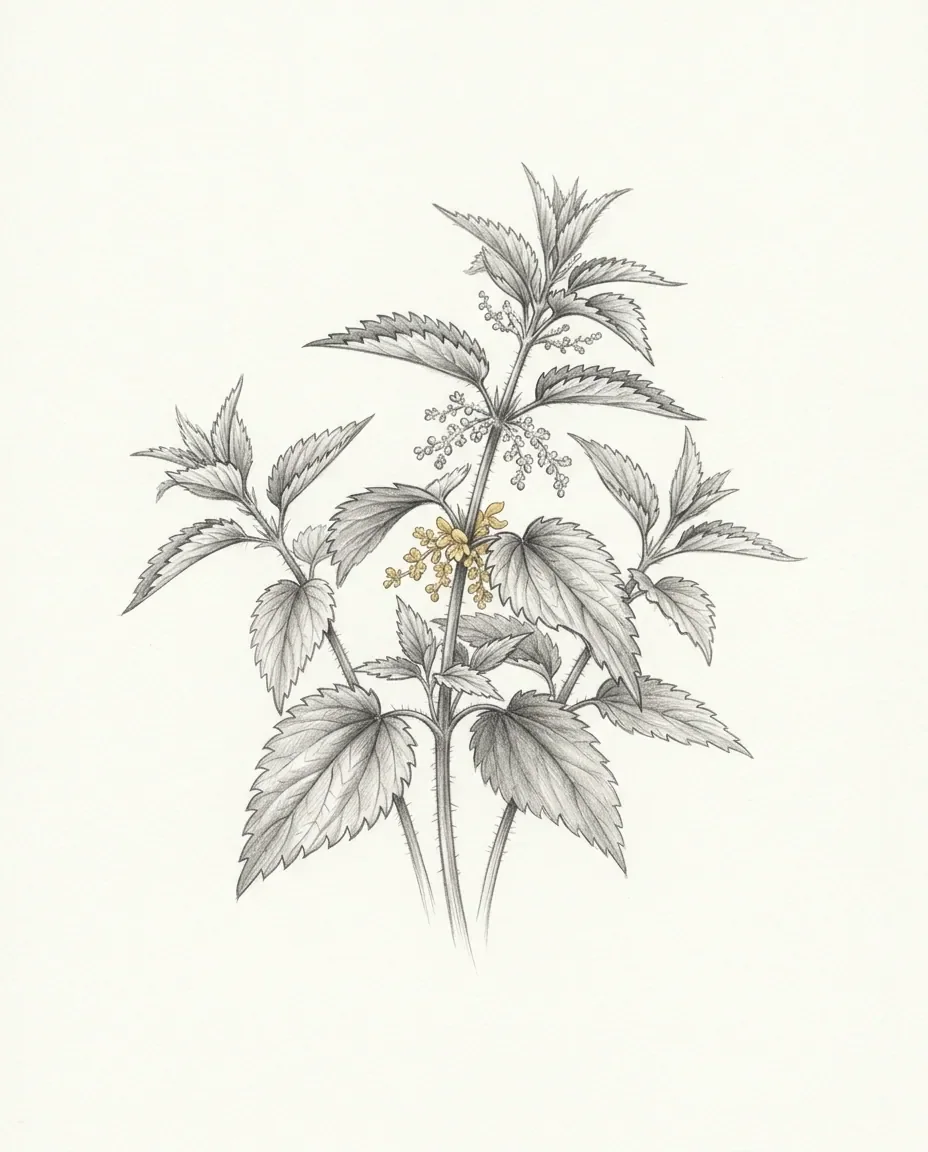
Urtication is the deliberate application of stinging nettles to the skin, most often by rubbing the leaves against bare flesh or striking it with a bundle of stems. The plant's fine hollow hairs, called trichomes, break on contact and inject a mix of formic acid, histamine and other irritants, producing a hot, prickling rash that can last from minutes to a day. Long before it had any erotic association, urtication was a mainstream folk-medicine technique, and it survives today, in a much narrower context, as a form of sensation play and pain play within BDSM.
Definition & scope
The sting comes from Urtica dioica, the common stinging nettle, and related species. Each leaf and stem carries thousands of brittle, silica-tipped hairs that snap off like tiny needles and inject their fluid under the skin on contact, a mechanism closer to an insect sting than to a burn. The resulting welts, urticaria, a name that shares the same Latin root as urtication itself, typically fade within a day, though sensitive skin can blister or scar with heavy or repeated contact.
Examples
What the term covers. A few nettle leaves pressed or brushed against a small patch of skin, usually the inner arm or thigh, to see how a person reacts; a bound bundle of stems swung like a light flogger across a larger area; and the historical medical version, in which the identical sting was applied to an arthritic joint or a paralysed limb for entirely non-erotic reasons. The sensation is the defining feature: a delay of seconds, then a prickling heat that builds over minutes and outlasts the contact by hours.
What the term does not cover. Figging uses prepared ginger against mucous membrane and burns almost at once. Wax play and temperature play deliver heat rather than an injected irritant. Abrasion play scrapes the skin's surface, pinching and clamping compresses it, and needle play deliberately breaks it. Impact play and flogging produce a sensation that is instant and mechanical, where nettling is chemical and slow. The word is also not a synonym for urticaria: the two share a Latin root, but one names a practice and the other a rash that can arise from almost anything.
How the word is used. Urtication is the older medical term and is what the historical and herbal literature uses; within kink communities the everyday words are "nettling" and "nettle play", with "urtication" surviving mainly in glossaries. Its only formal literature is medical-historical rather than psychiatric: it names a technique, not a diagnosis, and no diagnostic manual lists it.
History & origins
Ancient and folk medicine
The earliest surviving reference is Roman: the naturalist Pliny the Elder (23–79 CE) described nettle as an effective remedy for muscle paralysis, and the physicians Galen (c. 130–200 CE) and Dioscorides (1st century CE) both recorded nettle used medicinally on the skin, according to a history compiled in Spinal Cord Series and Cases. The underlying idea was counter-irritation: raising a stinging, superficial rash to draw attention, and supposedly blood flow, away from a deeper ache, in much the way rubbing a stubbed toe distracts from the pain of the injury.
Early modern to nineteenth century
The practice held on for centuries as ordinary folk medicine. The Scottish physician William Buchan's widely read Domestic Medicine (1779) noted that "some pretend to have found great benefit from rubbing the affected parts with nettles." In 1821 a Birmingham surgeon's assistant, John Piper, published a case of partial paralysis he reported as cured by urtication. A modern review of counter-irritation in paralysis found only two documented cases to assess in the whole historical record: Piper's, and a seventeenth-century flagellation case reported second-hand by Van Helmont (Silver & Weiner, 2019). Nettle-stinging was applied to rheumatism, sciatica, stiff joints and, as a treatment of last resort, cases of paralysis that had not responded to anything else.
Twentieth century to present
Mainstream medicine gradually dropped urtication as scientific pharmacology replaced counter-irritant folk remedies, though herbalists kept using it: a 2000 double-blind crossover trial by Randall and colleagues, cited in the same history, applied nettle leaf against a placebo leaf in 27 patients with base-of-thumb pain and reported significantly greater reductions in pain and disability scores, with 17 of the 27 saying they would choose to use stinging nettle again (Journal of the Royal Society of Medicine 93:305–309). Separately, and without any documented single point of origin, the same sting was picked up within twentieth-century BDSM and sensation-play communities as a recreational, negotiated form of pain play, grouped alongside implements such as figging and impact play that work by introducing a sharp, localized, temporary discomfort into a scene.
In practice
Within a kink context, urtication is typically introduced gradually: a few leaves brushed or pressed against a small area of skin, then, if wanted, a larger area or a bundle used more like a light flogging implement. The sting builds after a short delay and peaks over several minutes, distinguishing it from the immediate, sharp sensation of impact play. Participants commonly describe it as a sustained, prickling burn rather than a single strike, which places it closer to temperature play or fire-adjacent sensation than to caning or paddling in feel, even though the tool itself is a plant rather than an implement.
Psychology
The appeal follows the same broad model proposed for other pain and sensation play: a sharp, controlled, consensual discomfort can trigger an endorphin response, sharpen present-moment focus, and, within a power-exchange dynamic, function as a marker of trust between the person administering it and the person receiving it. Because urtication has no dedicated body of psychological research of its own, clinicians and researchers place it within the wider literature on consensual masochism and sensation play, where interest in giving or receiving pain is described as a common variation rather than a symptom of disorder (Joyal & Carpentier, 2017), and neither the DSM-5-TR nor the ICD-11 treats consensual pain play of this kind as a disorder absent distress or non-consent.
Prevalence & culture
Urtication has no dedicated general-population survey of its own; it is a minor variant nested within the broader popularity of pain and sensation play, interests that themselves poll as common rather than rare (Joyal & Carpentier, 2017). It is documented in kink glossaries and community references alongside other niche sensation practices, but it draws a far smaller dedicated following than mainstream impact play or bondage, and it remains more a specialty interest discussed within broader pain-play and munch communities than a named practice with its own events or literature. The closest quantitative context available is relative-frequency data from online fetish communities rather than a population estimate: Scorolli and colleagues (2007) counted the membership of 381 fetish discussion groups, covering at least 5,000 people, and found interest concentrated on body parts (33%) and objects associated with the body (30%), with objects unrelated to the body accounting for roughly 5% of preferences and no category corresponding to plant-based sensation practices appearing at all.
Safety, consent & law
Nettle stings are ordinarily self-limiting, but real risks exist. Contact can trigger allergic reactions ranging from mild swelling to, rarely, more serious hypersensitivity, and repeated or heavy stinging can break the skin, creating an infection risk. Eyes, mucous membranes, and broken or irritated skin should never be exposed to nettle. Because reactions vary considerably between individuals, practitioners are advised to start with brief, small-area contact, and to have antihistamines or a cool compress on hand for aftercare. Urtication is legal between consenting adults in essentially all jurisdictions, since it involves a wild or cultivated plant rather than a controlled substance or weapon, though the general legal principle that a person cannot consent to serious bodily harm still applies if injury results, as it would with any consensual pain or impact play.
Common questions
What does a nettle sting used in play actually feel like?
Not like a slap. There is a short delay, then a prickling heat that builds over several minutes and settles into a sustained burn with an itch inside it. That slow onset is the practical difference from impact play, where the sensation peaks at the moment of contact and then fades. Nettling keeps arriving after the leaves are gone, which is why it is normally introduced on a small area first.
How long does a nettle rash last?
Usually from a few minutes to about a day, depending on the person and on how much contact there was. The welts are a histamine reaction to the fluid injected by the plant's hollow hairs, and they typically fade without treatment. Sensitive skin, heavy contact, or repeated sessions on the same area can blister or, less often, mark for longer, which is the main reason for starting small and waiting to see how someone reacts.
Is urtication safe?
Reasonably, within limits, but not risk-free. Allergic reactions range from ordinary swelling to, rarely, serious hypersensitivity, and there is no way to know in advance which a person will have. Heavy or repeated stinging can break the skin and open an infection route. Nettle must never touch the eyes, mucous membranes, or already-broken skin. Test on a small patch, keep antihistamines and a cool compress to hand, and stop if the reaction spreads beyond the area treated.
How do you treat a nettle sting afterwards?
Rinse with cool water without rubbing, since rubbing drives more of the broken hairs into the skin. A cool compress and an oral antihistamine both reduce the reaction, and scratching is what turns a self-limiting rash into a broken-skin infection risk. A reaction that spreads well beyond the contact area, involves breathing difficulty, or produces swelling of the face or throat is a medical emergency rather than an aftercare problem.
Does stinging with nettles really help arthritis?
The claim is old and the evidence is thin. Mainstream medicine dropped urtication as pharmacology replaced counter-irritant remedies. One small trial is the notable exception: Randall and colleagues (2000) applied nettle leaf against a placebo leaf in 27 patients with base-of-thumb pain and reported significantly greater reductions in pain and disability scores, with 17 of the 27 saying they would use stinging nettle again. That is a single study on one joint, not a general endorsement.
What is the difference between urtication and figging?
Both use a plant to produce a burn, and there the similarity ends. Figging uses a carved piece of fresh ginger applied to mucous membrane, and its heat arrives quickly and stays where the ginger sits. Urtication injects an irritant into ordinary skin through the nettle's brittle hairs, so it spreads across whatever area was touched, builds slowly, and can be applied almost anywhere on the body.
Is nettle play legal?
Yes, between consenting adults in essentially every jurisdiction. Nettles are a common wild plant, not a controlled substance or a weapon, and nothing about gathering or using them is restricted. The general legal principle still applies that a person cannot consent to serious bodily harm, so a session that produced a real injury could be treated as an assault, the same rule that governs every other form of consensual pain play.
- Figging33/100Sensation & PainA sensation practice in which a piece of peeled, carved ginger root is inserted into the anus (or vagina) to produce a building, spreading burning sensation. It descends from a Victorian horse-trade trick called feaguing or gingering and is now a niche, medium-core BDSM activity.33
- Impact Play71/100Sensation & PainAn umbrella term for consensual BDSM activities in which one partner strikes another's body with a hand or implement for erotic sensation or power exchange. It spans light spanking through to firmer use of paddles, floggers, crops, and canes within negotiated limits.71
- Sensation Play45/100Sensation & PainAn interest in heightened, varied skin sensations created with soft, textured, or lightly stimulating implements. Feathers, fur, silk, brushes, ice, or pinwheels are typical, often combined with anticipation and the contrast between soothing and prickling touch. It is a common, gentle form of erotic play.45
- Pain Play58/100Algolagnia · Sensation & PainPain play (algolagnia) is a clinical umbrella term for sexual arousal connected to physical pain, whether that pain is received or inflicted. The received form is labelled active/masochistic, the inflicted form passive/sadistic. It frames pain itself, not any specific implement, as the source of erotic interest.58
- Flogging60/100Sensation & PainConsensual impact play in which one partner strikes another's body with a multi-tailed flogger, whip, or single-tail. The rhythmic sensation ranges from a broad "thuddy" impact to a sharp, stinging line. It is a common, negotiated element of BDSM sensation play.60
- Algophilia (Arousal from Pain)21/100Algophilia · Sensation & PainAn archaic sexological label for sexual arousal or pleasure derived from pain. A near-synonym of algolagnia that overlaps heavily with sexual masochism, the term clinicians use today.21
From Latin urtica, "nettle," traditionally traced to urere, "to burn," though some etymologists consider that link a folk etymology since urere's stem does not regularly produce urtica. The related medical term urticaria ("hives," a skin rash) shares the same root.
nettle · folk-medicine · sensation-play · pain-play
Prevalence is computed from the entry's cited population estimate. Rows marked ESTare indicative editorial estimates scored against a fixed anchor rubric, not measured quantities. Method & anchors: methodology.
Rare · ≈ 1 in 1,000
- 01Silver & Weiner (2019), Urtication (flogging with stinging nettles) and flagellation (beating with rods) in the treatment of paralysis, Spinal Cord Series and Cases 5:79History of urtication as folk medicine: Pliny the Elder, Galen and Dioscorides, William Buchan's 1779 Domestic Medicine, John Piper's 1821 case of partial paralysis cured by urtication, and its account of the Randall et al. (2000) nettle-sting trial.
- 02Urtication, World Wide WordsEtymology from Latin urtica/urere and documented historical range of urtication's uses.
- 03urtica, WiktionaryLatin etymology of urtica and its disputed derivation from urere, and the shared root with urticaria.
- 04Joyal & Carpentier (2017), The Prevalence of Paraphilic Interests and Behaviors in the General Population, J. Sex Research 54(2):161-171General population data placing masochism and pain-play interest within the range of common, not statistically unusual, sexual interests.
- 05DSM-5-TR, Paraphilic Disorders (American Psychiatric Association, 2022)Consensual pain/sensation play, including urtication, is not a paraphilic disorder absent distress, impairment or non-consent.
- 06ICD-11, Paraphilic disorders (World Health Organization)Modern clinical nosology does not classify consensual pain play as a disorder.
- 07Scorolli et al. (2007), Relative prevalence of different fetishes, International Journal of Impotence Research 19(4):432-437Relative-frequency data from 381 online fetish discussion groups (at least 5,000 people): body parts 33%, objects associated with the body 30%, objects unrelated to the body ~5%, with no plant-based sensation category recorded.
- 08Randall et al. (2000), Randomized controlled trial of nettle sting for treatment of base-of-thumb pain, J R Soc Med 93(6):305-309The 2000 double-blind crossover trial in 27 patients: significantly greater reductions in pain and disability scores than placebo, and 17 of 27 electing to use stinging nettle again.
- 09urticaria, WiktionaryShared Latin root between urtication and urticaria (hives).