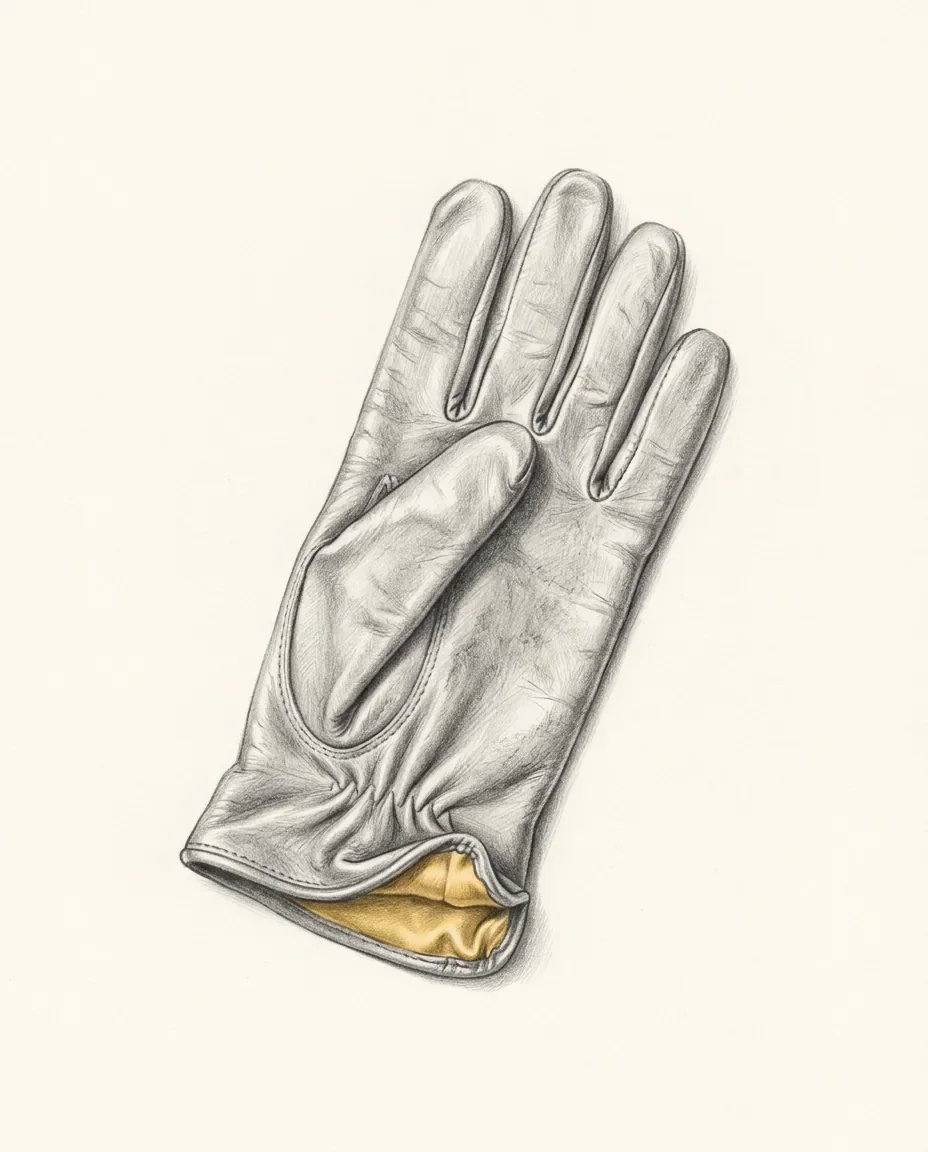
Leather Glove Fetish
Added 22 Jun 2026 · Updated 22 Aug 2026
An erotic interest focused specifically on leather gloves: their look on the fingers, scent, faint creak, and smooth feel. A material-specific subset of glove fetishism that overlaps leather fetishism; an uncommon preference, not a clinical disorder.
- Prevalence
- Uncommon
- Category
- Clothing & Garments
- Domain
- Sexual interest
- Confidence
- Low confidence
- Status
- Niche, material-specific clothing/leather fetish; a normal variation, not a distinct clinical paraphilia or disorder unless it causes distress or impairment.
- Also known as
- leather glove fetishism, leather glove kink, leather handwear fetish, driving glove fetish
- Added
- 22 Jun 2026
- Updated
- 22 Aug 2026
Featured in
Overview
Leather glove fetishism is an erotic interest in which arousal centres specifically on leather gloves worn on the hands. It is a material-specific subset of glove fetishism, the broader interest in handwear, narrowed to the qualities of leather: its supple look over the fingers, its scent, the faint creak, and its smooth feel. Recurring focal points include fitted driving gloves, long kidskin evening gloves, and snug fashion gloves. Because the appeal is bound up with the hide itself, it overlaps heavily with leather fetishism generally. It is best understood as a focused material preference that, for most people, layers onto otherwise conventional attraction rather than a disorder.
Definition & scope
The interest sits at the intersection of two broader categories: garment fetishism (arousal tied to an article of clothing) and material fetishism (arousal tied to a substance, here tanned hide). What distinguishes the leather-glove focus from generic glove interest is the specific sensory package of the leather itself, so a satin or latex glove rarely substitutes. It is not, in itself, a distress-causing condition: like other benign material interests it becomes clinically relevant only in the rare case where it causes marked distress or impairment, the threshold the DSM-5-TR uses to separate an interest from a disorder.
Examples
The interest is narrow by definition, so it is best described by what falls inside it and by the near-neighbours that do not.
What the term covers. Fitted driving gloves, unlined and close to the hand; long kidskin or lambskin evening gloves; snug dress and fashion gloves in the same materials. The appeal is a package rather than a single quality: the way leather creases over the knuckles and catches light, the faint creak, the smell of tanned hide, and the deliberate slowness of a glove being drawn on or peeled off. It runs in both directions, since wearing them can matter as much as seeing them worn, and it commonly extends into collecting by cut, length, colour and leather.
What the term does not cover. Glove fetishism is the general handwear interest, and satin, lace, net and latex gloves belong there; this entry covers only the leather-specific strand. Latex and rubber interests turn on a different material with a different sensory profile (squeak and sheen rather than creak and grain), so one rarely substitutes for the other. Leather fetishism is the wider material interest that also takes in jackets, harnesses and boots. A hand fetish is a partialism directed at the hand itself, which a glove conceals rather than displays; the two frequently point in opposite directions. And a uniform fetish that happens to include gloves is an interest in the whole costume and the authority it signals, not in the handwear.
How the word is used. Plain descriptive English, community register. There is no clinical term for it: neither diagnostic manual names a glove or a leather category, and both reach the territory only through the general heading of fetishistic disorder. The working vocabulary is borrowed from the glove trade (kidskin, lambskin, unlined, gauntlet length), which is part of why enthusiasts discuss craftsmanship as readily as arousal.
History & origins
Gloves have carried erotic and social charge for centuries, as markers of status, modesty, and ritualised touch, long before any clinical vocabulary existed to describe a fixation on them.
Cultural lineage
The glove sits at the boundary between concealment and revelation: removing one was a charged gesture in courtship, and the garment recurs as an erotic motif in literature and art.
- 18th century: Tracey Hutchings-Goetz's 2019 study The Glove as Fetish Object in Eighteenth-Century Fiction and Culture (Eighteenth-Century Fiction 31(2):317) traces how gloves were eroticised in eighteenth-century fiction, standing in for the absent or longed-for hand.
- 19th–20th centuries: Long evening gloves and fitted leather driving gloves became fashion signifiers of glamour, authority, and mediated touch, a coding that later cinema and couture reinforced. The gloved hand became visual shorthand for both the elegant and the sinister, from screen sophisticates to the leather-gloved villain of mid-century thrillers.
Clinical lineage
- 1886: Richard von Krafft-Ebing's Psychopathia Sexualis catalogued attractions to clothing and to materials such as leather as forms of object fetishism.
- 1887: Alfred Binet introduced fétichisme into the erotic context in Le fétichisme dans l'amour, proposing that such attachments arise through early associative experience.
- Modern references: "Leather glove fetish" is not a separately named clinical condition; it sits within clothing and material fetishism. Wikipedia's glove fetishism article explicitly lists leather first among glove materials, and the single clinical case it cites is Noguchi & Kato's 2010 report of glove fetishism in a patient with Williams syndrome (Psychiatry and Clinical Neurosciences 64(6):663), an isolated case study rather than evidence of a discrete diagnosis.
In practice
Expression is typically low-key:
- A preference for a partner wearing leather gloves, or wearing them oneself.
- Enjoyment of the visual, tactile, auditory (the creak), and olfactory experience of gloved hands.
- Collecting particular cuts, lengths, colours, or leathers: kidskin, lambskin, fitted driving gloves.
Many enthusiasts emphasise aesthetics and craftsmanship as much as any sexual element, and the interest often coexists with broader leather or boot preferences.
Psychology
What causes it?
Leather glove fetishism fits standard models of fetish formation. Associative learning can link the garment to a formative attraction, while the symbolism leather and gloves carry in fashion and film (glamour, authority, anonymity, mediated touch) reinforces the cue. Two features specific to gloves may add to the appeal: the multisensory richness of leather (scent, creak, sheen) and the partial concealment of the hand, a normally exposed body part, which lends a charge of mystery. As with fetishism generally, these mechanisms are descriptive rather than proven, and the evidence base for any single cause is thin.
Is it normal?
Yes, in the ordinary sense: a consensual material preference in an adult is a common-spectrum variation, not a disorder. Joyal & Carpentier (2017) found fetishistic interests to be widespread in the general population rather than rare, though their survey does not isolate gloves specifically.
Prevalence & culture
Leather gloves are a niche interest, studied chiefly within broader clothing and leather fetishism rather than on their own. In Scorolli and colleagues' 2007 analysis of online fetish communities, footwear (around 32%) and legwear (around 33%) dominated the garment-fetish data while handwear was a minor share, consistent with this entry's uncommon tier. Dedicated communities and FetLife groups exist but are small. Leather gloves retain mild mainstream resonance through couture, motoring imagery, and cinematic depictions of elegant or menacing characters.
Safety, consent & law
Leather glove fetishism involves ordinary garments and consenting adults, with no inherent safety, consent, or legal concerns. The usual norms of mutual consent and privacy apply.
Common questions
What is the difference between a leather glove fetish and a glove fetish?
Glove fetishism is the umbrella: an erotic interest in handwear of any material, satin, lace, net and latex included. The leather-specific form is one strand of it, defined by the material rather than the garment: the grain, the scent, the creak, the particular way hide moves over the knuckles. The useful test is substitution: if a satin glove would do just as well, the interest is the broader one.
Do people with this fetish wear the gloves themselves or prefer a partner wearing them?
Both, often in the same person. Some are drawn to the sight of gloved hands on someone else, some to the enclosed, tactile feeling of wearing them, and many enjoy either. There is no standard configuration, and nothing about the interest requires a partner at all; a good deal of it is aesthetic appreciation and collecting.
Is a leather glove fetish the same as a hand fetish?
Close to the reverse. A hand fetish is a partialism, an erotic focus on the hand as a body part; a leather glove fetish attaches to an object that covers the hand and hides it. The two can coexist, and the tension between concealment and the shape underneath is something several accounts of glove interest point to, but they are not the same object.
Do latex or medical gloves count?
Not as this interest. Latex handwear belongs with latex and rubber interests, which have their own sensory character, and with medical setting kink, where the glove signals a clinical role rather than a material. Someone may well hold both interests; they are simply not the same one, and the material is what distinguishes them.
Is a leather glove fetish a disorder?
No. A consensual material preference in an adult is an ordinary variation. Joyal and Carpentier (2017) found fetishistic interests to be widespread in the general population rather than rare, though their survey does not isolate gloves. A diagnosis would require marked distress or impairment, which a private preference for a garment does not produce.
How common is a leather glove fetish?
Uncommon, and rarely studied on its own. The most-cited relative-frequency data, Scorolli and colleagues (2007), analysed hundreds of online fetish communities and found garment interest dominated by footwear (around 32%) and legwear (around 33%), with handwear a small share of the remainder. Dedicated leather-glove groups exist on platforms such as FetLife but are small.
- Glove Fetish34/100Glove fetishism · Clothing & GarmentsAn erotic interest in gloves as worn handwear, valued for their material (leather, satin, latex, lace) and for the way they cover the hands. Associations with elegance, formality, or restraint add to the appeal. An uncommon garment-and-material fetish, not a clinical disorder.34
- Leather Fetish65/100Leather fetishism · Objects & MaterialsAn erotic attraction to leather as a material: its look, smell, creak, shine, and feel when worn. It overlaps strongly with BDSM gear and is bound up with a recognised, organised leather subculture with its own bars, codes, and titles.65
- Boot Fetish52/100Clothing & GarmentsA sexual interest in boots, from knee-high and thigh-high fashion styles through riding, work, combat, and military boots. They are valued for their silhouette, materials, and connotations of authority. It overlaps with shoe, leather, and uniform fetishism.52
- Ballet Boot Fetish32/100Clothing & GarmentsAn erotic interest in ballet boots, the fetish footwear that holds the foot fully en pointe on a seven-inch heel. The appeal lies in the leg line, the object itself and the limit it places on walking. A niche within shoe and boot fetishism.32
- Fur Clothing Fetish29/100Doraphilia · Clothing & GarmentsAn erotic interest in wearing or being touched by fur garments such as coats, stoles, and wraps, valued for their softness, warmth, and luxurious feel. It is a benign garment fetish, the worn-clothing subtype of doraphilia.29
- Suit and Tie Fetish33/100Clothing & GarmentsAn erotic interest centred on tailored suits, dress shirts and neckties, prized for their formality and perceived masculinity. Power symbolism and crisp tactile detail add to the appeal. It is a niche clothing fetish, not a clinical disorder.33
"Glove" derives from Old English *glōf*, "covering for the hand"; "leather" from Old English *leþer*, tanned animal hide; "fetish" comes via French *fétiche* from Portuguese *feitiço*, "charm, sorcery," from Latin *facticius*, "made by art." The erotic sense of *fétichisme* was introduced by Alfred Binet in 1887.
handwear · leather · garment fetishism
Prevalence is computed from the entry's cited population estimate. Rows marked ESTare indicative editorial estimates scored against a fixed anchor rubric, not measured quantities. Method & anchors: methodology.
Uncommon · ≈ 1 in 100
- 01Glove fetishism, Wikipediadefinition of glove fetishism; explicit listing of leather among glove materials; cites the Noguchi & Kato clinical case
- 02Noguchi M & Kato S (2010), A case of Williams syndrome with glove fetishism, Psychiatry and Clinical Neurosciences 64(6):663clinical case reference for glove fetishism cited by the Wikipedia article
- 03Hutchings-Goetz, T. (2019), The Glove as Fetish Object in Eighteenth-Century Fiction and Culture, Eighteenth-Century Fiction 31(2):317historical/cultural eroticisation of the glove as a fetish object
- 04Scorolli et al. (2007), Relative prevalence of different fetishes, Int. J. Impotence Research 19(4):432-437prevalence anchor (handwear a minor sub-category among clothing/garment fetishes)
- 05Sexual fetishism, Wikipedia (carries the Scorolli 2007 relative-frequency table)carries the Scorolli relative-frequency table; Binet 1887 coinage; material/garment fetishism context and the not-a-discrete-diagnosis framing
- 06Psychopathia Sexualis, WikipediaKrafft-Ebing (1886) catalogued attractions to clothing and to materials such as leather as object fetishism
- 07Alfred Binet, Le fétichisme dans l'amour (1887), PhilPapersBinet introduced 'fétichisme' into the erotic context in 1887 with the associative-experience theory
- 08Joyal & Carpentier (2017), The Prevalence of Paraphilic Interests and Behaviors in the General Population, J. Sex Research 54(2):161-171fetishism in general is common in the population, though gloves are not isolated
- 09DSM-5-TR, Paraphilic Disorders (American Psychiatric Association, 2022)a material/garment interest is a disorder only where it causes marked distress or impairment; a consensual untroubled preference is not pathologised
- 10FetLife, kink community group sizes (community-size proxy)community-size proxy: dedicated leather-glove groups exist but are small