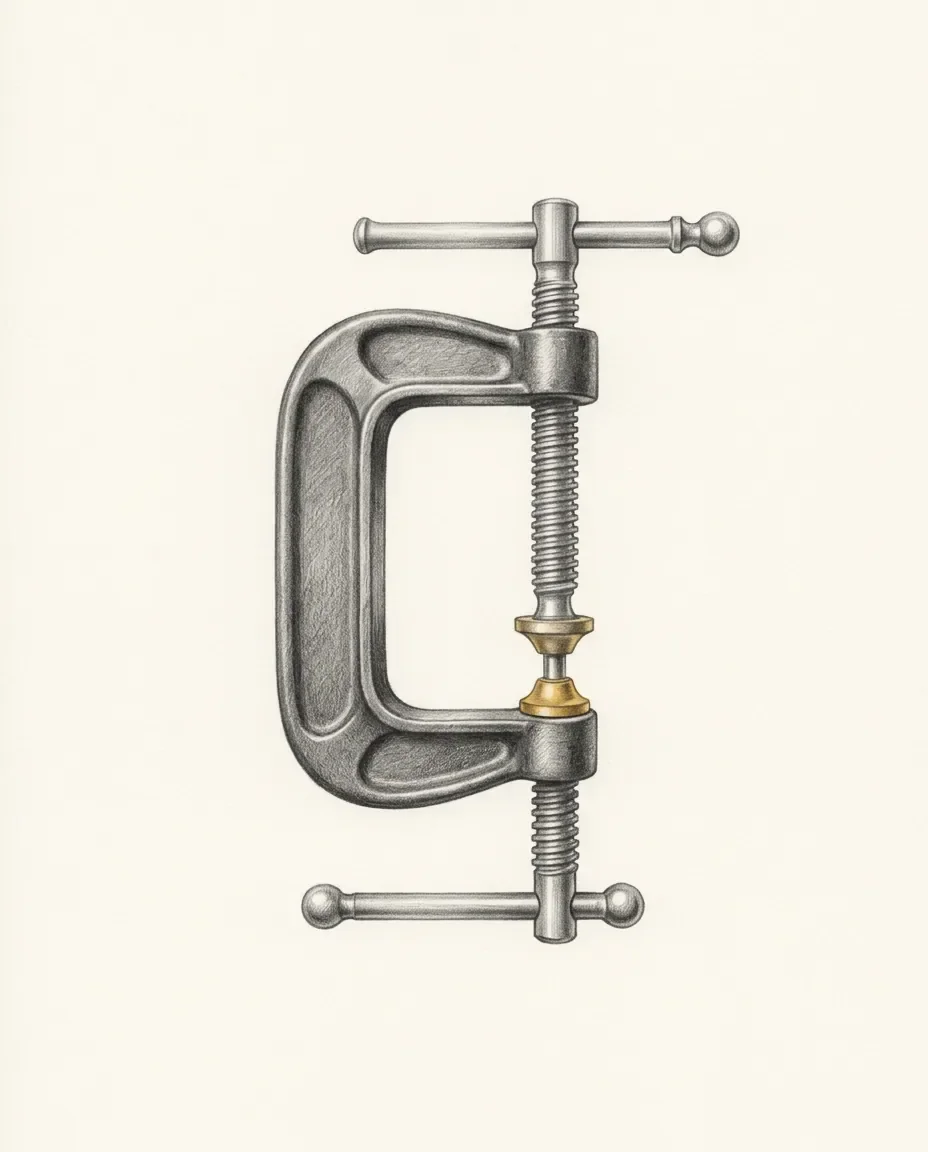
Pinching and Clamping
Added 21 Jun 2026 · Updated 22 Aug 2026
A consensual sensation-play interest in steady, focused pressure applied to the skin or sensitive areas, by the fingers or by implements. Clamps and clothespins are typical. The appeal lies in the slow build of controlled pressure and the vivid rush of sensation when it is released.
- Prevalence
- Common
- Category
- Sensation & Pain
- Domain
- Sexual interest
- Confidence
- Medium confidence
- Status
- Common consensual sensation-play variation, not a clinical paraphilia.
- Also known as
- clamping, clamp play, pinching, pressure play, nipple clamps
- Added
- 21 Jun 2026
- Updated
- 22 Aug 2026
Featured in
Overview
Pinching and clamping is a consensual sensation-play interest in which steady, focused pressure is applied to the skin or to sensitive areas, either with the fingers or with implements designed to grip: clothespins, binder clips, and purpose-made adjustable clamps. It sits within the broader family of sensation play and pressure-based erotic stimulation, distinguished from impact play by its sustained rather than momentary character. This article surveys where the practice comes from, how it is typically expressed, why it appeals, and how to do it safely.
Examples
What the term covers. Fingertip pinching of a fold of skin, varied by grip and duration; a row of wooden clothespins set along an arm, thigh or torso; adjustable clamps on the nipples; binder clips and similar household objects borrowed for their spring; and clover clamps, whose scissor action tightens the harder they are pulled. The defining feature is that the pressure is held: the anticipation while it stays on, and the surge when it comes off, are as much the practice as the initial pinch.
What the term does not cover. Impact play and spanking deliver force in momentary blows rather than sustained pressure, which is the cleanest line between the two families. Biting and scratching are brief and surface-marking. Needle play and knife play breach the skin or threaten to, where clamping only compresses it. Nipple play is the wider field in which clamps are one instrument among many, and bondage restrains limbs rather than gripping tissue. The technique should also not be confused with the disposition behind it: a standing taste for the sensation belongs to masochism, and clamping is one branch of sensation play beside wax play and temperature play.
How the word is used. Plain descriptive English rather than a clinical coinage. There is no Greek label for it, and it appears in neither DSM-5-TR nor ICD-11. Community shorthand is simply "clamps" or "clamping"; "nipple clamps" is the retail term under which most of the hardware is sold, which is why it dominates search even though the practice is not confined to that one site.
History & origins
Pinching and clamping has no single coinage: it is a descriptive folk term for techniques far older than any clinical vocabulary, and its lineage runs through both the sexological literature on pain-linked arousal and the practical toolkit of modern kink.
Clinical lineage
The deliberate eroticisation of controlled pain and pressure entered Western medical literature in the late nineteenth century.
- 1886: Richard von Krafft-Ebing's Psychopathia Sexualis named masochism (after the novelist Leopold von Sacher-Masoch) and sadism, framing pain-linked arousal as a clinical subject for the first time in a systematic taxonomy.
- 1903: In Love and Pain, part of his Studies in the Psychology of Sex, Havelock Ellis argued more moderately that a taste for giving or receiving mild pain, what he grouped under algolagnia, lay on a continuum with ordinary courtship rather than being inherently pathological, and that pain itself, not cruelty, was the operative element.
- 2013–2022: The modern manuals completed the shift from pathology to normal variation. The DSM-5 and DSM-5-TR and the ICD-11 treat consensual sensation play of this kind as an ordinary expression of human sexuality, reserving any diagnosis for cases involving distress, impairment, or non-consent.
Cultural & subcultural evolution
As an everyday technique rather than a named condition, pinching and clamping was codified inside the twentieth-century BDSM and leather subcultures.
- 1790: The first literary depiction of a nipple clamp appears in the Marquis de Sade's Justine (published 1791), an early record of clamping as an erotic device.
- mid-twentieth century onward: As the American leather scene grew, practitioners adopted cheap, controllable household items (wooden clothespins, binder clips, clothes-hangers with integral clips) as accessible "pervertibles," predating mass-market BDSM equipment.
- 1981: Clamping with clothespins was documented in the lesbian-feminist S/M anthology Coming to Power by the Samois collective, one of the texts that brought kink technique into print.
- Later decades saw purpose-made hardware circulate through toy retail and community education: tweezer clamps, magnetic clamps, and the clover clamp (also called a butterfly or bird clamp), a Japanese design originally made for gripping sailcloth or sewing fabric whose scissor action tightens the harder it is pulled.
In practice
Pinching and clamping is typically expressed during partnered intimacy or within negotiated power-exchange scenes. Participants vary intensity by changing gripping force, the number and placement of clamps, and how long pressure is held; many describe a notable surge of sensation at the moment a clamp is removed, often the most prized part of the experience, as restricted blood flow returns. It is frequently layered with light bondage or dominance dynamics, and shades into related sensation interests such as scratching, biting, hair pulling, and spanking. This entry describes the interest clinically and does not provide how-to instruction.
Psychology
The appeal is commonly linked to heightened bodily awareness, the interplay of mild discomfort and arousal, trust between partners, and the focusing or "grounding" effect that intense but controlled sensation can produce. For some it functions mainly as sensory variety; for others it carries a power-exchange or submission element. Sustained, anticipated pressure can also trigger endorphin release, and the rush felt on release is sometimes attributed to returning circulation and accompanying neurochemical changes: though the specific mechanisms for clamp play are little studied and largely inferred from the broader literature on masochism and pain play. As with much of consensual kink, the evidence base is qualitative more than experimental.
Prevalence & culture
As a mild, common variation, pinching and clamping appears frequently within surveys of pain- and pressure-related interest, though it is rarely studied as a discrete category, so figures are inferred from broader sensation-play data. Joyal & Carpentier's (2017) provincial survey of 1,040 adults found masochism-type interest reported by roughly 23.7% of women and 13.9% of men: common enough to fall outside the "statistically unusual" range. In Lehmiller's (2018) survey of over 4,000 Americans, around 65% reported fantasising about receiving pain. Nipple clamps and pinching are routinely listed in lay A-to-Z kink guides, and the practice has moderate visibility through BDSM education and toy retail.
Safety, consent & law
Between consenting adults the practice is legal and generally considered low-risk when handled with care. Responsible practice emphasises explicit negotiation, safewords, and aftercare, and pays particular attention to circulation: prolonged clamping restricts blood flow, so practitioners limit how long pressure is held and watch for numbness or discolouration. Removing a clamp returns blood, and a fresh wave of sensation, to the area, which is part of the appeal but also a moment to monitor. Duration carries more of the risk than intensity does: tissue held under pressure for a long stretch can bruise or be left with lasting numbness, so placement is kept to soft tissue, away from bone and from points where a nerve runs close to the surface. Numbness that persists after a clamp is removed, or skin that stays pale or discoloured, is a reason to stop rather than continue. It is not a clinical paraphilia.
Common questions
How long can you leave nipple clamps on?
There is no single safe duration, because the limiting factor is circulation rather than the clock. Sustained pressure squeezes blood out of the compressed tissue, and the longer it stays out the sharper the return and the greater the risk of bruising or lingering numbness. Common practice is to keep the interval short, to reduce tension rather than tolerate more of it, and to remove a clamp at once on numbness, coldness, or a change in skin colour.
Why does it hurt more when the clamp comes off?
Because release is a different event from pressure. While a clamp is on, blood flow through the compressed tissue is restricted and the area gradually dulls; when it is removed, circulation floods back into nerves that had gone quiet, producing a brief and vivid surge that many people find the most intense moment of the practice. It is also the moment worth watching, since it reveals how long the tissue was actually compressed.
Can clamps cause permanent damage?
Serious injury is uncommon in careful play, but it is not impossible. Prolonged or very tight compression can bruise, irritate nerves, and in extreme cases damage tissue left without blood supply for too long. The warning signs are numbness that persists well after removal, skin that stays pale or discoloured, and pain that does not settle. Any of these is a reason to stop and, if it continues, to seek medical attention rather than wait it out.
Where on the body are clamps used?
The nipples are the most common site, which is why nearly all commercial hardware is sold for them, but pinching and clamping work anywhere there is a fold of loose skin to grip: the inner arm, the thigh, the flank, an earlobe. Placement is generally kept to soft tissue and away from bone and from points where a major nerve runs close to the surface, where compression is more likely to leave lasting numbness.
What can you use if you do not own clamps?
Much of the practice predates purpose-made equipment. Wooden clothespins, binder clips and similar sprung household items were adopted by the mid-century leather scene precisely because they were cheap, available and easy to control, and they are still in use. Fingers require nothing at all. Improvised objects differ mainly in that their tension is fixed rather than adjustable, so intensity is varied through placement and duration instead.
Is pinching and clamping a paraphilia?
No. Neither DSM-5-TR nor ICD-11 treats consensual sensation play of this kind as a disorder; both reserve a diagnosis for cases involving distress, impairment, or a person who has not consented. The modern manuals moved deliberately away from the nineteenth-century framing under which any taste for pain-linked arousal was pathological, and clamping is now catalogued as a technique rather than a condition.
- Spanking78/100Sensation & PainAn interest in giving or receiving consensual, rhythmic blows to fleshy areas of the body, by hand or with implements such as paddles. People do it for erotic sensation, discipline themes, or power exchange between consenting adults.78
- Scratching46/100Amychesis · Sensation & PainAmychesis is a consensual interest in arousal from scratching or being scratched with the fingernails, producing sharp surface sensation. It sometimes leaves temporary marks. A form of sensation play that links touch with intimacy and marking.46
- Biting Kink51/100Odaxelagnia · Sensation & PainOdaxelagnia is a consensual interest in arousal from biting or being bitten, ranging from gentle nibbling to firmer bites that may leave a temporary mark. It blends strong sensation, intimacy, and a mild element of marking, and sits at the gentle end of sensation play.51
- Hair Pulling44/100Trichophilia · Sensation & PainA consensual interest in the sensation and dynamic of pulling, or having one's hair pulled, during intimacy. The appeal blends scalp tension, dominance and surrender, and the guided movement the grip allows.44
- Mummification45/100Sensation & PainMummification is a form of consensual bondage in which a person's body is wrapped or encased in materials such as plastic film, tape, or bandages. The wrapping often runs head to foot, restricting movement and heightening sensory experience. It is a recognised BDSM practice, not a clinical paraphilia.45
- Sensation Play45/100Sensation & PainAn interest in heightened, varied skin sensations created with soft, textured, or lightly stimulating implements. Feathers, fur, silk, brushes, ice, or pinwheels are typical, often combined with anticipation and the contrast between soothing and prickling touch. It is a common, gentle form of erotic play.45
A plain-English descriptive compound with no clinical -philia or -lagnia root. "Pinch" derives from Anglo-Norman French pincer/pincier ("to squeeze, nip"); "clamp" comes from Middle Dutch and Middle Low German klampe ("hook, clasp, brace"). The pairing is modern kink vocabulary naming the practice by its two everyday techniques rather than a coined term.
pressure sensation · sustained pain · implement-delivered
Prevalence is computed from the entry's cited population estimate. Rows marked ESTare indicative editorial estimates scored against a fixed anchor rubric, not measured quantities. Method & anchors: methodology.
Common · ≈ 1 in 20
- 01Joyal & Carpentier (2017), The Prevalence of Paraphilic Interests and Behaviors in the General Population, J. Sex Research 54(2):161-171general-population masochism/pain-play interest (~23%) as upper context for this niche technique
- 02Lehmiller (2018), Tell Me What You Want, survey of 4,175 Americansfantasy prevalence of receiving pain (~65%) framing sensation play as common
- 03An A–Z of Kinks and Fetishes, Glamourlay framing of nipple clamps and pinching as known kink implements
- 04Richard von Krafft-Ebing, Psychopathia Sexualis (1886)historical naming of masochism/sadism and the medical study of pain-linked arousal
- 05Sensation play, Wikipediaframing of pinching/clamping within the broader umbrella of BDSM sensation play
- 06Nipple clamp, Wikipediahistory of clamps (1790 Justine reference; clover/tweezer/magnetic types) and the blood-flow-restriction-and-release mechanism
- 07Havelock Ellis, Studies in the Psychology of Sex, Vol. 3 (Love and Pain, 1903), Project GutenbergEllis framing mild pain (algolagnia) as a continuum with ordinary courtship rather than inherent pathology
- 08Havelock Ellis, Wikipediabiography of the sexologist who advanced the algolagnia/love-and-pain framing
- 09Marquis de Sade, Wikipediaauthor of Justine (1790), earliest literary depiction of a nipple clamp
- 10Samois (collective), WikipediaComing to Power (1981) anthology documenting clothespin clamping technique in print
- 11DSM-5-TR, Paraphilic Disorders (American Psychiatric Association, 2022)consensual sensation play treated as normal variation; diagnosis reserved for distress, impairment or non-consent
- 12ICD-11, Paraphilic disorders (World Health Organization)modern depathologisation of consensual kink in WHO nosology